Subtitle: A landmark discovery 1.2 billion light-years away provides a rare test for galaxy evolution theories and could refine navigation on Earth.
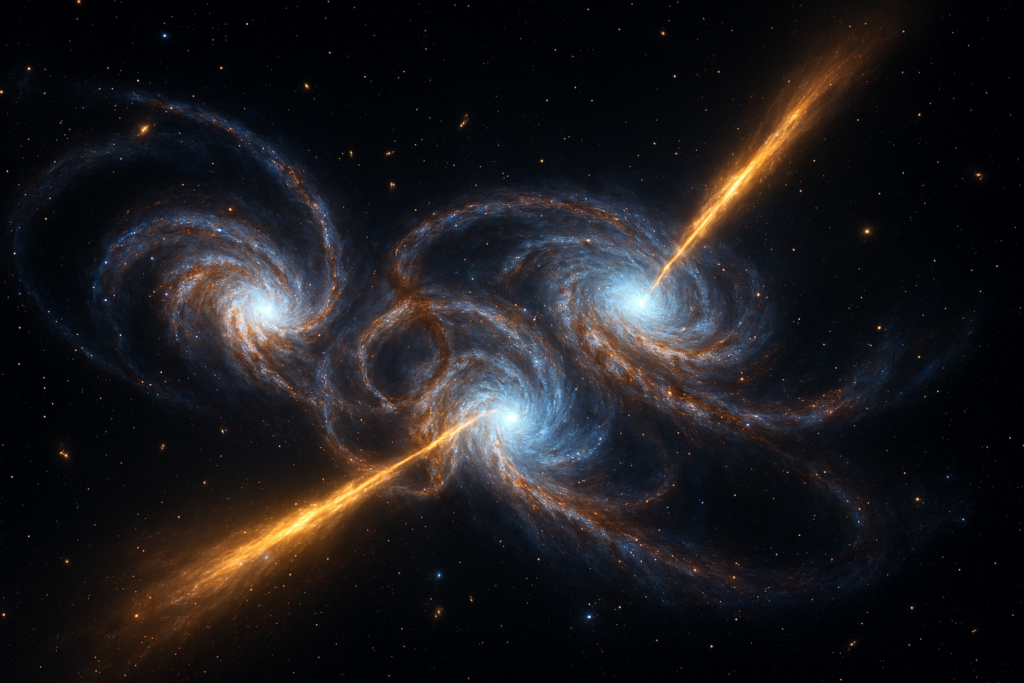
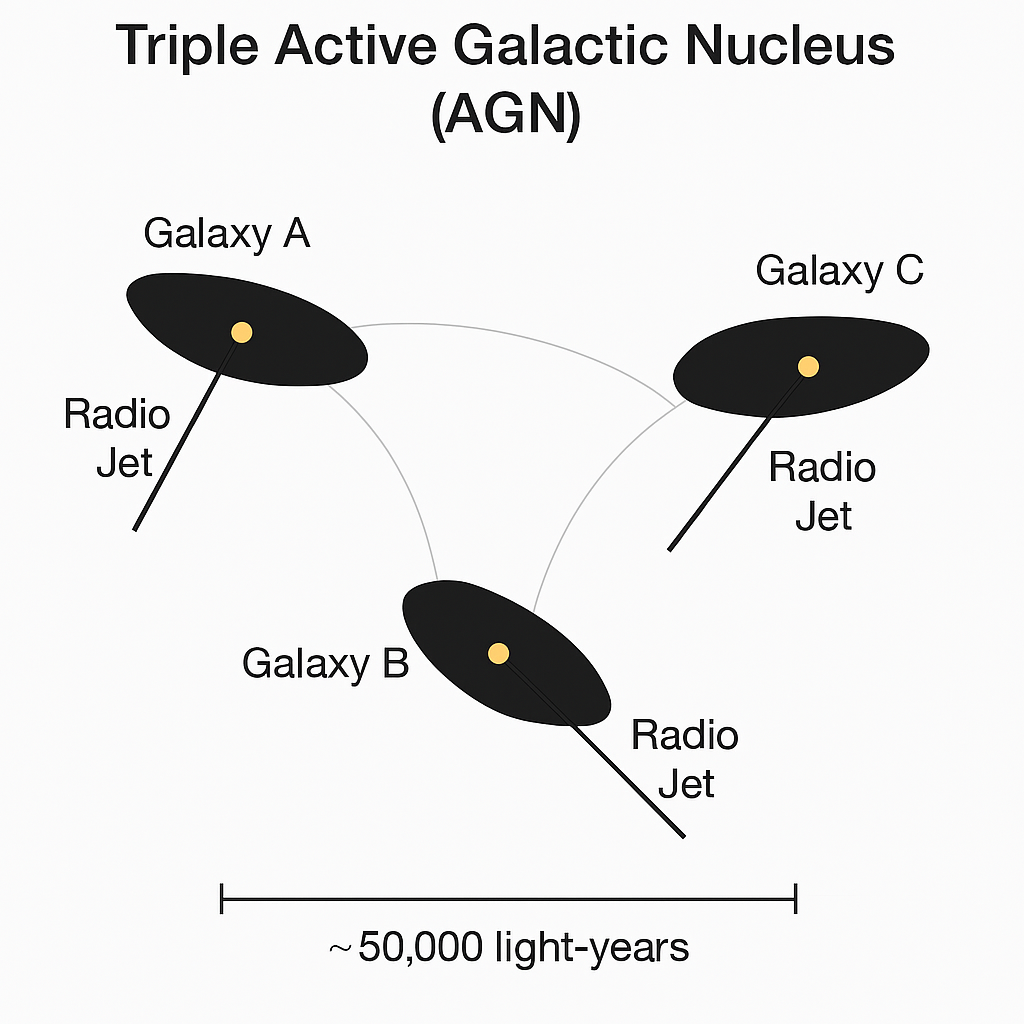
In a celestial find that reads like science fiction, an international team of astronomers has confirmed the existence of an extraordinary cosmic trio: three supermassive black holes, all actively feeding and blasting out radio waves, at the hearts of three merging galaxies. The discovery, published in The Astrophysical Journal Letters, marks the first confirmed “triple radio AGN” system and offers an unprecedented real-world laboratory for understanding how galaxies and their central black holes grow through collisions.
The system, cataloged as J1218/J1219+1035, lies approximately 1.2 billion light-years from Earth. Using the powerful National Science Foundation’s Very Large Array (VLA) and Very Long Baseline Array (VLBA), scientists detected three distinct, compact, and powerful sources of radio emission. Each source pinpointed the center of one of three gravitationally entangled galaxies.
“The system was hiding in plain sight,” said lead researcher Dr. Emma Schwartzman, an astrophysicist at the U.S. Naval Research Laboratory. “Initial data hinted at activity from two black holes. Only with the sharp vision of our radio telescopes could we clearly reveal all three, shining brightly. Triple active nuclei are predicted but incredibly rare. This is the first time we’ve seen all three ‘light up’ in the radio spectrum during a merger.”
Why This “Triple Threat” Is a Scientific Goldmine
Galaxies are believed to grow through a process called hierarchical merging—smaller galaxies smash together to form larger ones. When galaxies merge, their central supermassive black holes are thought to eventually spiral together and coalesce, an event that would release ripples in spacetime known as gravitational waves.
Discovering a system where all three black holes are actively consuming gas and dust (“active”) during this merger phase is a critical snapshot of this chaotic process. It allows scientists to study how multiple black holes compete for material, how their powerful jets interact, and what drives them to become active simultaneously.
“This discovery gives us a rare window into a dynamic phase of galaxy evolution,” Dr. Schwartzman explained. “It’s like catching three giants in a cosmic kitchen, all actively feeding at the same time. We can now study the conditions that make that possible.”
From Deep Space to Your GPS: An Unexpected Navy Application
Beyond its cosmic significance, the discovery has a surprisingly down-to-earth application for precision navigation. The U.S. Naval Research Laboratory’s interest stems from the use of distant, stable black holes (AGNs) as fixed reference points to anchor the International Celestial Reference Frame (ICRF)—the fundamental coordinate system for all satellite navigation, including GPS.
“AGNs in pairs or triples can appear as a single, wobbly point from far away, creating a potential source of error,” said Nathan Secrest of the U.S. Naval Observatory, a collaborator on the study. “Identifying and studying these complex systems helps us clean up our cosmic map, removing unstable markers. This directly improves the accuracy and reliability of navigation and timing systems critical for both military and civilian use.”
A Discovery Born from Multi-Wavelength Teamwork
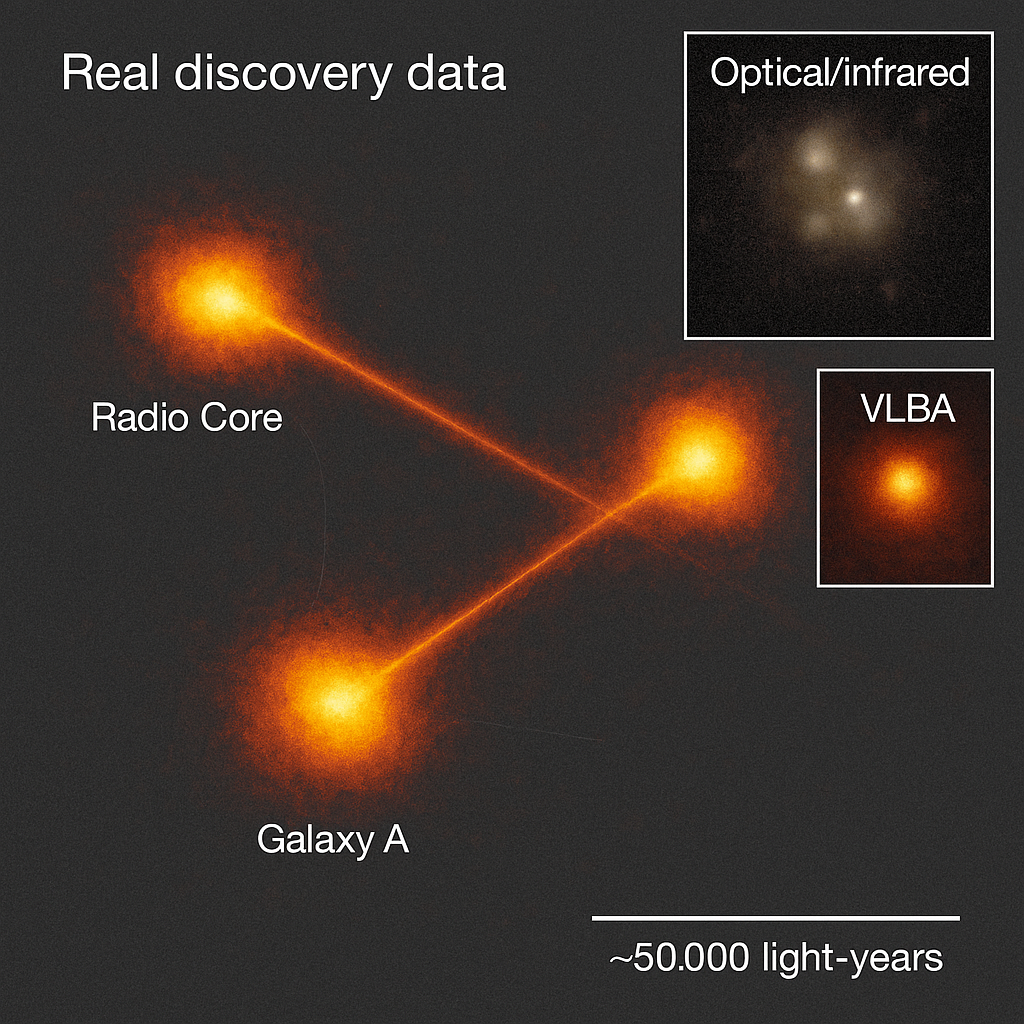
The finding underscores the necessity of observing the universe across different types of light. Infrared surveys first flagged the system as peculiar. Optical observations suggested activity. But only high-resolution radio imaging could definitively separate the three black holes and confirm their nature, piercing through the dust-choked environments of the colliding galaxies.
“No single method could have done this alone,” emphasized Dr. Schwartzman. “We needed the infrared hint, the optical clues, and finally the radio confirmation. This is a textbook case for why multi-wavelength astronomy is essential.”
The research team plans follow-up observations in X-ray and near-infrared light to probe the high-energy output of the black holes and map the distorted structures of the merging galaxies. They hope to detect faint streams of stars and gas—”bridges”—connecting the trio, which would provide a direct view of the gravitational turmoil reshaping the system.
The identification of J1218/J1219+1035 proves such complex systems exist and are detectable. Astronomers will now begin searching for others, moving this cosmic phenomenon from the realm of theoretical prediction into a new frontier of observable astrophysics.