A crowded galaxy group is losing the gas that makes new stars
The galaxies in COSMOS-Gr30 hold far less cold gas than usual. A new study asks where that gas went.

The newest discoveries in astronomy, from NavsoraTimes (Navsora Times). Read one in the time it takes to finish your coffee.
 Lead story
Solar System
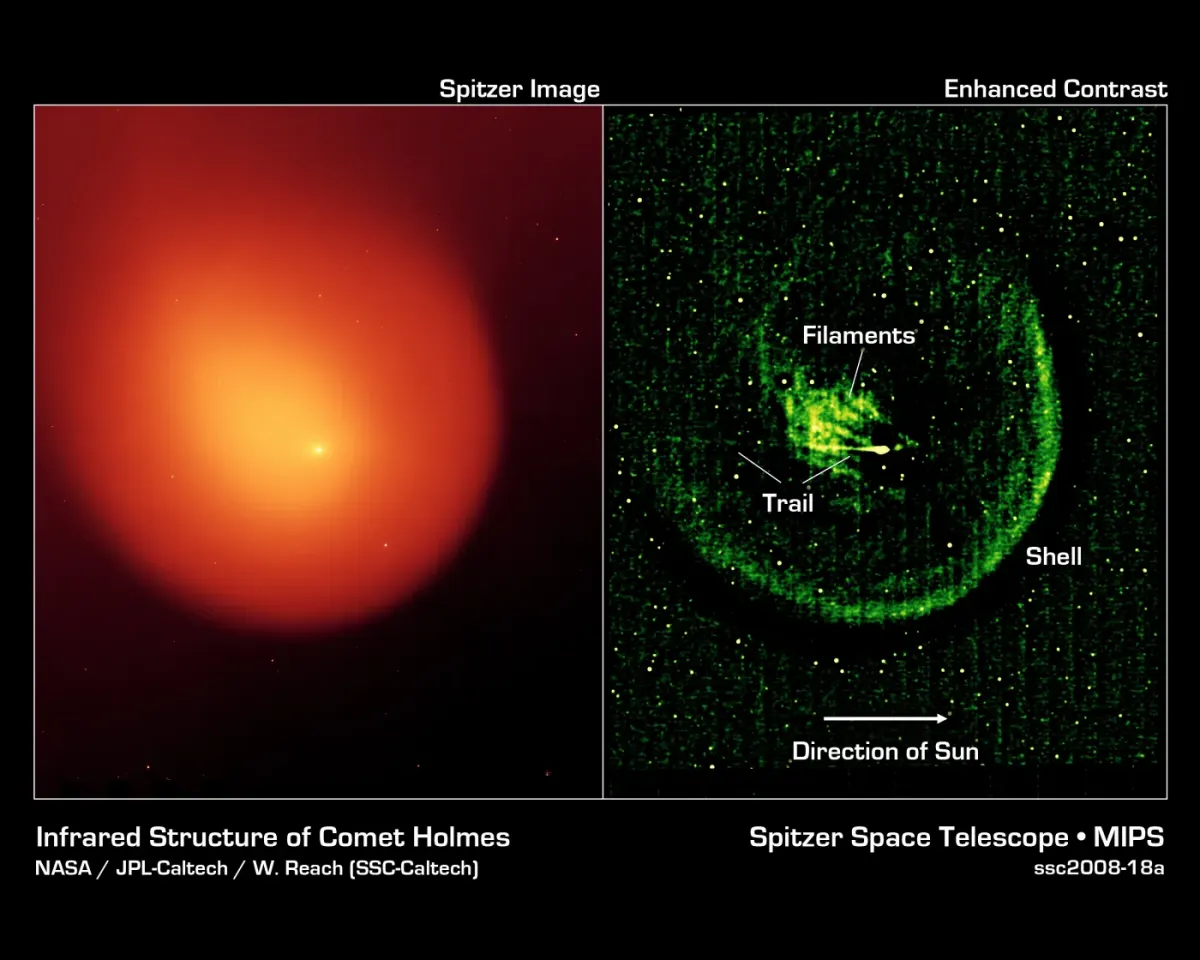
Scientists think escaping gas may have torn away parts of its dusty outer crust.
The galaxies in COSMOS-Gr30 hold far less cold gas than usual. A new study asks where that gas went.
Every little glow in this picture is a galaxy. Look closer at Euclid's new photo. You will find bent light and a secret cluster hiding far behind.
Are we alone? NASA is planning a giant telescope to find out. It will hunt for signs of life on planets far, far away.
A super-Earth just 25 light-years away sits in its star's habitable zone — but teeters on a razor's edge where its atmosphere could be stripped away forever.
Read the story →No plants. No animals. Not even germs. Scientists built an Earth with no life on a computer. It still stayed warm and wet.
Hubble shows the dwarf galaxy NGC 4449 bursting with new stars. A new study suggests small galaxies like it are blowing much of their oxygen out into space.
Saturn has 293 confirmed moons, more than any other planet. Here is how people first spotted it, who found its biggest moons, and how all those moons get their names.
Hubble has spotted a giant 10-sided wave swirling around Saturn's south pole. Here is a simple guide to the ringed planet, from its 274 moons to its 10-hour day.
A photo from Sardinia, Italy, shows Saturn just above the Moon's edge, moments before the Moon slid in front of it. NASA picked it as its Astronomy Picture of the Day.
NASA's Perseverance rover found tiny crystals of the mineral that makes rubies hidden in pale Mars rocks. They are too small to see, but they glowed under the rover's…
Discovered by scientists. Decoded by meSanjay Verma, founder of NavsoraTimes. Every story links to the original research. About NavsoraTimes
NASA's Perseverance rover has now driven farther than any other vehicle on another world. It did it in five and a half years, while hunting for signs of ancient life on…
Webb found black holes in young galaxies that looked far too big. A new study uncovered hidden, smaller ones too, so the early universe may not have been full of…
Nothing made by people has ever gone this far. On 18 November, even light needs a whole day to reach Voyager 1. Want to celebrate?
Two small NASA spacecraft just swung past Earth and fired their engines, setting off on a 10-month trip to Mars to find out how it lost its air.
A scientist says the giant jets from some black holes may slowly cut off their own food, making the black hole go dim in about 4 million years.
A millisecond radio burst that crossed 10 billion years of space has been traced to a tiny, young galaxy, offering a new way to map the hidden universe.
NASA's Chandra found 84 strange objects glowing in low-energy X-rays across six galaxies, including the Pinwheel Galaxy. See what they might be.
NASA's Chandra spots a galaxy merger in action, revealing black hole activity and star formation hidden behind thick dust.
Two Jupiter-size planets found near a distant star are lighter than cotton candy, and no one is fully sure how gas giants get this fluffy.
A star gets ripped apart by a black hole and lights up the sky. See how NASA's Roman Space Telescope will catch these rare cosmic flashes.
NASA caught the Sun's strongest solar flare in weeks on camera. Here is what an X1.1 flare means for radios, power grids, and you.
Astronomers found two Jupiter-sized planets so light they are less dense than Styrofoam. Here is why these super-puff planets could rewrite planet formation science.
ESA's Euclid took a stunning sneak peek at our galaxy's crowded core — the exact region NASA's Roman telescope will scan for hidden black holes and rogue planets.
Webb and Hubble just proved Terzan 5 is not a globular cluster but a living fossil — a relic from when our Milky Way was still being built 12.5 billion years ago.
This June, Venus and Jupiter shine together after sunset, the Moon covers Venus, and the Summer Triangle rises. NASA's complete June 2026 skywatching guide.
NASA-backed scientists found Earth got phosphorus and nitrogen from nearby space rocks, not distant comets. Jupiter's gravity was the silent gatekeeper that made life…
NASA spotted a glowing X-ray dot 11.8 billion light-years away that could finally explain hundreds of mysterious 'little red dots' seen in the early universe.
Hubble caught spiral galaxy M88 mid-journey to the Virgo Cluster's core, where colossal forces will slowly strip away its gas and transform it forever.
The James Webb telescope stared at a rocky super-Earth 48 light-years away and found total darkness — no air, no crust, just ancient scorched rock baking at 1,000°C.
Earth leaks radio waves into space every day. A top radio astronomer says alien civilisations are doing the same — and we already have the tools to catch them.
One gravitational wave out of 28 may carry dark matter's hidden fingerprint. Scientists found a clue inside a black hole crash that could finally reveal the invisible.
A new radio map of the Milky Way magnetic field reveals a giant diagonal twist where the galaxy's invisible field flips the wrong way.
Earth's surface is warming, yet the upper atmosphere keeps cooling. Scientists have finally cracked the strange physics behind the contradiction.
NASA's MAVEN spotted the Zwan-Wolf effect at Mars, a space squeeze never seen in any planet's air before. It hints at how the Sun reshapes Mars.
Hubble caught NGC 1266 stuck between two lives. A black hole inside the galaxy is choking off new stars before they can even be born.
A 60-year mystery about why space around the Milky Way looks too calm is finally solved. Galaxies near us form a giant flat sheet, not a ball.
Scientists finally know why Venus has a giant 6000-km cloud wall. It is the biggest atmospheric shock found anywhere in the solar system.
NASA's Roman Space Telescope launches September 2026 to hunt hidden planets near the Milky Way's busy core, and Hubble has now mapped the area first.
Five years in, NASA's Perseverance rover reached Mars' unexplored western frontier — and turned its camera on itself, revealing rocks older than Jezero Crater itself.
A massive galaxy spotted by the James Webb Space Telescope shows zero rotation just 2 billion years after the Big Bang — a trait that should take billions more years to…
A Brown University team shows the cosmological constant may be topologically protected against quantum corrections — just like the Hall conductance in superconductors…
A deep learning tool just re-measured 28 comets and found long-period comets are far larger than expected — rewriting what we know about the early solar system's violent…
Earth's orbit wobbles, tilts, and stretches on 100,000-year cycles — triggering every ice age in history. Here's what Milankovitch figured out a century ago, and why it…
Mars tugs Earth closer to the Sun every 2.4 million years, stirring the deep ocean and warming the climate — a cosmic rhythm locked in seafloor sediment for 65 million…
After 49 years in space, Voyager 1 just had a key instrument shut off to save power. Here's why NASA made this sacrifice — and what it means for the mission's future.
NASA's Hubble captured NGC 3137, a spiral galaxy 53 million light-years away that lives in a group strikingly similar to our own Milky Way's neighbourhood.
A new study says the Large Magellanic Cloud has never visited the Milky Way before — but a rival team disagrees. Here's what the science actually shows.
Astronomers found a galaxy with two generations of energy beams: one ancient and cold, the other just waking up. And a strange tail is breaking the rules of aging.
Fred Hoyle coined 'Big Bang' in 1949 to mock a rival theory. The universe didn't explode — space expanded. And the theory lacked its defining event for over 50 years.
A new Nature Astronomy study used 10 isotope systems simultaneously to show Earth built itself entirely from inner Solar System material — no outer-space pebbles…
French physicist Jean-François Geneste proposes dropping a foundational axiom of geometry to build a universe model that unifies quantum theory with relativity.
NewCluster tracks 10 chemical elements, cosmic dust, and galaxy motion inside a Virgo-sized cluster at 68-parsec resolution — finer than most isolated galaxy simulations.
For the first time ever, astronomers caught a comet reversing its own spin — driven by gas jets on its surface. Here's what comet 41P revealed about deep space chaos.
NASA's Hubble compared images taken 25 years apart and found the Crab Nebula's filaments still racing outward at 3.4 million mph — a millennium after the original…
Galaxies in compact groups quench star formation faster than neighbors — but how far along they are depends on where the group sits inside its host cluster.
NASA's Parker Solar Probe completed its 27th solar flyby on March 11, 2026 — flying 3.8M miles from the Sun at 430,000 mph to unlock the secrets of space weather.
ASU researchers built a life-detection method based on atmospheric complexity — and Earth already scores higher than every other planet tested, including Venus.
A nearly Earth-sized planet was found in archived K2 data from 2017 — orbiting a bright nearby star in or near the habitable zone. Here's why it matters.
A 0.9-second gamma-ray flash, a ghost galaxy buried in a cosmic tidal tail, and a chain of stellar collisions spanning 700 million years — NASA's Chandra X-ray…
NASA's James Webb Space Telescope turned two powerful instruments on spiral galaxy NGC 5134 — and captured how stars are born, grow old, and die, all at once, 65 million…
The cosmic microwave background shows the universe is geometrically flat — but flat doesn't mean infinite. Here's why the shape of the cosmos may be stranger, and less…