 Sanjay Verma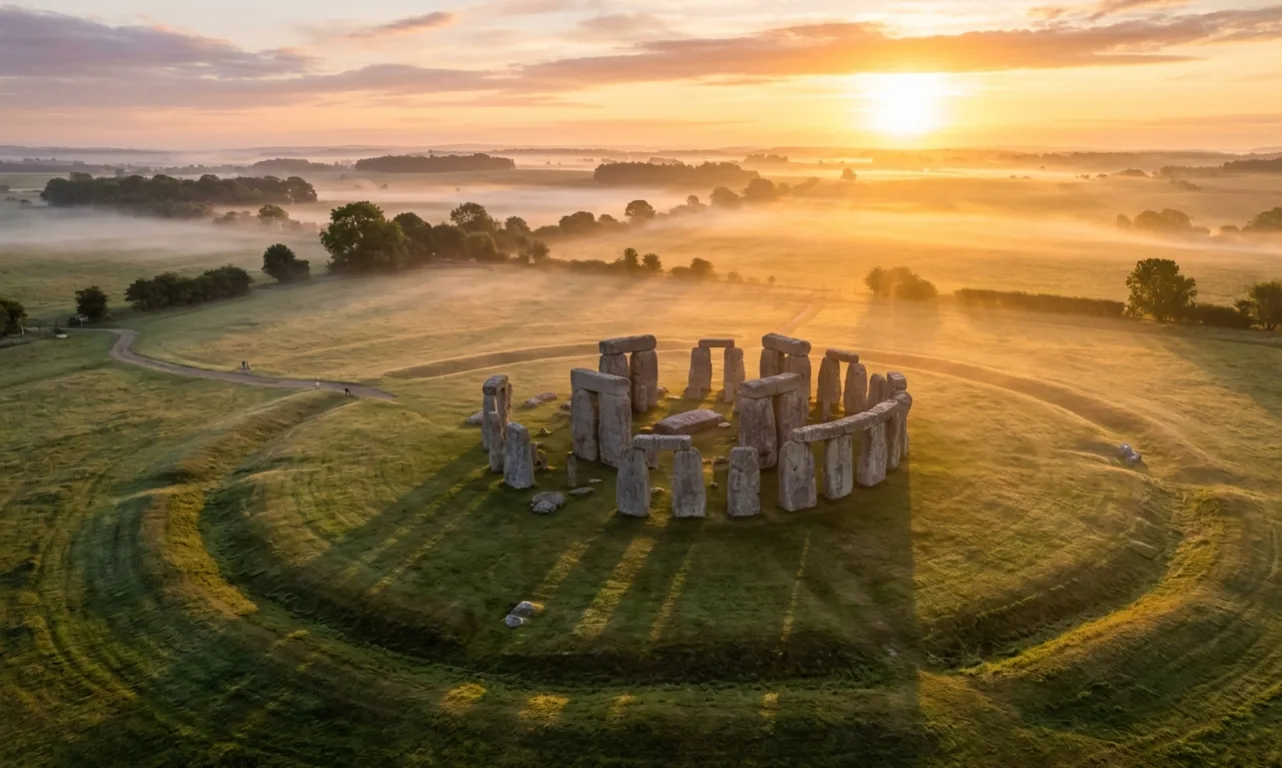
In This Article
- The Stone That Does Not Belong
- Reading Rocks Like a Fingerprint
- How Could a Glacier Move a 6-Tonne Stone Hundreds of Kilometres?
- The Dogger Bank Problem
- What This Tells Us About Ancient People
Imagine lifting a stone the weight of a small truck — and then carrying it 700 kilometres on foot. That is the puzzle at the heart of a new study published in the Journal of Quaternary Science. At the centre of Stonehenge, buried flat beneath the famous stone circle, lies a single slab called the Altar Stone. Scientists now have strong evidence it came from northeast Scotland. The question is no longer just where it came from — but how on earth it got here, and whether an ancient glacier did some of the work.
The Stone That Does Not Belong
Stonehenge is built from three very different types of rock. The giant upright stones, called sarsens, came from a forest about 25 kilometres away. The smaller bluestones were carried from the Mynydd Preseli hills in Wales, roughly 230 kilometres to the west. Then there is the Altar Stone — and it is neither of these.
The Altar Stone is a single slab of Devonian Old Red Sandstone, a type of rock formed from ancient river and lake sediments roughly 400 million years ago. It measures almost 5 metres long, 1 metre wide, and weighs around 6,000 kilograms. A 2024 study in Nature pointed to the Orcadian Basin in northeast Scotland as its likely source — a vast ancient lake bed that once covered thousands of square kilometres. This new 2026 research goes further, narrowing the source and seriously testing whether a glacier could have carried it partway south.
Reading Rocks Like a Fingerprint
Every rock contains tiny mineral crystals called zircons. Think of them as a rock's identity card: each geological region produces zircons of a slightly different age, depending on the ancient volcanoes and mountain belts that once existed there. By measuring the age of these zircons using uranium and lead isotopes — a technique called uranium-lead (U-Pb) dating — scientists can match a rock to its home region, even after the rock has been moved thousands of kilometres away.
The research team compared the Altar Stone's zircon profile against every published dataset from Scottish Old Red Sandstone outcrops. The closest match came from a site called Sarclet on the Caithness coast, with a statistical match score of 0.96 out of 1. Sandstones from Braemore, Kirtomy, and Portskerra — all in northern mainland Scotland — also matched well. Critically, rocks from Orkney and from several other Scottish basins were excluded. The Altar Stone's mineral fingerprint points firmly to the mainland of northeast Scotland.
How Could a Glacier Move a 6-Tonne Stone Hundreds of Kilometres?
During the last ice age — which peaked around 26,000 years ago and ended roughly 12,000 years ago — a vast ice sheet covered most of Britain and Ireland. This sheet, known as the British-Irish Ice Sheet, was in places more than a kilometre thick. Rocks frozen into the base of a glacier do not stay still. They travel, carried by the slow grinding movement of the ice, sometimes for hundreds of kilometres before the glacier melts and drops them.
Such a transported rock is called a glacial erratic — literally, a rock that has "wandered." The scientists used a new computer model that tracks how erratics move as ice-flow directions change over thousands of years. This matters because a glacier does not always flow in the same direction. Over millennia, the ice sheet's flow paths shifted dramatically. A rock could travel northeast for a thousand years, then swing southeast as conditions changed. The model tested whether any plausible ice-flow history could have carried a Caithness boulder southward towards England.
"Glacial transport may have provided an intermediate stage in the stone's journey, but alone cannot account for the final emplacement on Salisbury Plain. Even under a glacially assisted scenario, substantial anthropogenic transport would have remained necessary."
— Clarke, Veness et al., Journal of Quaternary Science, 2026The Dogger Bank Problem
The modelling produced a result that surprised even the researchers. Under certain ice-flow scenarios, the model showed that a rock from Caithness could have been glacially transported as far south as Dogger Bank — a shallow, oval-shaped plateau that today sits beneath the North Sea, roughly 400 kilometres northeast of Stonehenge. During the ice age, Dogger Bank was dry land, rising above the surrounding terrain like a low hill in the middle of what is now the sea.
If the Altar Stone reached Dogger Bank by ice, the human transport challenge drops from 700 kilometres to around 400 kilometres. That is still a colossal undertaking. But there is a serious timing problem. Dogger Bank was flooded by rising sea levels between 8,000 and 7,000 years ago. The Altar Stone was almost certainly erected at Stonehenge several millennia after that. So if the stone ever rested on Dogger Bank, ancient people would have had to retrieve it from a landscape that was being swallowed by the sea — and then transport it overland and by water for hundreds of kilometres more.
What This Tells Us About Ancient People
The research makes one thing unmistakably clear: no glacier alone can explain the Altar Stone's presence at Stonehenge. The modelled ice-flow paths do not reach Salisbury Plain under any tested scenario. Even in the most ice-assisted version of events, people still had to move a 6-tonne stone at least 400 kilometres. That required boats, ropes, rollers or sledges, coordinated labour, and planning across generations.
There is also the older Anglian glaciation to consider. This much larger ice sheet, around 450,000 years ago, extended further south than the last one and could theoretically have carried Scottish rock closer to England. But no computer models of sufficient detail exist yet for that glaciation, so it cannot yet be tested. The question remains open — and tantalising.
- Scotland is the source: Detrital zircon analysis firmly rules out Orkney and several other Scottish basins, pointing to Caithness on the northeast mainland as the most likely origin.
- Ice helped, but not all the way: Glacier modelling shows ice could have moved the stone southeast toward Dogger Bank, but the final 400 km to Stonehenge required human agency regardless.
- Ancient people were extraordinary: Whether or not glaciers assisted, Neolithic communities were capable of coordinating massive, long-distance transport operations across sea and land.
"Either scenario therefore implies a society capable not merely of moving stone but also coordinating complex, large-scale acts of monument construction across extensive geographic ranges." — Clarke, Veness et al., Journal of Quaternary Science, 2026.
The Altar Stone is not simply a mystery about geology or glaciers. It is evidence that 5,000 years ago, people looked at a lump of rock in the far north of Scotland and decided it belonged somewhere else entirely — somewhere specific, somewhere sacred, hundreds of kilometres away. Whether ice carried it partway or humans carried it every step, the ambition behind that decision is what endures. The stone made it. So did the people who wanted it there.
📄 Source & Citation
Primary Source: Clarke A.J.I., Veness R.L.J., Kirkland C.L., Clark C.D., Gandy N., Emery A., Bradley S.L., Ely J.C. & Ignéczi Á. (2026). From highlands to henge: refining the provenance and transport pathways of Stonehenge's Altar Stone. Journal of Quaternary Science, 1–8. https://doi.org/10.1002/jqs.70080
Authors & Affiliations: Anthony J. I. Clarke (Curtin University, Perth); Remy L. J. Veness (Sheffield Hallam University); Christopher L. Kirkland (Curtin University); Chris D. Clark (University of Sheffield); Niall Gandy (Sheffield Hallam); Andy Emery (Wessex Archaeology); Sarah L. Bradley, Jeremy C. Ely (University of Sheffield); Ignéczi Ádám (University of Bristol).
Data & Code: No new datasets were generated or analysed in this study, per the authors' Data Availability Statement.
Key Themes: Altar Stone · British-Irish Ice Sheet · Detrital Zircon · Glacial Transport · Stonehenge Provenance
Supporting References:
[1] Clarke A.J.I. & Kirkland C.L. (2026). Detrital zircon-apatite fingerprinting challenges glacial transport of Stonehenge's megaliths. Communications Earth & Environment, 7, 54.
[2] Clarke A.J.I., Kirkland C.L., Bevins R.E., Pearce N.J.G., Glorie S. & Ixer R.A. (2024). A Scottish provenance for the Altar Stone of Stonehenge. Nature, 632, 570–575.
[3] Veness R.L., Clark C.D., Ely J.C., Knight J.L., Igneczi A. & Bradley S.L. (2025). Modelling erratic dispersal accounting for shifting ice flow geometries. Journal of Quaternary Science, 40, 944–957.
No comments yet. Be the first to share your thoughts.
Leave a Comment