 Vikas Singh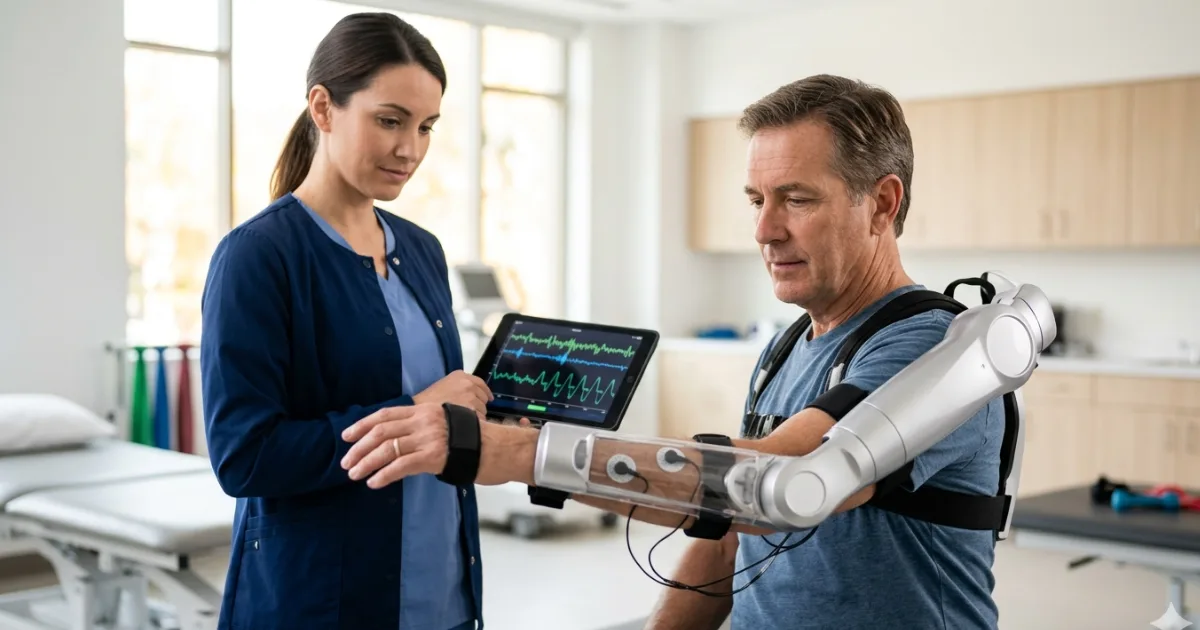
In This Article
- The Rehab Crisis Nobody Talks About
- What These Robots Actually Do
- How Does an AI Robot Know What Your Arm Wants to Do?
- From Lab Bench to Hospital Bed
- The Questions That Still Need Answering
Imagine losing the use of your arm after a stroke — and then spending weeks in a hospital gym with a robot that learns, in real time, exactly how hard you're trying to move. Not a robot that just lifts your arm for you, but one smart enough to give you precisely the right amount of help at precisely the right moment. That future is no longer theoretical. A landmark systematic review published in January 2026 in ACM Transactions on Human-Robot Interaction — the most comprehensive mapping of its kind — reveals that AI-powered upper limb rehabilitation robots have become remarkably sophisticated, and the gap between the research lab and the clinic is closing fast.
The Rehab Crisis Nobody Talks About
Upper limb disorders — caused by strokes, spinal cord injuries, and musculoskeletal conditions — affect hundreds of millions of people worldwide. The arms and hands are the most active parts of the human body; losing control of them doesn't just affect your ability to exercise, it strips away your ability to eat, dress yourself, and live independently.
Conventional therapy depends entirely on a skilled physiotherapist being physically present, session after session. That's not just expensive — it's impossible to scale. There simply aren't enough therapists to meet global demand. Worse, traditional assessment is partly subjective, shaped by a clinician's judgment on a given day. Robots don't get tired. They don't have off days. And now, they're getting smart.
What These Robots Actually Do
The 2026 review, authored by researchers at Università Campus Bio-Medico di Roma and Italy's National Research Council, screened over 17,000 published studies and distilled 35 that met rigorous criteria for how AI is genuinely integrated into a robot's control loop — not just used to assess patients after the fact. Those 35 papers, published between 2010 and 2024, map to four distinct jobs that AI now performs inside these machines.
The first is User Intention Recognition — the robot figuring out what movement you want to make before you fully make it. The second is Robot Motion Planning — generating the precise therapeutic trajectory that the robot should guide your limb through. Third is Robot Interaction Control — the moment-to-moment physics of how the machine pushes and pulls against your arm. And fourth is System Adaptation — the robot sensing your fatigue, stress levels, or compensatory bad habits, and adjusting therapy accordingly.
How Does an AI Robot Know What Your Arm Wants to Do?
This is the genuinely astonishing part. The most widely studied technique is called electromyography (EMG) — tiny electrodes placed on your skin that pick up the electrical signals your muscles produce. Even before a limb fully moves, those signals carry intent. AI classifiers trained on EMG data can now distinguish between a patient meaning to lift their elbow, rotate their wrist, or reach forward, with accuracies above 90% in the best systems. One deep learning model reached 99% accuracy in detecting the precise moment of movement intention.
But muscle signals aren't the only input. Some systems read brain waves via EEG — a non-invasive cap of electrodes on the scalp that detects motor intention even in patients whose muscles can't produce a reliable signal. These brain-computer interface approaches are harder to decode (accuracy sits closer to 60–70% in real-time tests), but they matter enormously for patients with severe paralysis who have no usable muscle activity left.
Beyond intention recognition, AI also handles the robot's physical behaviour. Reinforcement learning algorithms — the same family of techniques used to train game-playing AIs like AlphaGo — are being used to teach robots to find the optimal trajectory through a rehabilitation exercise, avoiding obstacles and adapting to each patient's unique range of motion. One system tested on stroke patients automatically tuned its level of assistance based on whether the patient was actively trying or compensating with their trunk.
"AI allows the extraction of meaningful patterns from large volumes of heterogeneous data, such as kinematic and dynamic variables from robots and biosignals, to support adaptive, data-driven therapy."
— Molle, Tamantini & Zollo · ACM Transactions on Human-Robot Interaction, 2026From Lab Bench to Hospital Bed
The implications go well beyond a single patient's arm. Globally, stroke is one of the leading causes of long-term disability — the World Health Organization estimates 15 million people suffer a stroke every year, with five million left permanently disabled. Upper limb impairment is among the most common and most disabling consequences. The ability to deploy an AI robot rehabilitation system that doesn't just exercise a patient's arm but learns from every session could transform the economics and equity of recovery.
Some systems are already doing something quietly revolutionary: detecting when a patient is using compensatory movements — cheating, essentially, by rotating their trunk instead of properly extending their arm — and triggering force feedback to correct it in real time. One such system achieved an F1-score of 98.5% in identifying these patterns in stroke patients. That's a level of consistency no human observer could maintain across hours of therapy.
The physiological monitoring angle is also striking. Systems in the review measured heart rate, respiration rate, skin conductance, and skin temperature simultaneously — essentially reading the patient's stress and fatigue levels — and used that data to dial the game-like VR exercises up or down every 30 seconds. One system reached 91.4% accuracy in classifying whether a patient was relaxed, moderately engaged, or overloaded, and adjusted difficulty accordingly. PubMed indexes the underlying physiological signal research that makes this possible.
The Questions That Still Need Answering
For all its promise, the field has a transparency problem. The review found that the vast majority of studies were validated only on healthy subjects — not on the stroke patients, spinal cord injury survivors, or people with musculoskeletal conditions these robots are actually designed to help. Datasets are almost never shared publicly, and source code is rarely released, making it nearly impossible for other researchers to reproduce or build on results.
There's also a measurement chaos problem. Studies report wildly different performance metrics — accuracy, F1-score, mean absolute error, position tracking error, therapist agreement ratings — making direct comparisons essentially meaningless. The field is crying out for standardised benchmarks, the way the computer vision community has ImageNet or the NLP community has GLUE.
Reinforcement learning — arguably the most powerful paradigm for truly autonomous therapy adaptation — is the least used. The reason is sobering: you can't safely let an algorithm learn by trial and error on a vulnerable patient's arm. Creating realistic simulation environments that model individual physiological responses faithfully enough to train RL agents safely remains an unsolved problem. The BBC Future and National Geographic Science have both explored how this safety challenge is slowing clinical adoption.
- Intent detection is nearly solved — for muscles. AI classifiers reading EMG signals exceed 90% accuracy consistently, making real-time robot control responsive and natural for most patients with some residual muscle activity.
- Deep learning dominates, but datasets are closed — every lab builds its own dataset, trains its own model, and rarely shares either. Without open benchmarks, the field cannot converge on best practice.
- Clinical validation is the next frontier — the technology is ready for rigorous trials with real patient populations; what's missing is the funding, ethical frameworks, and regulatory pathways to take it there.
"Sustained research and development are imperative to fully harness the potential of AI within this pivotal healthcare domain." — Molle, Tamantini & Zollo, ACM Transactions on Human-Robot Interaction, 2026.
📄 Source & Citation
Primary Source: Molle R, Tamantini C, and Zollo L. (2026). Artificial intelligence in upper limb robot-aided physical rehabilitation: A systematic review. ACM Transactions on Human-Robot Interaction, 15(2), Article 41. https://doi.org/10.1145/3779302
Authors & Affiliations: Rita Molle (Università Campus Bio-Medico di Roma); Christian Tamantini (Institute of Cognitive Sciences and Technologies, National Research Council of Italy); Loredana Zollo (Università Campus Bio-Medico di Roma)
Data & Code: Primary data is held privately by the respective study authors; source code availability varies by paper. See individual citations within the review for details.
Key Themes: AI in Rehabilitation · Machine Learning · Deep Learning · Upper Limb Exoskeleton · Stroke Recovery · Robot Interaction Control · User Intention Recognition
Supporting References:
[1] Luo L et al. (2019). A greedy assist-as-needed controller for upper limb rehabilitation. IEEE Trans. Neural Networks Learn. Syst., 30(11):3433–3443.
[2] Yang Z et al. (2021). An intention-based online bilateral training system for upper limb motor rehabilitation. Microsystem Technologies, 27:211–222.
[3] McDonald CG et al. (2020). A myoelectric control interface for upper-limb robotic rehabilitation following spinal cord injury. IEEE Trans. Neural Syst. Rehabil. Eng., 28(4):978–987.
No comments yet. Be the first to share your thoughts.
Leave a Comment