 Krishan Gopal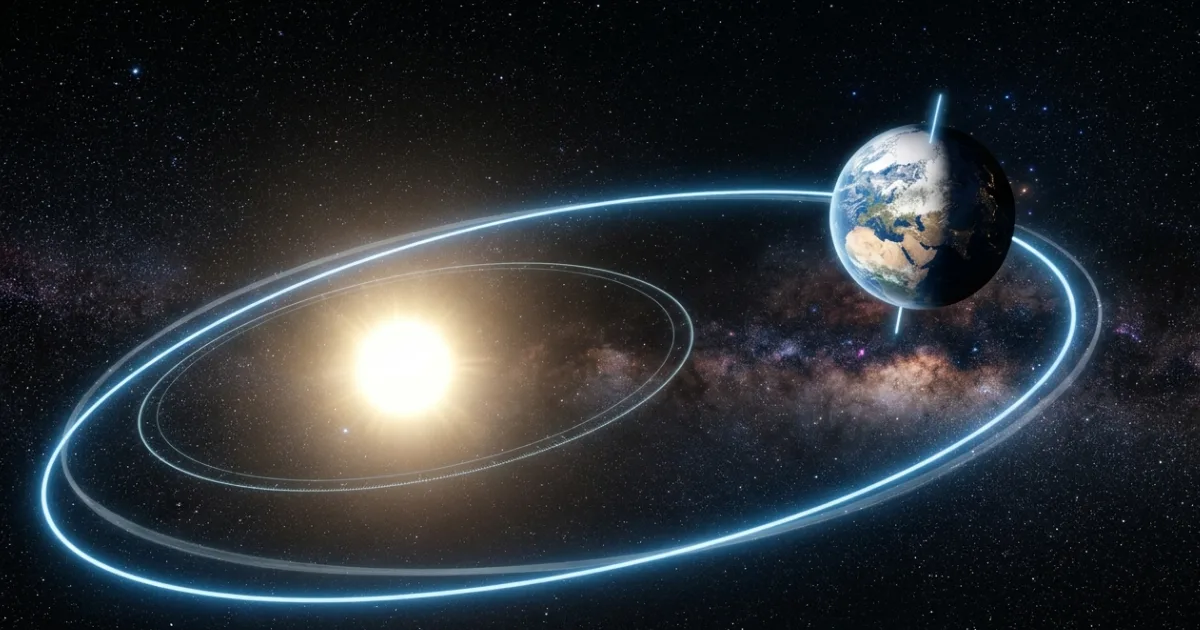
In This Article
- The Astronomer Who Mapped Time Itself
- Eccentricity: When Earth's Orbit Goes Oval
- How Do Milankovitch Cycles Actually Cause Ice Ages?
- What the Geological Record Confirms
- The Questions That Still Need Answering
Picture Earth as a spinning top — slightly off-kilter, tracing a path around the Sun that isn't quite a perfect circle. Now imagine that over tens of thousands of years, that path slowly stretches and squashes, the tilt of the top wobbles a degree or two, and the whole axis swivels like a slow gyroscope. These are not dramatic changes. But they are enough to tip the planet into an ice age — or pull it back out of one. They are the Milankovitch cycles, and they have been running Earth's deep climate clock for hundreds of millions of years.
The Astronomer Who Mapped Time Itself
In the early 20th century, a Serbian mathematician named Milutin Milankovitch set himself an almost absurd task: compute, by hand, how much solar radiation has reached every latitude on Earth for every season over the past several hundred thousand years. He spent years — decades — filling notebooks with calculations, driven by the hunch that subtle variations in Earth's position relative to the Sun were the hidden engine of the ice ages.
He published his comprehensive theory in 1941. He died in 1958, still largely unrecognised. It wasn't until the 1970s — when ocean sediment cores and ice cores finally gave scientists a geological record deep enough to test his predictions — that the world caught up. Today, Milankovitch cycles sit at the foundation of paleoclimatology, the science of Earth's ancient climates.
Eccentricity: When Earth's Orbit Goes Oval
Earth's path around the Sun is not a perfect circle. It's an ellipse — a gentle oval — and the degree of that oval-ness changes over time. This is called orbital eccentricity, and it shifts on a roughly 100,000-year cycle, driven mainly by the gravitational influence of Jupiter and Saturn pulling on Earth from across the solar system.
When eccentricity is high, Earth swings much closer to the Sun at one end of its orbit (perihelion) and much farther away at the other (aphelion). At peak eccentricity, that translates to around 23% more solar radiation hitting Earth at closest approach than at the farthest point — a meaningful difference in the planet's energy budget. Currently, Earth's orbit is near its most circular and slowly becoming more so, a trend that will continue for thousands of years.
Eccentricity also explains why our seasons are unequal lengths. Northern Hemisphere summer — when Earth is near aphelion — currently lasts about 4.5 days longer than winter. As eccentricity decreases, those seasonal lengths gradually equalise.
How Do Milankovitch Cycles Actually Cause Ice Ages?
No single cycle flips the planet into an ice age alone. The mechanism is subtler — and more elegant. What matters most is how much summer sunlight falls on the high northern latitudes, where the great ice sheets of past glaciations were born. When summer at those latitudes is cool enough that the previous winter's snow doesn't fully melt, the snow survives into the next winter. Year after year, it accumulates. Ice sheets grow. And as they grow, they reflect more sunlight back into space — a feedback loop that amplifies the initial orbital nudge into a full glacial period.
Obliquity — the tilt of Earth's axis — plays the central role here. Right now, Earth tilts at 23.4 degrees, slowly decreasing toward its minimum of 22.1 degrees about 10,000 years from now. A lower tilt means milder seasons: cooler summers and warmer winters. Cooler summers mean less melting. Less melting means more ice. More ice means a cooler planet. The tipping point, once crossed, is self-reinforcing. NASA's climate team confirms that obliquity drove ice age timing — roughly every 41,000 years — between one and three million years ago.
Precession adds another layer. As Earth's axis wobbles like a slow spinning top over a 25,800-year cycle, it changes which hemisphere receives extra solar energy during Earth's closest annual approach to the Sun. Today, the Southern Hemisphere gets that boost in its summer. In about 13,000 years, the wobble will have shifted enough that the Northern Hemisphere receives it instead — amplifying Northern summers and potentially triggering more extreme seasonal contrasts.
"Small cyclical variations in the shape of Earth's orbit, its wobble, and the angle its axis is tilted play key roles in influencing Earth's climate over timespans of tens of thousands to hundreds of thousands of years."
— NASA Science Editorial Team · NASA Science, 2024What the Geological Record Confirms
Milankovitch's theory sat largely untested for decades after his death. The evidence to verify it simply didn't exist yet. Then, in 1976, a landmark study in Science by Hays, Imbrie, and Shackleton changed everything. Analysing deep-sea sediment cores spanning 450,000 years, the authors found the fingerprints of the Milankovitch cycles locked into the chemical and biological record of ocean mud. Ice ages had occurred precisely when the orbital theory predicted. The paper is still called the "Rosetta Stone of ice ages."
Since then, ice core records from Greenland and Antarctica have pushed the evidence back hundreds of thousands of years further — and it keeps matching. The U.S. National Academy of Sciences formally embraced the theory. Ice ages have been coming and going, on Milankovitch's schedule, for a very long time.
The Questions That Still Need Answering
For all its power, the Milankovitch theory leaves one deeply puzzling gap. About 800,000 years ago, something shifted. Ice ages that had been arriving every 41,000 years — matching the obliquity cycle — suddenly began arriving every 100,000 years, matching the eccentricity cycle instead. This transition, known as the Mid-Pleistocene Transition, is one of the biggest unsolved problems in paleoclimatology. The orbital forcing didn't change. Something internal to the Earth-climate system did — but scientists don't yet know what.
There are other open questions too: exactly how the cycles interact at peak alignment, how quickly ice sheets can grow and collapse, and how Milankovitch forcing interacts with feedbacks from the carbon cycle and ocean circulation. The theory is robust — but it is not complete. What's clear is that the universe keeps exquisitely precise time, and written into every layer of ice and sediment is the same ancient rhythm, patient and indifferent, ticking across geological deep time.
- Three cycles, one climate engine — Eccentricity, obliquity, and precession work together, not independently, to pace the timing of ice ages.
- Summer sunlight is the key variable — What drives glaciation is not global cold, but reduced summer warming at northern high latitudes, allowing ice to accumulate year after year.
- Today's warming is a separate story — Milankovitch cycles are real and powerful, but they operate on timescales 100,000 times slower than human-caused climate change.
"The theory that Milankovitch cycles drive the timing of glacial-interglacial cycles is well accepted — but research to better understand exactly how the cycles combine to affect climate is ongoing." — NASA Science Editorial Team, NASA Science, 2024.
📄 Source & Citation
Primary Source: NASA Science Editorial Team (2020, updated 2024). Milankovitch (orbital) cycles and their role in Earth's climate. NASA Science. science.nasa.gov ↗
Authors & Affiliations: NASA Science Editorial Team; NASA Goddard Institute for Space Studies (GISS), New York.
Data & Code: NASA Climate Time Machine interactive available at climate.nasa.gov ↗
Key Themes: Orbital Eccentricity · Axial Obliquity · Precession · Glacial Cycles · Paleoclimatology
Supporting References:
[1] Hays JD, Imbrie J, Shackleton NJ. (1976). Variations in the Earth's orbit: pacemaker of the ice ages. Science, 194(4270):1121–1132. doi:10.1126/science.194.4270.1121 ↗
[2] EPICA Community Members. (2004). Eight glacial cycles from an Antarctic ice core. Nature, 429:623–628. doi:10.1038/nature02599 ↗
[3] NASA Climate. Why Milankovitch cycles can't explain Earth's current warming. climate.nasa.gov ↗
No comments yet. Be the first to share your thoughts.
Leave a Comment