 Krishan Gopal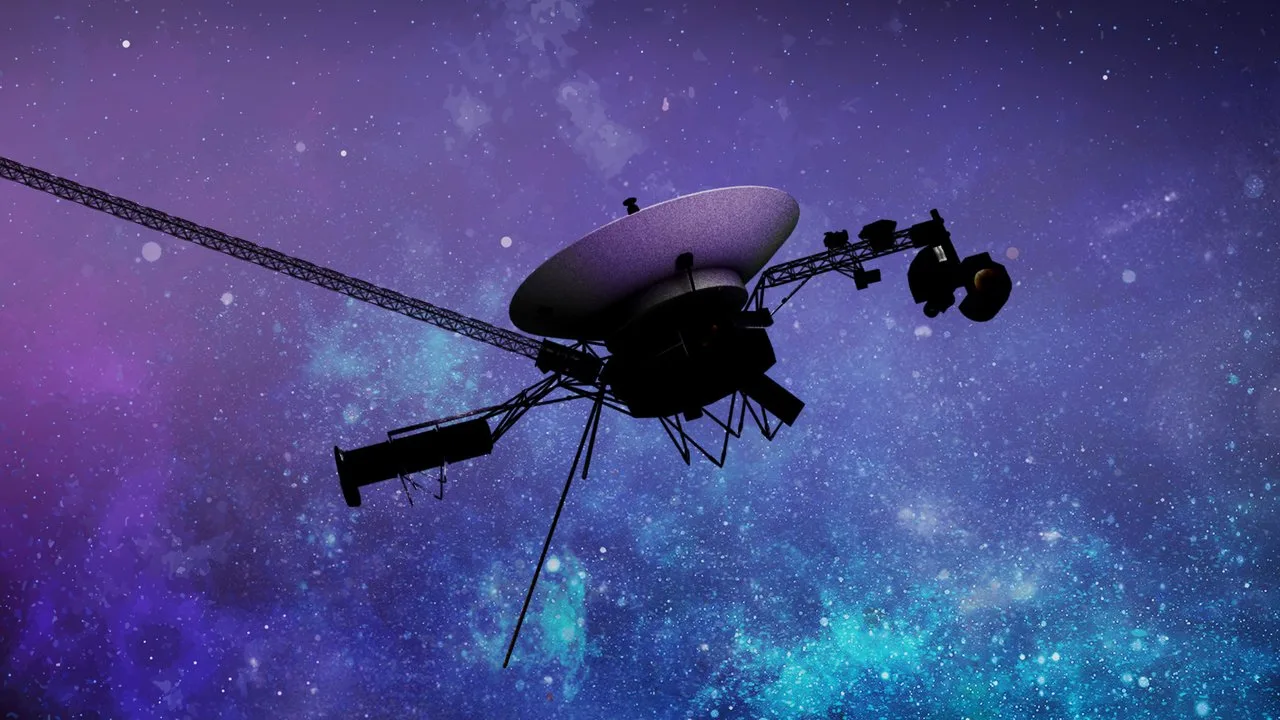
In This Article
- A 49-Year-Old Machine Running on Fumes
- What the LECP Actually Did — and Why It Mattered
- How Does NASA Keep a Spacecraft Alive 15 Billion Miles Away?
- The "Big Bang" — NASA's Last Lifeline for Voyager
- What Happens When the Last Light Goes Out
Somewhere in the darkness beyond our solar system, a spacecraft the size of a small car is fighting to stay alive. On April 17, 2026, engineers at NASA's Jet Propulsion Laboratory sent a command into the void — a command that took 23 hours just to arrive. Its mission: switch off one of Voyager 1's last remaining science instruments to prevent the probe from losing power entirely. The patient, tireless work of keeping humanity's most distant emissary alive just entered its most critical chapter yet.
A 49-Year-Old Machine Running on Fumes
When Voyager 1 lifted off from Cape Canaveral on September 5, 1977, it carried enough nuclear fuel to power a small appliance for decades. That fuel — decaying plutonium inside a radioisotope thermoelectric generator (RTG) — has been quietly converting heat into electricity ever since. The problem? Each spacecraft loses roughly 4 watts of power every single year.
That sounds trivial. But after nearly five decades, those losses have stacked up to the point where every remaining watt is precious. Engineers at JPL must now constantly balance two competing demands: keep the science instruments running, and keep the spacecraft warm enough that its fuel lines don't freeze solid in the -270°C void of interstellar space.
It's the engineering equivalent of keeping a campfire burning in a blizzard with only a handful of logs left.
What the LECP Actually Did — and Why It Mattered
The instrument NASA just switched off is called the Low-energy Charged Particles experiment, or LECP. It has been running almost without interruption since 1977 — nearly 49 unbroken years of science. Its job was to measure low-energy charged particles: ions, electrons, and cosmic rays streaming in from both our solar system and the wider galaxy.
Think of the LECP as a kind of weather station for interstellar space. Just as a weather buoy bobs in the ocean sending back data on currents and pressure, the LECP has been recording the ebb and flow of particle "weather" far beyond the reach of any other instrument in human history. It detected pressure fronts and regions of varying particle density in the interstellar medium — data that simply cannot be gathered any other way.
The same instrument was switched off on Voyager 2 in March 2025. Now both twins have gone quiet on this particular channel. However, one small motor inside the LECP — the mechanism that rotates its sensor to scan in all directions — will remain powered on. It consumes just 0.5 watts, and engineers are keeping it running for a reason: if they ever find extra power down the road, they want the option to switch the LECP back on.
How Does NASA Keep a Spacecraft Alive 15 Billion Miles Away?
This is where the story gets genuinely remarkable. Every decision about Voyager 1 is made under conditions of almost absurd constraint. A command sent from JPL in Southern California takes about 23 hours to reach the probe. Once received, the shutdown process for the LECP took an additional three hours and 15 minutes to complete. There is no real-time control — no joystick, no live feed. Just careful calculation, a transmitted signal, and then a very long wait.
The urgency of the April 17 shutdown came from a scare in late February. During a routine, planned roll manoeuvre on February 27, Voyager 1's power levels fell unexpectedly. Engineers realised that any further dip could trigger the spacecraft's undervoltage fault protection system — an automatic safety mode that would begin shutting down components on its own to protect the probe. Recovering from a fault-protection event is a lengthy, risky process. The team needed to act before the spacecraft took matters into its own hands.
Voyager 1 originally launched with 10 sets of science instruments. Seven have already been switched off over the years. After the LECP shutdown, only two main instruments remain active: the magnetometer, which measures magnetic fields, and the plasma wave subsystem, which monitors how plasma and charged particles behave in the interstellar environment. Both continue sending back irreplaceable data from a place no other probe has ever reached.
"While shutting down a science instrument is not anybody's preference, it is the best option available."
— Kareem Badaruddin, Voyager Mission Manager · NASA JPL, 2026The "Big Bang" — NASA's Last Lifeline for Voyager
Switching off the LECP buys Voyager 1 roughly a year of breathing room. But the engineering team at JPL isn't stopping there. They're working on what they've informally nicknamed "the Big Bang" — an ambitious, all-at-once overhaul of the spacecraft's power systems designed to squeeze out several more years of operation.
The plan involves swapping out a group of powered devices simultaneously, trading older, higher-draw components for lower-power alternatives. The goal is to keep the spacecraft warm enough to prevent its fuel lines from freezing while still leaving enough electricity to run at least one science instrument. It's a delicate balancing act — the kind of engineering problem that has no textbook solution, because no textbook was ever written for keeping a 49-year-old nuclear-powered robot functional in interstellar space.
Because Voyager 2 has slightly more power to spare and is somewhat closer to Earth, it will serve as the test subject first. The Big Bang tests are scheduled for May and June 2026. If those go well, the same procedure will be attempted on Voyager 1 no earlier than July 2026. And here's the tantalising possibility: if the Big Bang works, engineers believe there's a real chance Voyager 1's LECP could be switched back on — reviving a sensor that was never meant to rest.
What Happens When the Last Light Goes Out
Engineers are realistic about what lies ahead. Both Voyager spacecraft have now been weathering deep space for nearly half a century, and unforeseen failures could shorten any timeline. The goal is to keep at least one instrument running on each probe into the 2030s — but nobody is pretending that's guaranteed. The Voyagers have surprised their creators before, surviving far longer than the original five-year planetary mission anyone planned for. Whether that story has another chapter depends on ingenuity, luck, and a few carefully spent watts.
What's worth sitting with for a moment is the sheer scale of what these two machines have accomplished. Voyager 1 crossed the boundary of our solar system in 2012. Every day since, it has been drifting further into a region of the universe that no human instrument had ever sampled. The data it returns about the interstellar medium — the magnetic fields, the particle densities, the way the sun's influence fades and the galaxy's begins — is utterly unique. There is no other source for it.
When the last instrument finally goes dark, it won't be a failure. It will be the end of the longest, most productive road trip in human history — a journey that began when bell-bottoms were in fashion and will end, quietly, somewhere between the stars.
- Power is the mission's only enemy now — Voyager 1's RTG loses 4 watts per year; every shutdown buys time for the instruments that matter most.
- The Big Bang is the last major play — NASA's coordinated component swap, tested on Voyager 2 first, could extend the mission into the 2030s and potentially revive the LECP.
- Two instruments still tell the story — The magnetometer and plasma wave subsystem continue sending irreplaceable data about a region of space no other probe will reach for generations.
"The Voyager spacecraft have far surpassed their original mission to study the outer planets. Every bit of additional data we have gathered since then is not only valuable bonus science for heliophysics, but also a testament to the exemplary engineering that has gone into the Voyagers — starting nearly 50 years ago and continuing to this day." — Patrick Koehn, Voyager Program Scientist, NASA Headquarters, 2026.
📄 Source & Citation
Primary Source: NASA Jet Propulsion Laboratory. (2026, April 17). NASA shuts off instrument on Voyager 1 to keep spacecraft operating. NASA JPL News. https://www.jpl.nasa.gov/news/nasa-shuts-off-instrument-on-voyager-1-to-keep-spacecraft-operating/
Authors & Affiliations: Kareem Badaruddin (Voyager Mission Manager, JPL); Patrick Koehn (Voyager Program Scientist, NASA Headquarters, Washington D.C.)
Data & Code: Voyager mission telemetry and instrument data available via NASA's Space Physics Data Facility at spdf.gsfc.nasa.gov
Key Themes: Deep Space Exploration · Interstellar Medium · Radioisotope Thermoelectric Generator · Heliosphere Science · Long-duration Spacecraft Operations
Supporting References:
[1] NASA Science. (2026, April 17). NASA shuts off instrument on Voyager 1 to keep spacecraft operating. NASA Science Voyager Blog. science.nasa.gov
[2] NASA JPL. (2025, March 5). NASA turns off two Voyager science instruments to extend mission. NASA JPL News. jpl.nasa.gov
[3] Lea, R. (2026, April 17). NASA shuts down Voyager 1 instrument to keep probe exploring interstellar space. Space.com. space.com
[4] NPR Science. (2026, April 19). The little probe that could: Why Voyager 1 matters, and why NASA just switched part of it off. NPR. npr.org
[5] BBC Sky at Night Magazine. (2026). NASA shuts off another Voyager science instrument to save power. BBC Sky at Night. skyatnightmagazine.com
No comments yet. Be the first to share your thoughts.
Leave a Comment