 Krishan Gopal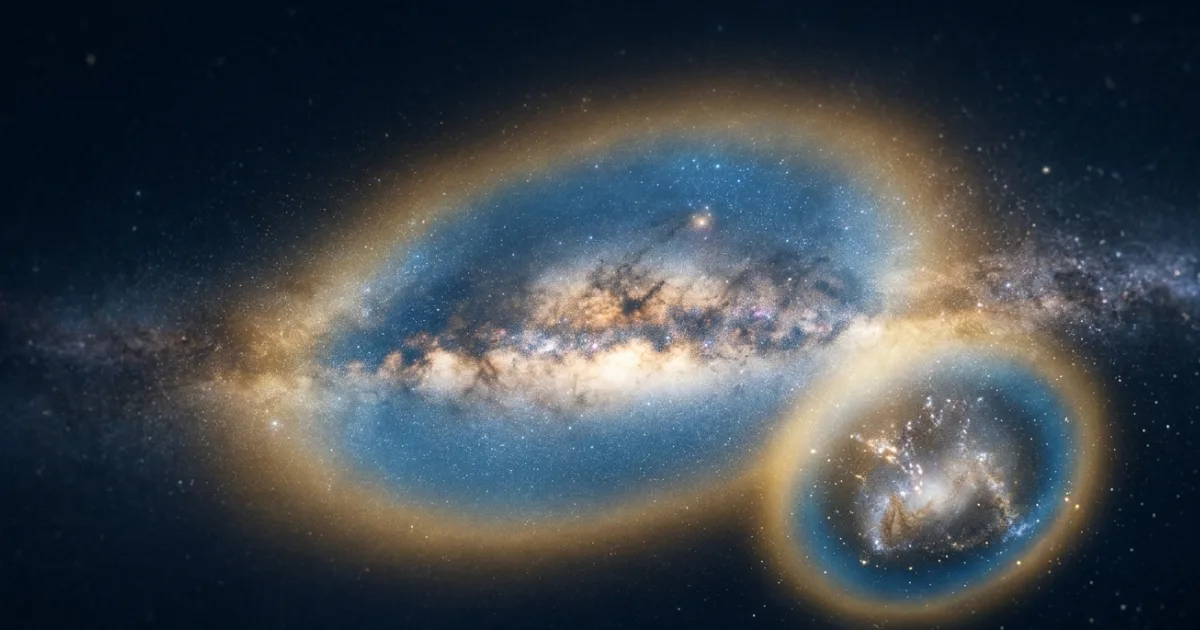
In This Article
- A Galaxy in Our Backyard — and a Very Old Argument
- The Paper That Restarted the Whole Debate in 2024
- Why Does the LMC's Gas Corona Settle the Question?
- What It Means If the LMC Really Is a First-Timer
- The Counterevidence — and Why the Debate Continues
A galaxy almost as big as the Milky Way has been drifting through our cosmic neighbourhood — and scientists still cannot agree on whether it has ever visited before. A team of researchers led by Scott Lucchini published new work in 2026 claiming that the Large Magellanic Cloud (LMC) is, without question, making its very first pass by the Milky Way. But not everyone is convinced. And the gap between the two camps tells us something fascinating about how little we still understand our own galaxy.
A Galaxy in Our Backyard — and a Very Old Argument
The Large Magellanic Cloud sits about 160,000 light-years from Earth. On a clear night in the Southern Hemisphere — somewhere like the deserts of Rajasthan or the highlands of Chile — you can actually spot it with the naked eye. It looks like a smudged patch of stars, detached from the main band of the Milky Way. But its size is deceptive. The LMC contains billions of stars and has enough mass to tug at our galaxy's shape.
For decades, astronomers quietly disagreed about whether the LMC had ever swung close to the Milky Way before. The tools to settle this debate properly just didn't exist. And then, in 2024, physicist Eugene Vasiliev published a paper that poured fuel on an old fire.
The Paper That Restarted the Whole Debate in 2024
Vasiliev's 2024 paper made a specific and testable claim: if the Milky Way's dark matter halo — the invisible cloud of matter that envelops our galaxy — has an uneven structure where particles move faster in certain directions, then the LMC's current speed and position fit perfectly with a "second pass" model. Meaning the LMC would have already looped past the Milky Way somewhere between 6 and 8 billion years ago, at a distance of roughly 100 kiloparsecs — about 326,000 light-years.
That's a big claim. And Lucchini's team didn't accept it without a fight. They first looked at hypervelocity stars — extremely fast-moving stars that had been shot out by the LMC's central black hole like cosmic cannonballs. The thinking was that these stars, if tracked carefully, could reveal whether the LMC had followed a first-pass or second-pass route. The result? Both models fit the data equally well. Unhelpful, to say the least.
Why Does the LMC's Gas Corona Settle the Question?
Here's where it gets genuinely clever. Lucchini's team turned to something unexpected — the warm cloud of gas that surrounds the LMC like a bubble. This is called the corona. Using a simulation package called GIZMO, they built detailed models of both the LMC and the Milky Way, including "live" gas particles representing the gas halos of both galaxies. They ran the numbers. Then they used a second tool, Trident, to generate simulated ultraviolet light readings that would match what real telescopes would detect.
They compared this fake data to real telescope observations — specifically, Carbon IV and Hydrogen II absorption readings taken from background quasars sitting beyond the LMC. The first-pass model reproduced those real readings almost perfectly. The second-pass model? Not so much. The reason is straightforward: if the LMC had already flown through the Milky Way's gas once before, it would have lost a large chunk of its corona to that interaction. The corona we see today is too big, too full, for a galaxy that's already been through our gas halo once.
"The LMC corona favours a first passage — the observed gas profile simply cannot be explained if the LMC has already orbited the Milky Way once before."
— Lucchini et al. · University of Wisconsin-Madison · arXiv, 2026What It Means If the LMC Really Is a First-Timer
This matters more than it might seem. A lot more, actually. If the LMC is on its first approach, the Milky Way's current shape and structure has been formed without the disruption a previous encounter would have caused. Our galaxy's spiral arms, the position of the Sun, the tidal streams of stars that trail behind the LMC — all of these would look different if the LMC had passed through once already.
There is also the question of what comes next. The LMC is expected to eventually merge with the Milky Way — a collision that will unfold over billions of years. If this really is the first encounter, we are watching the very beginning of that long, slow dance. For astronomers studying galaxy evolution, this is the rough equivalent of catching a patient at the very first symptom before anything serious has happened. Knowing the history changes everything about the prognosis.
For those of us in India, here's a point worth noting: India's own astronomical infrastructure, including observatories like the Indian Institute of Astrophysics and the upcoming Thirty Meter Telescope collaboration, positions Indian researchers to directly contribute to this exact type of galactic gas and stellar dynamics work in the coming decades.
The Counterevidence — and Why the Debate Continues
Lucchini's team is confident. But science rarely wraps up so cleanly. Just weeks before their papers appeared, an independent group using the Subaru Hyper Suprime-Cam telescope published findings of their own. They found stars sitting around 30 kiloparsecs out in the Milky Way's halo — tidal debris that, they argue, aligns much better with the second-pass scenario Vasiliev proposed.
The Lucchini team hasn't yet had time to formally respond to that paper. Their own simulations also carry real limitations: the Small Magellanic Cloud (the LMC's smaller companion) was left out entirely, even though it contributes the majority of neutral gas in the Magellanic Stream — the long trail of gas both galaxies leave behind as they move. Leaving that out is a significant simplification. The team also modelled the corona as a simple, uniform structure, when in reality it is a messy, multi-temperature environment.
NASA's upcoming Aspera mission is expected to observe the gas distribution around the Magellanic Clouds far more directly. That data, when it comes, could tip the scales one way or the other. Until then, the question — first-timer or returning visitor? — remains genuinely open.
- The corona size is key — The LMC's warm gas halo is too large to have survived a previous trip through the Milky Way's own gas, according to the new simulation study.
- Rival evidence exists — An independent team using the Subaru telescope found halo stars that fit better with a second-pass model, keeping the debate alive.
- NASA's Aspera mission could decide it — The upcoming space mission will observe Magellanic gas in ultraviolet light, offering data direct enough to settle the argument.
"Hopefully upcoming missions, such as NASA's Aspera mission, will allow us to look directly at the morphology and distribution of the Magellanic gas more closely." — Andy Tomaswick, Universe Today, 2026.
📄 Source & Citation
Primary Source: Lucchini S, Han JJ, Mishra S, Fox AJ et al. (2026). The LMC Corona Favors a First Passage. arXiv Pre-print. https://arxiv.org/abs/2510.03395
Authors & Affiliations: Scott Lucchini, Jiwon Jesse Han, Sapna Mishra, Andrew J. Fox and collaborators. University of Wisconsin–Madison and Space Telescope Science Institute (STScI).
Data & Code: Pre-print available via arXiv. Simulation data generated using GIZMO and Trident software packages. See arXiv supplementary materials for full methodology.
Key Themes: Large Magellanic Cloud · Galaxy Orbital Dynamics · Magellanic Stream · Dark Matter Halo · Ultraviolet Spectroscopy
Supporting References:
[1] Vasiliev E. (2024). The LMC's second passage and the anisotropic dark matter halo of the Milky Way. arXiv Pre-print.
[2] Lucchini S & Han JJ. (2026). Threading the Magellanic Needle: Hypervelocity Stars Trace the Past Location of the LMC. arXiv, arXiv:2510.03393.
[3] Subaru Hyper Suprime-Cam Team. (2026). Tidal debris in the Milky Way halo consistent with LMC second-passage scenario. arXiv Pre-print (independent study, 2026).
No comments yet. Be the first to share your thoughts.
Leave a Comment