 Krishan Gopal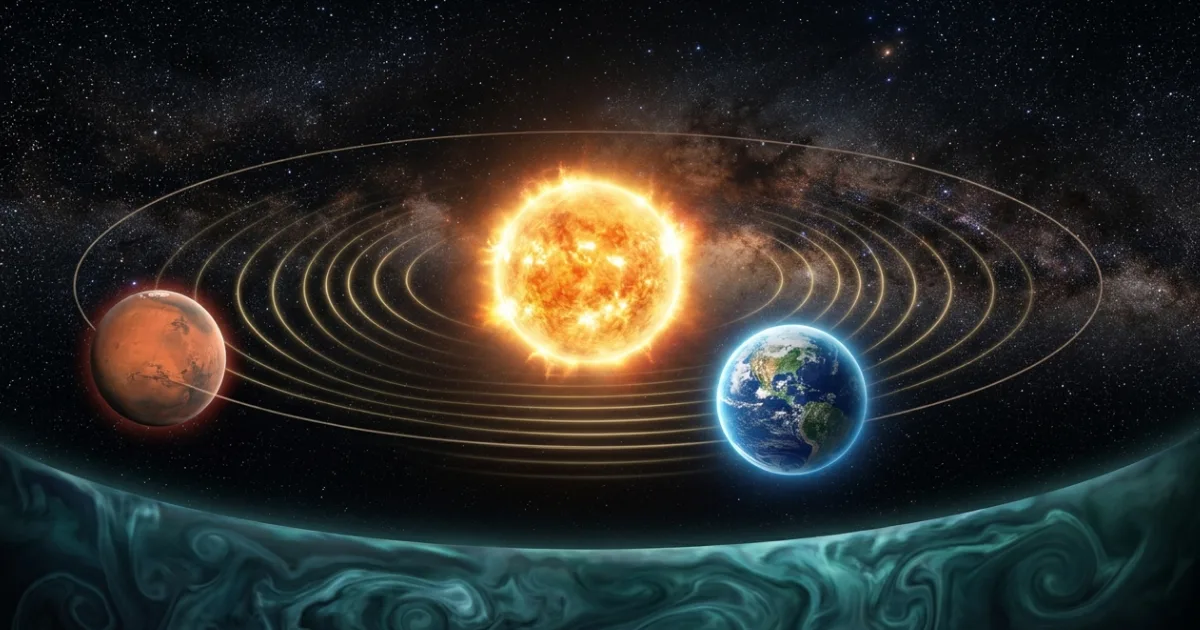
In This Article
- A Tug From Across the Solar System
- The Deep Ocean's Hidden Pulse
- How Does Mars' Gravity Actually Warm Earth?
- What This Means for the Ocean's Future
- The Questions That Still Need Answering
Every 26 months, Mars and Earth swing into opposition — the moment they pass closest to each other in space. For most of us, that's a great night for stargazing. But for Earth's climate, that cosmic rendezvous carries consequences that unfold over millions of years. New research, drawing on 65 million years of deep-sea sediment records, reveals that Mars' gravitational pull subtly reshapes Earth's orbit on a 2.4-million-year cycle — warming the planet and stirring the very bottom of the ocean in the process.
A Tug From Across the Solar System
Think of Earth's orbit like a slightly squashed circle — not a perfect ring around the Sun, but a gentle ellipse. Now imagine a neighbour planet tugging on that ellipse, almost imperceptibly, year after year. That's what Mars does. Its gravitational influence is tiny compared to Jupiter's, but because it operates in a long, slow resonance with Earth, the effects accumulate over geological timescales.
Scientists call these interactions gravitational perturbations, and they've long been linked to the Milankovitch cycles — the periodic changes in Earth's orbit and tilt that are thought to drive ice ages. What's new here is the discovery of a much longer rhythm, one that isn't tied to ice ages alone, but to the fundamental circulation of the deep ocean itself.
The Deep Ocean's Hidden Pulse
The deep ocean is not the still, dark place most people imagine. It carries heat, salt, and dissolved gases across the globe. It shapes the seafloor. And, it turns out, it beats to a rhythm set partly by the planets above it. Researchers at the University of Sydney mapped seafloor sediment layers spanning 65 million years and found recurring gaps — places where strong deep currents had swept sediment away rather than letting it settle.
Those gaps appear like clockwork, every 2.4 million years. The team matched this timing precisely to the known resonance cycle between Mars and Earth's orbits. When the planets reach a certain alignment, Earth drifts slightly closer to the Sun, the climate warms, and the deep ocean becomes measurably more energetic — generating powerful underwater eddies that can scour the seabed thousands of metres below the surface. The full study is published in Nature Communications.
How Does Mars' Gravity Actually Warm Earth?
Here's where the physics gets elegant — and a little mind-bending. Mars and Earth don't just orbit the Sun independently; they interfere with each other's paths through a phenomenon called orbital resonance. Over millions of years, that interference periodically stretches Earth's orbit into a slightly more elongated shape. The technical term is increased orbital eccentricity. During those phases, Earth passes closer to the Sun at its nearest point, receiving a small but meaningful boost in solar radiation.
That extra warmth heats the ocean surface, which disrupts the temperature and density gradients that normally keep deep water stratified and calm. Warmer, less dense surface water pushes against the cold depths. The result: deep-water circulation intensifies, generating large-scale eddies powerful enough to erode sediment layers that had been building up for hundreds of thousands of years. NOAA describes the deep-ocean conveyor belt — the Atlantic Meridional Overturning Circulation — as central to this kind of heat transport.
"The gravity fields of the planets in the solar system interfere with each other, and this interaction, called a resonance, changes planetary eccentricity — a measure of how close to circular their orbits are."
— Dietmar Müller, University of Sydney · Nature Communications, 2024Lead author Adriana Dutkiewicz, a sedimentologist at the University of Sydney, put it plainly: warmer oceans drive more vigorous deep circulation. The sediment record doesn't lie — every 2.4 million years, the abyss gets restless. The timing is too precise, and too consistent across 65 million years of data, to be coincidence.
What This Means for the Ocean's Future
There's an urgent, present-day dimension to this research. Scientists have been watching the Atlantic Meridional Overturning Circulation — AMOC, the ocean's great conveyor belt — with growing alarm. Some models suggest it could weaken significantly within decades as the climate warms, a scenario with serious consequences for weather patterns from Western Europe to South Asia.
The new findings offer a cautious note of reassurance — but not a clean one. Even if the large-scale circulation weakens, smaller deep-water eddies could continue mixing the ocean independently. Professor Müller noted that at least two distinct mechanisms drive deep-water mixing, meaning a slowdown in one doesn't necessarily stagnate the entire system. National Geographic has covered the stakes of ocean circulation change in depth.
The Questions That Still Need Answering
The research is compelling, but it opens as many doors as it closes. The team's analysis is based on sediment gaps — absences, rather than direct physical records of the cycles themselves. While the 2.4-million-year timing is strikingly consistent, confirming the precise mechanism linking orbital changes to specific ocean eddy events will require more high-resolution seafloor cores from multiple ocean basins. It's also still unclear how the warming signal propagates from the surface to abyssal depths, and how quickly that transition happens once an orbital cycle peaks.
There's also a broader question: if planetary resonance can shape Earth's ocean circulation over geological time, what other planets in our solar system are quietly tugging on us in ways we haven't yet mapped? The deep ocean holds billions of years of history. We've only just begun reading it.
- Mars shapes Earth's orbit — through a gravitational resonance that repeats every 2.4 million years, slightly stretching Earth's path around the Sun.
- Warmer oceans churn deeper — when orbital eccentricity peaks, ocean surface temperatures rise enough to intensify abyssal circulation and erode seafloor sediment.
- Human warming is different — today's climate crisis is driven by greenhouse gases and operates on decades, not millions of years; Mars is not responsible for the heat we're feeling now.
"This will potentially keep the ocean from becoming stagnant even if Atlantic meridional overturning circulation slows or stops altogether." — Adriana Dutkiewicz, University of Sydney, Nature Communications, 2024.
📄 Source & Citation
Primary Source: Dutkiewicz A, Müller RD, et al. (2024). Mars-Earth orbital resonance paces deep-sea sediment cycling. Nature Communications, 15, 1769. https://doi.org/10.1038/s41467-024-46171-5
Authors & Affiliations: Adriana Dutkiewicz (lead, sedimentologist) and Dietmar Müller (geophysics professor), both at the University of Sydney, Australia.
Data & Code: Supplementary data and sediment core references available via the Nature Communications article page linked above.
Key Themes: Orbital Eccentricity · Planetary Resonance · Deep-Ocean Circulation · Milankovitch Cycles · AMOC
Supporting References:
[1] NASA. Milankovitch orbital cycles and their role in Earth's climate. science.nasa.gov ↗
[2] NOAA Ocean Service. What is AMOC? oceanservice.noaa.gov ↗
[3] BBC Science & Environment. The evidence for human-caused climate change. bbc.com ↗
No comments yet. Be the first to share your thoughts.
Leave a Comment