 Dr. Raj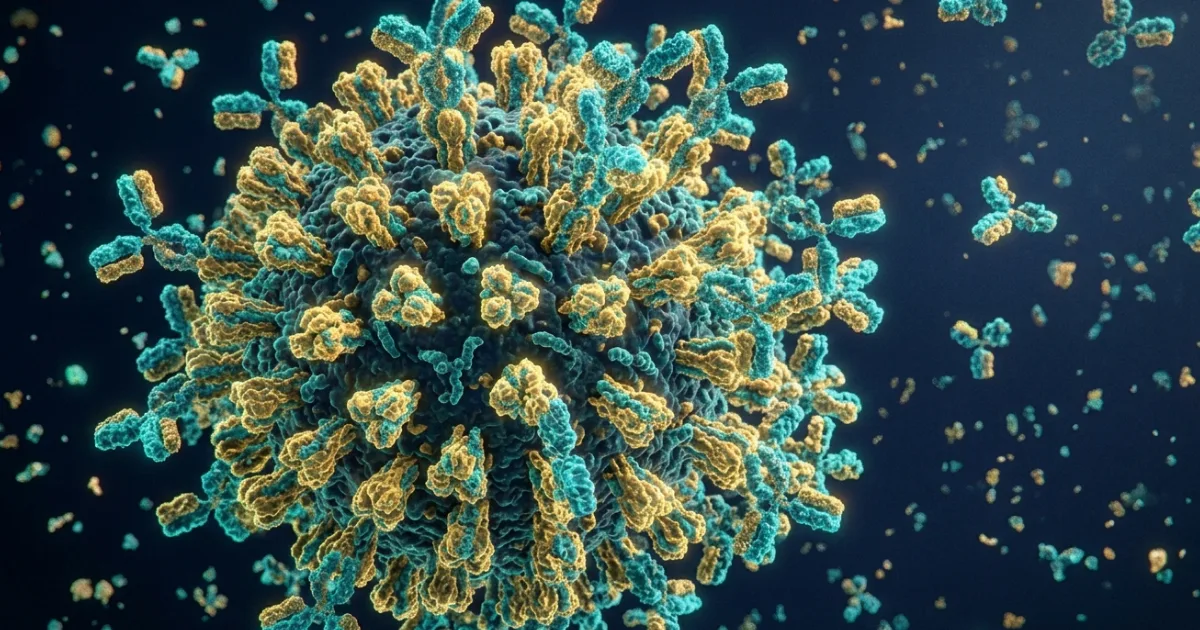
In This Article
- A Disease We Thought We Had Under Control
- Why Measles Has Always Been a Treatment Blind Spot
- How Do These New Antibodies Actually Stop the Virus?
- What This Means for People Who Can't Be Vaccinated
- The Questions That Still Need Answering
Measles was supposed to be a solved problem. For decades, the MMR vaccine has been one of medicine's greatest success stories — and yet right now, in 2026, measles is surging across the Americas, Europe, and Central Asia at rates not seen since the early 2000s. Into that unsettling context, scientists at the La Jolla Institute for Immunology (LJI) have just delivered something the world has never had before: a panel of human monoclonal antibodies that can neutralize the measles virus, both as a preventive shield and as an after-the-fact treatment.
A Disease We Thought We Had Under Control
Cast your mind back to 2000. Global measles cases stood at roughly 38 million per year, and the death toll reached 777,000 — a staggering number for a vaccine-preventable illness. According to a January 2026 report in The Lancet Microbe, decades of vaccination brought that death count down 88% by 2024, to around 95,000. Progress, yes — but not victory.
The COVID-19 pandemic disrupted immunisation programmes worldwide, creating gaps in childhood vaccine coverage that the virus has since exploited ruthlessly. By August 2025, PAHO reported over 10,000 confirmed measles cases across ten countries in the Americas alone — a 34-fold increase on the same period the year before. Countries including Canada, the UK, Austria, and Spain have since lost their official measles-elimination status.
So we're at an odd crossroads: a disease we know how to prevent is nevertheless spreading. And until now, if you contracted measles — whether because you were unvaccinated, immunocompromised, or simply unlucky — there was no targeted medical treatment waiting for you.
Why Measles Has Always Been a Treatment Blind Spot
Here's what made measles such a stubborn therapeutic target: scientists simply hadn't characterised the human antibody response to it in enough detail. We knew the MMR vaccine worked brilliantly, but we didn't fully understand why — which antibodies it produced, which parts of the virus they attacked, or which ones were the most potent defenders. Without that structural map, designing a targeted therapy was like trying to pick a lock you'd never seen.
Existing supportive care for measles — vitamin A supplementation, IV fluids for severe cases — helps manage symptoms but doesn't fight the virus itself. For immunocompromised patients, newborns, and people in regions with limited healthcare, measles can escalate rapidly to pneumonia, encephalitis, and death. A direct antiviral therapy has been a glaring gap.
How Do These New Antibodies Actually Stop the Measles Virus?
The LJI team, led by Professor and CEO Erica Ollmann Saphire, started with a single blood sample from a person vaccinated years earlier with the MMR vaccine. From that one vial, they isolated B memory cells — the long-lived immune cells that hold the blueprints for past antibody responses. They then cloned over 100 distinct human antibodies and systematically tested each one against the measles virus. The full findings were posted on PubMed as a preprint in September 2025 before the final peer-reviewed study was published in Cell Host & Microbe.
Measles turns out to be a "shape-shifting" virus. When it encounters a human cell, it unfolds — like a coiled spring releasing — to expose molecular machinery that fuses the virus with the cell membrane. The new research shows that the most powerful antibodies work by grabbing onto this fusion protein before it can spring open, locking it in its pre-release shape and leaving the virus stranded outside the cell, unable to infect anything.
Other antibodies in the panel target the hemagglutinin (H) protein — the virus's attachment hook that it uses to first grab onto a cell surface. Block both the hook and the spring, and the virus is effectively disarmed on two fronts simultaneously. Using cryo-electron microscopy, the team produced 3D structural images of these antibodies clinging to the virus — the kind of atomic-resolution detail that will guide drug designers for years to come.
"These antibodies work as prophylaxis — to protect from initial infection — and they work after viral exposure as a treatment to fight measles infection. It may be possible to give someone an infusion of these antibodies and deliver the immune response they wish they had."
— Erica Ollmann Saphire, La Jolla Institute for Immunology · Cell Host & Microbe, 2026The preclinical results were striking. Study collaborators at Ohio State University tested four lead antibodies in cotton rats — a standard model for measles research — and found that all four slashed viral loads whether administered before exposure or within 24 to 48 hours after infection. One antibody targeting the fusion protein drove the virus down to undetectable levels in every single animal tested. "We found that these antibodies are exceptionally potent," said co-first author Dr Dawid Zyla. "Two orders of magnitude better than comparable molecules reported at conferences."
What This Means for People Who Can't Be Vaccinated
Think about who actually needs a measles treatment, as opposed to a vaccine. Newborns under 12 months are too young for the MMR jab and entirely vulnerable. Patients undergoing chemotherapy or organ transplants often can't mount an immune response to live vaccines. People with certain genetic immune deficiencies have no protection at all. For all of these groups, the MMR vaccine is simply not an option — and right now, neither is any drug therapy. A 2025 study in Annals of Medicine & Surgery documented the US measles resurgence as the worst since 1992, with a 17% hospitalisation rate in early outbreak cases — a reminder of how severe the disease can be in vulnerable individuals.
A ready-to-use antibody infusion could serve as emergency post-exposure prophylaxis: given within the 72-hour window after a known exposure, it could pre-empt the infection before it takes hold. For healthcare workers accidentally exposed, for unvaccinated children in outbreak zones, and for immunocompromised adults who test positive, this kind of tool would be genuinely life-saving.
The Questions That Still Need Answering
It's worth being precise about where this research sits on the long road from lab discovery to pharmacy shelf. The preclinical results in cotton rats are genuinely exciting, but an animal model is not a human. The next steps involve designing and completing human clinical trials — testing safety, dosing, and efficacy in people — a process that, even on an accelerated timeline, typically takes several years. The research has not yet been independently replicated, and the manufacturing cost and scalability of monoclonal antibody therapies remains a real-world constraint, particularly for lower-income countries that shoulder much of the global measles burden.
There are also open scientific questions: How long does antibody protection last after an infusion? Do all nine epitope clusters identified in the study respond equally well, or are some variants of the measles virus resistant to certain antibodies? And could long-term use of passive antibody therapy in any way reduce the incentive for vaccination in communities where vaccine hesitancy is already a problem? These are not reasons to dismiss the discovery — they are the exact questions that well-designed clinical trials will need to answer. As a comprehensive 2025 review in the New England Journal of Medicine noted, the primary driver of today's measles resurgence is a failure to vaccinate — not a failure of the vaccines themselves. Any new therapeutic must complement, not compete with, that message.
- First-ever structural map of measles antibodies — Researchers identified nine distinct epitope clusters across two viral surface proteins, creating a blueprint that will accelerate future drug and vaccine design.
- Works before and after exposure — Unlike most current options, the lead antibodies reduced viral loads whether given prophylactically or within 48 hours of infection, opening the door to both prevention and treatment uses.
- A critical gap, now closer to being filled — For immunocompromised patients, newborns, and the unvaccinated, this research charts a realistic path toward a dedicated measles antiviral for the first time in history.
"Discovery, characterisation, and in vitro and in vivo success of these fully human monoclonal antibodies now provide new avenues for prophylactic or therapeutic intervention against this re-emerging virus." — Acciani, Zyla, Saphire et al., Cell Host & Microbe, 2026.
📄 Source & Citation
Primary Source: Acciani M, Zyla D, Niemeyer G, et al. (2026). Uncovering the features of measles-targeting human antibodies elicited by the MMR vaccine. Cell Host & Microbe. https://doi.org/10.1101/2025.09.09.675230
Authors & Affiliations: Marissa Acciani, Dawid Zyla, Erica Ollmann Saphire (La Jolla Institute for Immunology); Stefan Niewiesk (Ohio State University); Matteo Porotto (Columbia University Irving Medical Center)
Data & Code: Structural data deposited in the Protein Data Bank; preprint available at bioRxiv and PubMed (PMID: 41000712)
Key Themes: Measles Virology · Monoclonal Antibody Therapy · Vaccine Immunology · Cryo-EM Structural Biology · Infectious Disease Outbreak Response
Supporting References:
[1] Johnson A et al. (2025). Measles resurgence in the United States: epidemiological and clinical observations from 2025. Annals of Medicine & Surgery, DOI: 10.1097/JS9.0000000000003499. PubMed
[2] Lancet Microbe Editorial (2026). Global resurgence in measles. The Lancet Microbe, DOI: 10.1016/S2666-5247(26)00002-9. The Lancet
[3] PAHO (2025). Ten countries in the Americas report measles outbreaks in 2025. PAHO/WHO
No comments yet. Be the first to share your thoughts.
Leave a Comment