 Sanjay Verma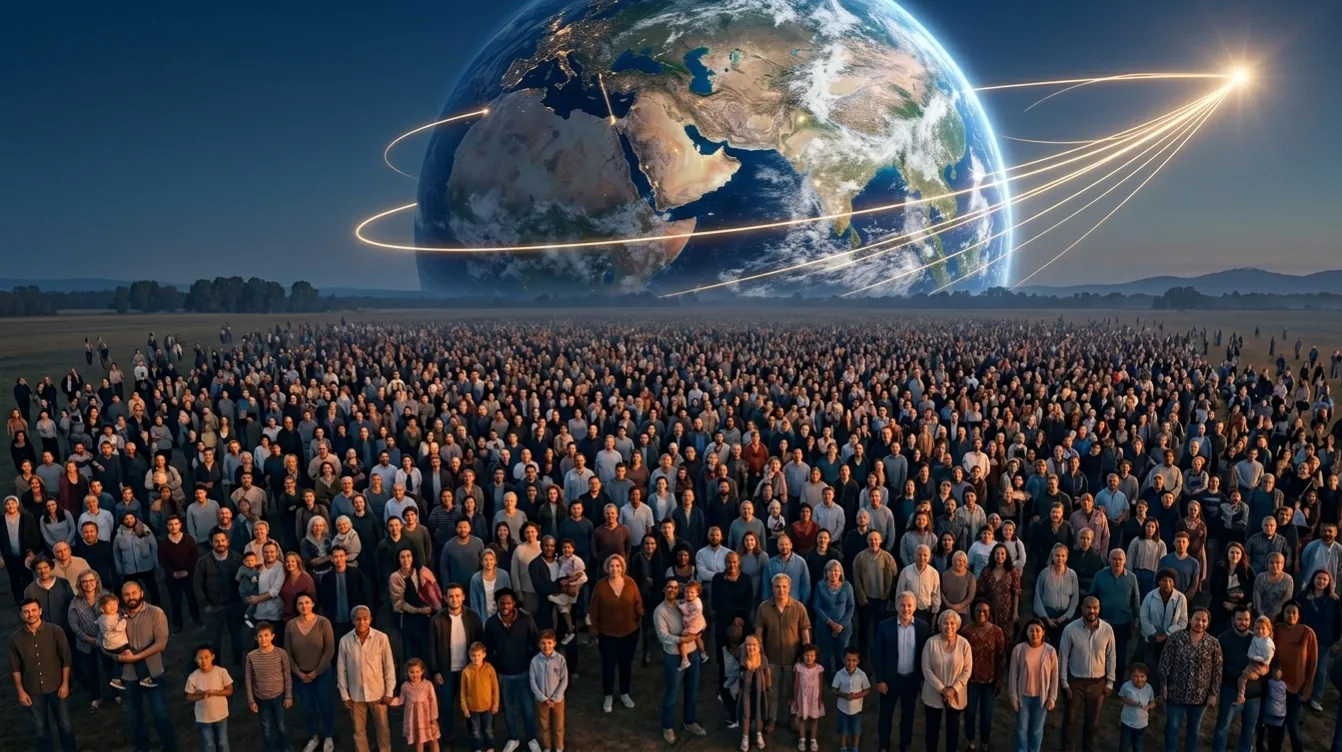
In This Article
- A Number That Holds All of Us
- Why the Old Promises Kept Breaking
- How Can One Equation Hold 12,000 Years?
- What This Means for the People You Love
- What the Math Will Never Know
Somewhere right now, a baby is taking its first breath. Somewhere else, an old man is taking his last. Add up every one of those moments and you get a single rising line: the human population. Two scientists have just found that one quiet equation can trace that line across 12,000 years, and that the same math holds a gentle warning about the years ahead.
A Number That Holds All of Us
Think about that line for a moment. Every dot on it is a real life, with a name, a family, a morning routine. For most of history the line crawled. Whole centuries passed with barely a change.
Then, in the blink of a few lifetimes, it leapt upward. Scientists have long wanted one rule that could explain both the long stillness and the sudden rush. A team finally found one, and shared it in the journal Chaos, Solitons and Fractals.
The strange part is where this rule came from. It was not born in a study of people at all. To understand it, we have to start with something far colder.
Why the Old Promises Kept Breaking
People have tried to read our future for centuries. In 1798, Thomas Malthus warned that we would multiply faster and faster until food ran out. It was a frightening promise, and it did not hold. No living thing grows without end.
So Pierre Verhulst softened it. His logistic equation said growth slows and settles at a comfortable ceiling. Later still, others swung back to fear and predicted a wild blow-up, a "doomsday," around 2026. That year is here. The doomsday is not.
Each old rule was a single snapshot of a long, moving story, and a snapshot cannot tell you what happens next. The new study does something kinder. It says those old thinkers were not wrong, only partial, and stitches their pieces into one whole.
How Can One Equation Hold 12,000 Years?
The equation has a small heart, a single number the scientists call K. Picture it as a dial. Turn it one way and growth races ahead toward a sharp crash. Turn it the other way and growth eases into a slow, gentle rise.
Reading the real numbers, the team noticed something tender and quiet. Around 1970, that dial turned. Without anyone announcing it, the human population stepped out of its racing years and into a calmer rhythm, the one we are still living in.
But they did not stop at the good news. They asked a harder question, the kind that keeps you up at night. What if a war, a fast climate shock, or a great sickness suddenly slammed a hard limit on what the Earth can give? They built that fear into the math, and the line bent downward fast.
"The framework provides a compact setting to explore future scenarios, including a worst-case case in which the global population could halve as early as 2064."
— Zaccone & Trachenko, Chaos, Solitons and Fractals, 2026What This Means for the People You Love
Hold on to the calm part first. The model says we are in the gentle phase right now. The human population is still growing, but softly, easing a little more each year. That matches what people who watch global population trends see every day.
Why should this touch your life? Because every school your child will attend, every hospital bed, every pension a parent will lean on, is built on a guess about how many of us there will be. Getting that guess right is not abstract. It is care, planned ahead of time.
That is the reassurance. The quiet worry is that a dial can be turned twice. The calm setting could swing back to the racing one. So one honest question is left: how far should we really trust this math?
What the Math Will Never Know
The scientists are gentle and honest about the limits. Their equation can draw the shape of growth, but it cannot feel the reasons behind it. It does not know why a young couple chooses one child instead of four, or why families leave home for distant cities.
The fit to the past is also rough in places, and the steep-fall figure leans on a harsh limit chosen on purpose. A real peak, other recent work suggests, may instead arrive softly around 2030. The gift of this study is not a scary date. It is the reminder that the dial can turn, and that we are the hands on it.
- One rule, our whole story: A single equation traces 12,000 years of the human population, from silent centuries to the modern surge.
- The dial called K: It decides whether growth races toward a crash or eases into calm, and since 1970 it has rested on calm.
- 2064 is a warning, not a fate: The steep fall is a worst-case picture, drawn to show how fast a crisis could change everything.
"While the current growth trend does not lead to a doomsday, reverting to a different regime would reintroduce a finite-time divergence in the dynamics." — Zaccone & Trachenko, Chaos, Solitons and Fractals, 2026.
In the end, this is not really a story about an equation. It is a story about us. The line on that graph is woven from first cries and last breaths, from every choice we make about peace, kindness, and the planet we share. The math cannot write our future. It can only show us, gently, that the pen is still in our hands.
📄 Source & Citation
Primary Source: Zaccone A, Trachenko K. (2026). Global population crisis scenarios predicted by a general nonlinear dynamical model. Chaos, Solitons and Fractals, 209, 118542. https://doi.org/10.1016/j.chaos.2026.118542
Authors & Affiliations: Alessio Zaccone (University of Milan, Italy) and Kostya Trachenko (Queen Mary University of London, UK).
Data & Code: The study uses published population data from Sojecka & Drozd-Rzoska (2024); no new data were generated. Released open access under a CC BY 4.0 licence.
Key Themes: Human Population · Population Decline · Carrying Capacity · Nonlinear Dynamics · Mathematical Demography
Supporting References:
[1] Sojecka AA, Drozd-Rzoska A. (2024). Global population dynamics over the past 12,000 years. Scientific Reports, 14(1):9853.
[2] von Foerster H, Mora PM, Amiot LW. (1960). Doomsday: Friday, 13 November, A.D. 2026. Science, 132(3436):1291-1295.
[3] Yakovenko VM. (2025). Analysis of global population growth. Physica A, 661:130412.
No comments yet. Be the first to share your thoughts.
Leave a Comment