 Priyanka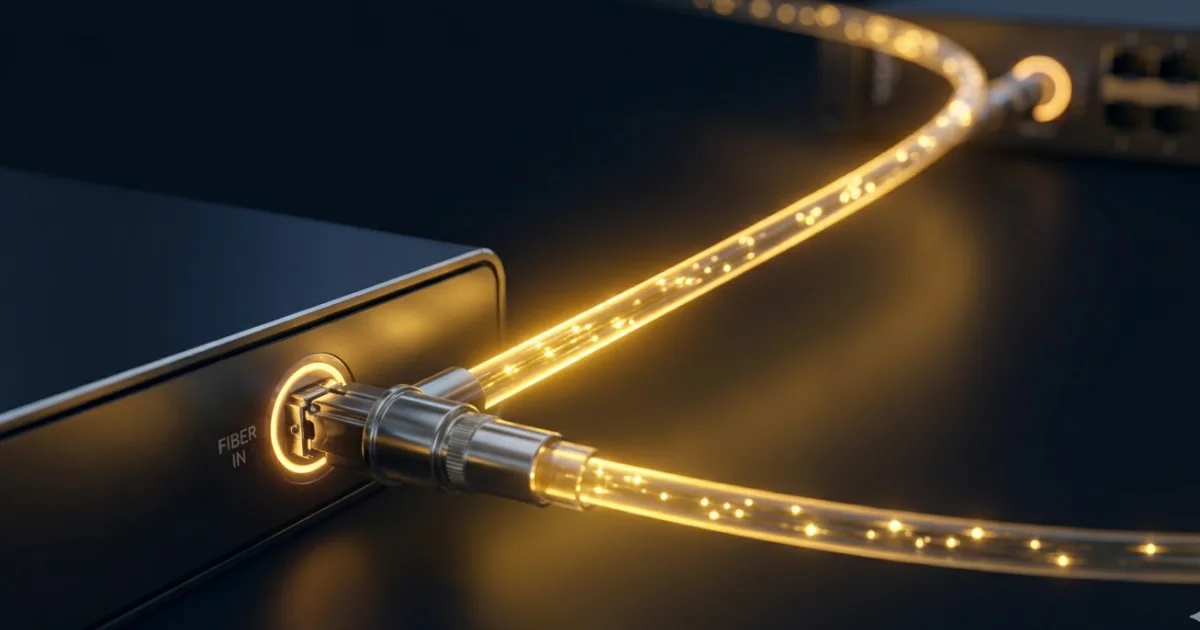
In This Article
- The Problem That's Been Blocking "Unhackable" Internet
- Why the Previous Approach Was Always Going to Break Down
- How Does This Quantum Lock Actually Work?
- What 120 km and 6 Hours Actually Prove
- The Honest Gaps — and What Still Needs Fixing
Imagine sending a secret password to someone 120 kilometres away — through a normal internet cable — and making it physically impossible for anyone to spy on it without you immediately knowing. That's exactly what a team of scientists just pulled off. Researchers at Leibniz Universität Hannover in Germany, working with teams from Stuttgart and China's Nanjing University, published results in Light: Science & Applications in February 2026 showing they had done exactly this — and the system kept running smoothly for six consecutive hours without a single human adjustment.
That last detail matters more than it sounds. Six hours. No babysitting. No crashes.
The Problem That's Been Blocking "Unhackable" Internet
The idea behind quantum key distribution — or QKD — is simple to grasp. Two people, let's call them Alice and Bob, want to share a secret encryption key. Instead of sending it as a normal digital signal (which can be secretly copied), they send it encoded in individual particles of light, called photons. Here's the trick: the laws of physics say that you cannot observe a photon without disturbing it. So if anyone tries to intercept the message, Alice and Bob will instantly see the disturbance in the signal and know they've been spied on.
That's the theory. It's beautiful. The problem is making it work over real distances, on real cables, in the real world.
For years, most QKD systems used ordinary laser light dimmed down to a very low level — not quite single photons, just very faint pulses. It works, but with a catch: lasers are statistically messy. Some pulses carry two photons instead of one, and that tiny gap in perfection is something a clever attacker can exploit. What researchers have been chasing is a source that fires exactly one photon per pulse, every single time. That's where the quantum dot comes in — and that's what makes this experiment different.
Why the Previous Approach Was Always Going to Break Down
Most earlier quantum communication experiments used something called polarisation encoding. Think of light as a wave that can vibrate in different directions — up-down, left-right, at an angle. Polarisation encoding hides the secret bit in which direction that vibration points. It's the natural first idea, and it works fine on a lab bench.
But real cables buried underground are a different story entirely. Temperature changes, vibrations from traffic, even the weight of soil pressing on the cable — all of these physically twist and stress the fibre. That constant stress gradually scrambles the direction of the light's vibration, so the secret code starts arriving garbled at the other end. To fix this, you need complex correction systems running around the clock. More equipment, more things that can go wrong, higher costs.
The Hannover team took a different approach. Instead of hiding the key in the direction the light vibrates, they hid it in timing — specifically, whether each photon arrives slightly early or slightly late within a tiny time window. Timing is almost completely unaffected by the physical stresses on the cable. The photon still arrives; it just needs to arrive at the right moment. This approach — called time-bin encoding — is far more forgiving in real-world conditions.
How Does This Quantum Lock Actually Work?
Here's the interesting part. The sender — Alice — uses a fibre loop and a single voltage-controlled switch to prepare each photon in one of three possible states before sending it down the cable. Depending on what voltage she applies, the photon emerges as either a "0", a "1", or a special checking state that lets her detect if anyone tried to eavesdrop. That's the entire encoding process. One loop, one switch. Elegantly simple.
On the receiving end, Bob's device reads the timing of each arriving photon to figure out which state it carries. A small automatic phase-correction system keeps the receiver in sync without anyone needing to touch it — it self-adjusts in real time by watching its own error rate.
The photons themselves travel at 1560.6 nm wavelength — the same standard used by ordinary long-distance internet cables around the world. That's deliberate. The whole point is to build quantum security on top of the fibre infrastructure that already exists, not to require entirely new cables. India has thousands of kilometres of this exact type of fibre already in the ground.
"This work provides the first experimental validation of integrating a quantum dot single-photon source with time-bin encoding in a telecom-band QKD system."
— Wang et al., Leibniz Universität Hannover · Light: Science & Applications, 2026What 120 km and 6 Hours Actually Prove
The system generated secure key data at roughly 15 bits per second over 120 km. To put that in perspective — 15 bits per second is enough to encrypt a short text message every few minutes. That's very slow compared to normal internet speeds, and the researchers don't pretend otherwise. But here's the key point: those 15 bits per second are guaranteed by the laws of physics to be private. Not just hard to break. Physically impossible to steal without Alice and Bob immediately noticing.
The six-hour stability run is what really catches the eye. Previous experiments with single-photon QKD tended to be short demonstrations — the system would work, then drift, then need human correction. This one ran across a full working shift, holding its error rate steady without anyone touching it. That's the difference between a lab curiosity and something that could actually be deployed.
For India, this matters in a concrete way. The government's National Quantum Mission, launched in 2023 with ₹6,000 crore in funding, specifically targets quantum-secured communication for banking, defence, and government networks. Results from Hannover set a visible benchmark for what Indian research programmes need to match — and the involvement of Nanjing University in this paper shows that China is already well along that road.
The Honest Gaps — and What Still Needs Fixing
The researchers are refreshingly open about where the system falls short. Fifteen bits per second is fine for encrypting short text, but you'd need much faster speeds for voice calls or video. The main bottleneck is the quantum dot itself — it has a natural "cooldown time" between photon emissions, which caps how quickly the system can work. Push it faster and photons from one pulse start overlapping with the next, creating errors.
There's also a significant light-loss problem. By the time each photon leaves Alice's encoding equipment, about 90% have been lost along the way — absorbed or scattered by the optical components. Bob's receiver does better, keeping about 42% of what arrives. This isn't unusual for quantum systems, but it's a clear engineering target for future versions. Better, lower-loss components would dramatically improve the speed and range.
One more open question: synchronisation. In this experiment, Alice and Bob were connected by a separate electrical cable just to keep their clocks in sync. In a real city-to-city deployment, you can't run a dedicated sync cable alongside 120 km of fibre. Several research teams globally are working on solutions, but it hasn't been fully solved yet.
- Timing beats direction — Hiding the secret key in the precise arrival time of a photon, rather than its light-wave direction, makes the signal much more stable in real cables buried in the ground.
- Six hours is the new standard — Short lab demonstrations have been done before; a system that runs unattended for half a workday is a genuinely different level of reliability.
- Existing cables, new security — Because the system uses the same wavelength as standard internet fibre, it can potentially be layered onto cable networks that already exist, rather than requiring new infrastructure.
"Our work identifies key advantages and also limitations of quantum dot single-photon sources for the generation of time-bin qubits. The results provide practical paths for optimization of all system components." — Wang, Yang, Ding et al., Light: Science & Applications, 2026.
📄 Source & Citation
Primary Source: Wang J, Hanel J, Jiang Z, Joos R, Jetter M, Rugeramigabo EP, et al. (2026). Time-bin encoded quantum key distribution over 120 km with a telecom quantum dot source. Light: Science & Applications, 15, 126. https://doi.org/10.1038/s41377-026-02205-9
Authors & Affiliations: Jipeng Wang, Joscha Hanel, Zenghui Jiang, Jingzhong Yang, Michael Zopf, Fei Ding (Leibniz Universität Hannover); Raphael Joos, Michael Jetter, Simone Luca Portalupi, Peter Michler (University of Stuttgart); Xiao-Yu Cao, Hua-Lei Yin (Nanjing University / Renmin University of China); Lei Shan (Anhui University)
Data & Code: Data supporting the plots in this paper are available from the corresponding author (Jingzhong Yang, jingzhong.yang@fkp.uni-hannover.de) upon reasonable request.
Key Themes: Quantum Key Distribution · Single-Photon Sources · Quantum Dots · Time-Bin Encoding · Telecom Photonics
Supporting References:
[1] Morrison CL et al. (2023). Single-emitter quantum key distribution over 175 km of fibre with optimised finite key rates. Nature Communications, 14, 3573.
[2] Zahidy M et al. (2024). Quantum key distribution using deterministic single-photon sources over a field-installed fibre link. npj Quantum Information, 10, 2.
[3] Yang J et al. (2024). High-rate intercity quantum key distribution with a semiconductor single-photon source. Light: Science & Applications, 13, 150.
No comments yet. Be the first to share your thoughts.
Leave a Comment