 Priyanka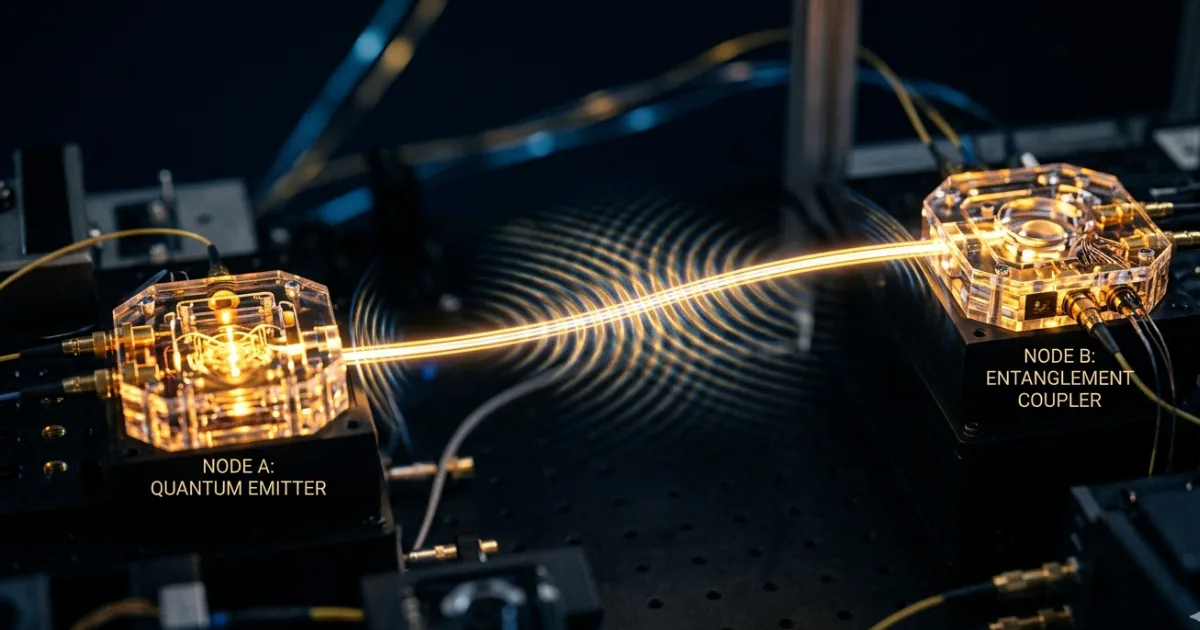
In This Article
- The Problem With Moving Quantum Information Around
- Why Single Giant Atoms Weren't Enough
- How Do Giant Superatoms Transfer Entanglement Without Destroying It?
- What This Could Mean for Quantum Networks
- What Still Needs to Be Solved
Entanglement is the quantum world's most useful and most fragile resource. Get two particles into an entangled state and you can, in principle, use that link to transmit quantum information — but brush the system against anything in the real world and the link snaps. Physicists at Chalmers University of Technology think they've found a structural workaround. In a paper published November 25 in Physical Review Letters, Lei Du and colleagues describe a class of composite quantum node — they call it a giant superatom — that can shuttle multi-qubit entangled states across a network while barely losing anything at all.
The Problem With Moving Quantum Information Around
Ask anyone building quantum hardware what keeps them up at night and decoherence is near the top of the list. Every time a quantum state interacts with its environment — a stray microwave photon, a vibration in the chip, even the act of measuring it — the delicate phase relationships that encode information get scrambled. You can fight it with error correction and deep cryogenic cooling. Groups all over the world do exactly that. But there's a subtler version of the problem that's harder to paper over: the quantum nodes themselves, as they decay, dump excitations directly into the waveguide they're connected to. That channel is supposed to carry information, not absorb it. This paper goes after that specific failure mode.
Why Single Giant Atoms Weren't Enough
Giant atoms aren't new. The first clear experimental demonstration came from Chalmers in 2014, when Gustafsson and colleagues coupled a superconducting qubit to a surface acoustic wave at two separate points and watched its decay rate shift dramatically depending on the geometry. The self-interference that produces that effect can, under the right conditions, make two atoms exchange excitations through a waveguide without either one losing any energy to it — so-called decoherence-free interaction. Neat trick. Problem is, a single giant atom carries a single-qubit state. If you want to actually run a quantum network — routing Bell pairs, W states, topological edge modes between nodes — you need to move entangled multi-qubit states intact. Nobody had a tidy way to do that.
How Do Giant Superatoms Transfer Entanglement Without Destroying It?
The GSA design is deceptively simple. Take a giant atom — call it atom 1, the one physically wired to the waveguide at two points — and attach a second atom directly to it via a coupling rate J. Atom 2 never touches the waveguide at all. It just rides along. That coupling hybridises the pair into two new energy states, labeled |+⟩ and |−⟩, each sitting at a slightly different frequency. Now, because each state has its own frequency, it accumulates a different phase as the field travels between the two coupling points. Set the geometry right — four lattice sites apart — and both states interfere destructively with themselves at the same time. Both go dark simultaneously. Neither one bleeds energy into the waveguide. The entangled state just sits there. When the team then braids two of these GSAs together — interleaving their coupling points — the protected state transfers cleanly from one node to the other, with fidelity the simulations put above 99%. Swap one GSA's frequency by exactly 2J and you get a different trick: the symmetric entangled state of node A converts into the antisymmetric state of node B. State swapping, decoherence-free.
"These results open exciting possibilities for quantum networks and quantum information processing."
— Du, Wang, Kockum, Splettstoesser · Chalmers University of Technology · Physical Review Letters, 2025What This Could Mean for Quantum Networks
The braided geometry is useful when nodes are close. For long-distance links, the team has a different approach — and honestly it's the part of this paper I find most surprising. Tune the phase difference between the two coupling coefficients to π/2, which you can do using SQUID couplers and standard flux modulation on a superconducting chip, and the two dressed states emit in opposite directions. Left and right. So a superposition inside one GSA splits itself across the waveguide: the |+⟩ component flies one way, |−⟩ flies the other, each gets absorbed by a receiver node sitting on the correct side. What you end up with is a four-qubit W-class entangled state shared across two spatially remote nodes, generated deterministically. No post-selection. No heralding. That's a genuinely different starting point compared to the probabilistic schemes most current quantum network proposals depend on.
What Still Needs to Be Solved
This is a theory paper. The simulations are rigorous and the hardware it calls for — superconducting qubits on microwave transmission lines — is already running in labs at Chalmers, MIT, and elsewhere. But simulations are not chips. Non-Markovian retardation effects, tiny timing mismatches caused by the field taking real time to travel between coupling points, do cause small residual decoherence even in the best braided-structure cases. The team notes this but doesn't fully quantify what it looks like on fabricated hardware. Phase stability across the full time-modulated coupling protocol is another thing nobody has tested yet at scale. And going beyond two or three nodes into a proper lattice of braided GSAs? Open question. The team point toward topological waveguides as one route to added protection, and non-Hermitian photonic environments as another. Those aren't near-term experiments. Still — the architecture is coherent, the target hardware exists, and the performance numbers are not modest.
- Both states go dark at once: At the right coupling-point geometry, both dressed states of a GSA cancel their own emission simultaneously — the entangled state stops decaying into the waveguide entirely.
- Direction does the sorting: A π/2 phase shift sends |+⟩ and |−⟩ in opposite directions, letting one GSA distribute a W-class entangled state across two remote nodes without any measurement step.
- The hardware is already out there: The full protocol maps onto superconducting qubit chips with SQUID couplers — devices that experimental groups are running today, making a near-term test genuinely plausible.
"By leveraging structured light-matter interactions, self-interference effects, and internal degrees of freedom, GSAs provide a versatile platform for programmable quantum information processing." — Du, Wang, Kockum, Splettstoesser, Physical Review Letters, 2025.
📄 Source & Citation
Primary Source: Du L, Wang X, Kockum AF, Splettstoesser J. (2025). Dressed interference in giant superatoms: Entanglement generation and transfer. Physical Review Letters, 135, 223601. https://doi.org/10.1103/crzs-k718
Authors & Affiliations: Lei Du, Anton Frisk Kockum, Janine Splettstoesser (Department of Microtechnology and Nanoscience, Chalmers University of Technology, Gothenburg, Sweden); Xin Wang (Institute of Theoretical Physics, Xi'an Jiaotong University, China)
Data & Code: Data available from the authors upon reasonable request (not publicly deposited). Supplemental Material available via the journal's online portal at the DOI above.
Key Themes: Giant Atoms · Quantum Entanglement · Decoherence-Free Interactions · Waveguide QED · Quantum Networks
Supporting References:
[1] Kockum AF, Johansson G, Nori F. (2018). Decoherence-free interaction between giant atoms in waveguide quantum electrodynamics. Physical Review Letters, 120, 140404.
[2] Kannan B et al. (2020). Waveguide quantum electrodynamics with superconducting artificial giant atoms. Nature, 583, 775–779.
[3] Dür W, Vidal G, Cirac JI. (2000). Three qubits can be entangled in two inequivalent ways. Physical Review A, 62, 062314.
No comments yet. Be the first to share your thoughts.
Leave a Comment