 Sanjay Verma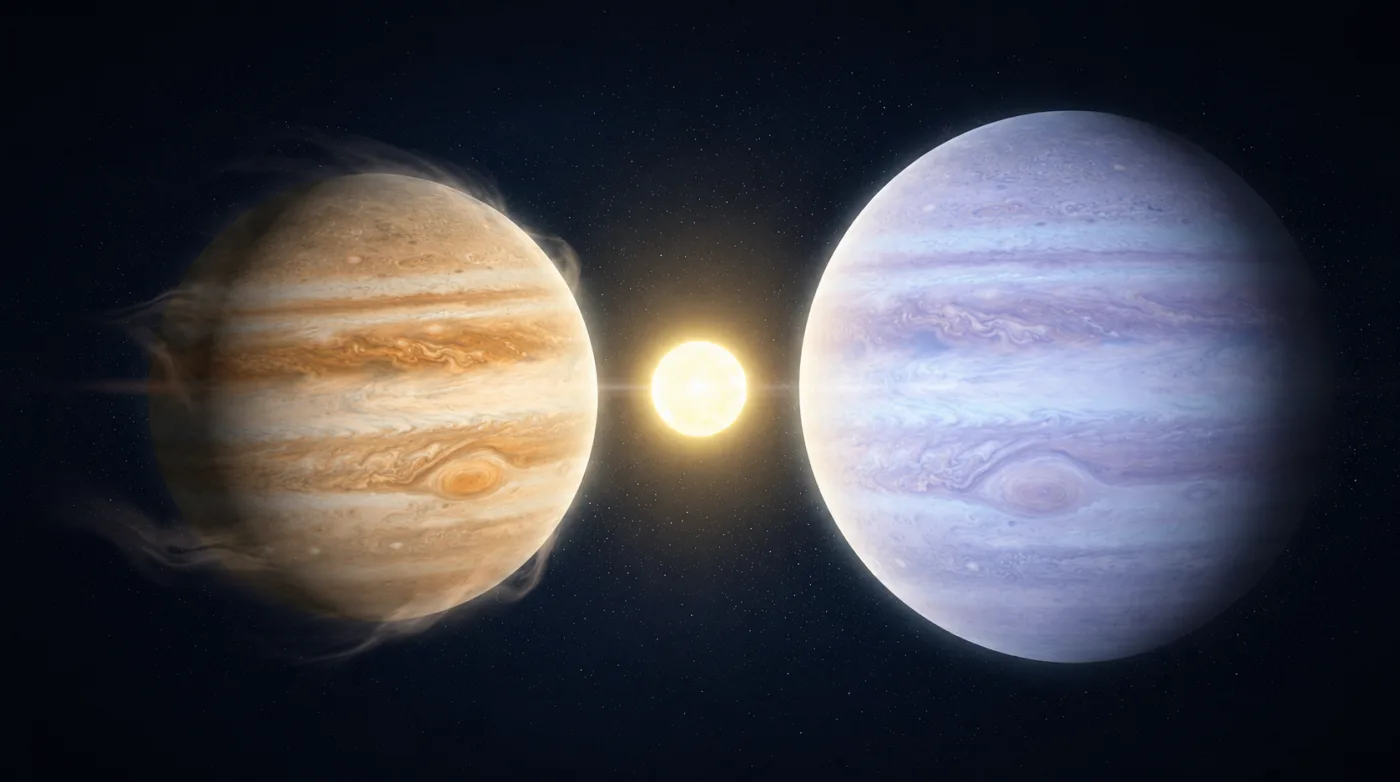
In This Article
- The Discovery That Left Astronomers Watching the Sky for Years
- Why These Cotton Candy Planets Break the Normal Rules
- How Do You Weigh a Planet You Can Never Touch?
- What Puffy Planets Reveal About How Worlds Are Born
- The Questions Still Waiting to Be Answered
Picture a planet the exact size of Jupiter, but so light it would float in a bathtub of water instead of sinking to the bottom. That is not a thought experiment. It is a real discovery orbiting a star called TOI-791, roughly 1,100 light-years from Earth. Astronomers have now confirmed two such worlds, nicknamed cotton candy planets for how impossibly light they are, circling the same star, and their existence is pushing scientists to rethink how giant planets are built in the first place.
The Discovery That Left Astronomers Watching the Sky for Years
NASA's TESS spacecraft first noticed a strange dip in the star's brightness back in 2019, a sign that something was passing in front of it. One signal lasted more than twelve hours, an unusually long transit that hinted at a planet on a wide, slow orbit. A second, fainter dip showed up two years later, and pinning down its true orbit took until 2025.
Confirming both signals meant catching complete transits from start to finish, something almost impossible from most locations since a single transit can last more than eleven hours. Led by astronomer Georgina Dransfield of the University of Oxford, the confirmation effort pulled in telescopes from Chile, Australia, South Africa, and a small telescope called ASTEP at Concordia Station in Antarctica, which enjoys months of unbroken daylight during the polar winter and could record full transits no ordinary observatory could catch.
Why These Cotton Candy Planets Break the Normal Rules
Jupiter is dense enough that if there were an ocean big enough to hold it, it would sink. TOI-791 b and c would float instead. Their density works out to roughly 0.04 grams per cubic centimeter, lighter than real spun-sugar cotton candy, which measures closer to 0.05, while Jupiter itself sits at about 1.33 grams per cubic centimeter, more than thirty times heavier for the same volume.
TOI-791 b is almost exactly Jupiter's size, yet it weighs in at only about 9.5 Earths, a tiny fraction of Jupiter's bulk. That mismatch between how big a planet looks and how little it actually weighs is exactly what makes cotton candy planets so puzzling to astronomers.
How Do You Weigh a Planet You Can Never Touch?
Astronomers usually weigh a planet by watching the tiny wobble its gravity causes in its star. That trick struggled here because TOI-791 spins unusually fast, blurring the starlight and hiding any wobble. Instead, the research team turned to the planets themselves: TOI-791 b and c circle in a near-perfect 5:3 rhythm, with one lap of the outer planet lining up almost exactly with every three laps of the inner one.
That rhythm means the two planets tug on each other's orbits, nudging each transit slightly early or slightly late by as much as fifty minutes over the years. Astronomers call this a transit timing variation, and by tracking it patiently across nine transits of TOI-791 b and four of TOI-791 c, they calculated real masses of about 9.5 Earths for the inner planet and 18.6 Earths for the outer one.
"two of the lowest density giant planets ever detected"
Source: TOI-791 discovery paper, MNRAS, 2026What Puffy Planets Reveal About How Worlds Are Born
Planets this light earned the nickname super-puffs, and until now only one other star system, Kepler-51, was known to host more than one of them. That makes TOI-791 just the second confirmed multi-planet super-puff system, giving astronomers a rare case to compare. One leading idea says super-puffs carry enormous, loosely packed hydrogen and helium atmospheres, sometimes more than twenty percent of their total mass, wrapped around a small solid core.
A competing idea suggests some of these planets are not puffy at all, just ordinary, denser worlds wearing wide, flat rings that make them look larger and lighter than they really are from Earth's point of view. TOI-791 cannot fully settle that debate yet, but comparing it against Kepler-51 narrows down which explanation fits the evidence better.
The Questions Still Waiting to Be Answered
Nobody has pinned down the exact age of TOI-791 yet, so it is unclear whether these planets are still cooling and shrinking or destined to stay puffy forever. The orbital shapes are debated too: the data lean slightly toward eccentric, stretched-out paths, but orbits that stretched would cross each other and destabilize the whole system, so researchers currently favor a simpler, nearly circular picture until more transits arrive.
Future observations with the James Webb Space Telescope could peer through the planets' atmospheres and search for the chemical signatures of hydrogen, carbon, and oxygen. The upcoming Ariel space mission is expected to study a thousand exoplanet atmospheres, and TOI-791 b and c are already considered strong candidates for that survey.
- Fluffier than candy: TOI-791 b and c are less dense than real spun-sugar cotton candy, despite being nearly Jupiter-sized.
- Weighed without touching: Astronomers calculated their masses by watching the two planets gently tug each other's orbits off schedule.
- A rare second case: TOI-791 is only the second known system with more than one super-puff planet, after Kepler-51.
Two planets that, by Jupiter's own example, should not be able to exist are still quietly circling that distant star, waiting for someone to explain them properly. That is really what keeps people looking up at the night sky in the first place: the chance that the universe out there is stranger, and lighter, than anyone ever expected it to be.
📄 Source & Citation
Primary Source: Dransfield G., Petit A. C., Triaud A. H. M. J., et al. (2026). ASTEP confirmation of a pair of long-period Jupiter-sized planets with extremely low densities transiting TOI-791. Monthly Notices of the Royal Astronomical Society, 549(4), 1-22. https://doi.org/10.1093/mnras/stag864
Authors & Affiliations: Georgina Dransfield (University of Oxford, Magdalen College) with the University of Birmingham, Observatoire de la Côte d'Azur, and an international collaboration spanning more than 30 institutions.
Data & Code: Photometry is available via NASA's Mikulski Archive for Space Telescopes (MAST) and ExoFOP; the transit-timing analysis code is published on GitHub under acpetit/TOI-791.
Key Themes: Exoplanet detection · Transit timing variations · Gas giant formation · Super-puff planets · TESS follow-up
Supporting References:
[1] Guillot T. et al. (2015). The ASTEP project: Antarctica search for transiting exoplanets. Astronomische Nachrichten, 336:638.
[2] Masuda K. et al. (2024). jnkepler: a transit-timing analysis package for multi-planet systems. Astronomical Journal, 168:294.
[3] Santerne A. et al. (2019). An extremely low density super-puff planet, HIP 41378 f. arXiv preprint, 1911.07355.
No comments yet. Be the first to share your thoughts.
Leave a Comment