 Sanjay Verma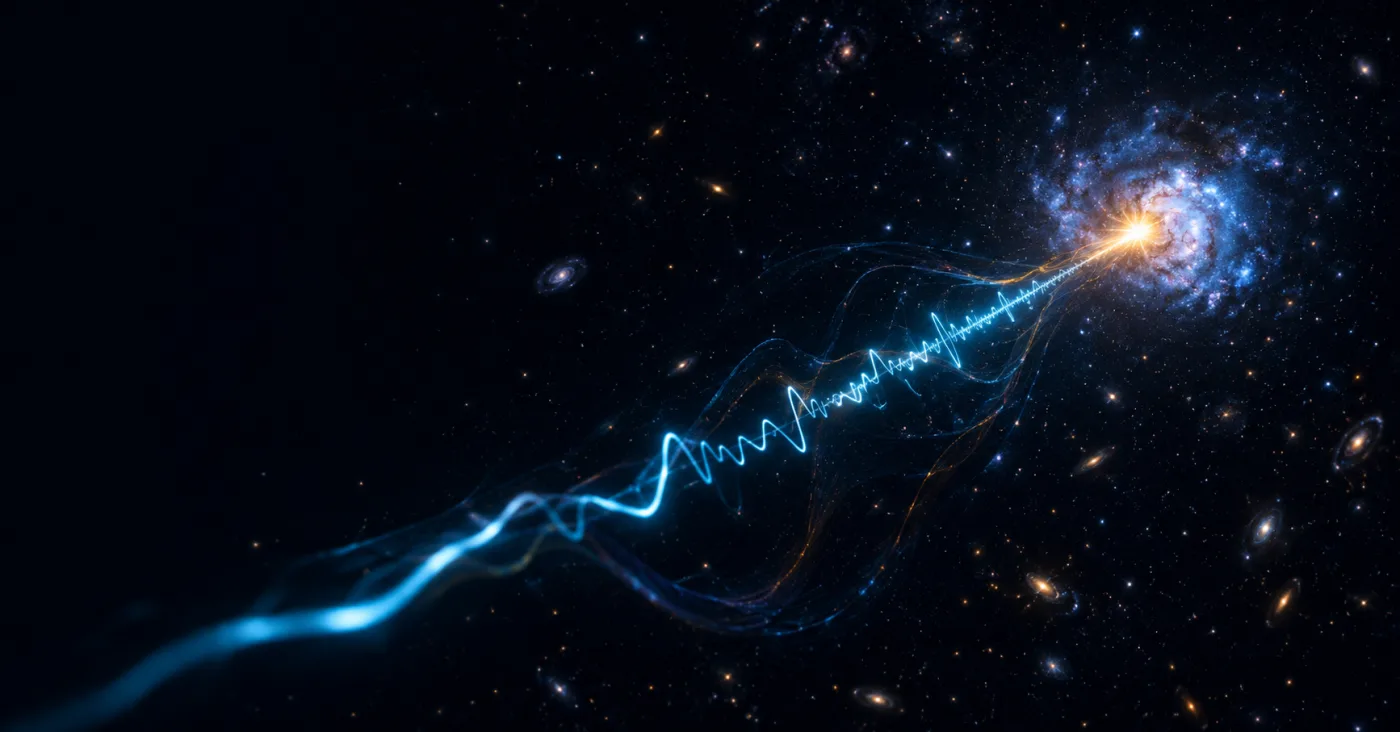
In This Article
- A Millisecond Flash That Outraced Ten Billion Years
- The Sydney-Led Team Chasing Signals Across the Cosmic Web
- Why a Faint Smudge Took Two Different Telescopes to See
- How a Radio Flicker Becomes a Distance Measurement
- What a Tiny, Star-Hungry Galaxy Suggests About the Source
- Where the Hunt for Older Signals Goes From Here
Something flickered in a distant galaxy more than 10 billion years ago, and for a few thousandths of a second, it outshone almost everything around it. That flicker finally reached Earth in March 2024, and astronomers have now traced it back to the tiny galaxy that sent it.
The signal, named FRB 20240304B, is the most distant fast radio burst ever matched to a confirmed home galaxy. The findings, led by researchers at the University of Sydney and published in Science on 8 October 2026, push the known age of these bursts back further than anyone had confirmed before. So what exactly makes a signal this old so hard to trace?
A Millisecond Flash That Outraced Ten Billion Years
Fast radio bursts, or FRBs, are intense pulses of radio energy that last only milliseconds, yet release roughly as much energy as the Sun produces over several days. Scientists have puzzled over their cause since the first one was identified in archived data in 2007, and more than 10,000 have now been catalogued.
What sets FRB 20240304B apart is distance. The burst left its source when the universe was roughly a fifth of its current age, and astronomers have now confirmed a redshift of 2.148, a measurement of how much the universe's expansion has stretched the light on its way here. Who actually ran this signal to ground?
The Sydney-Led Team Chasing Signals Across the Cosmic Web
Astrophysicist Manisha Caleb of the University of Sydney led the study, working with collaborators including Themiya Nanayakkara and researchers connected to the MeerTRAP project. The team used South Africa's MeerKAT radio telescope, a 64-dish array built to catch brief transient signals from space in real time.
Swinburne University astronomers Matthew Bailes and Ryan Shannon, who were not involved in leading this study but have worked on other FRB discoveries, offered outside context to media coverage of the find. Bailes has described fast radio bursts as a fundamental way to tally the universe's atoms, while Shannon pointed to magnetized neutron stars as one likely class of source.
Caleb herself called the burst's age range startling, even by the standards of a field used to huge numbers. Getting from a radio blip to a confirmed galaxy, though, took more than one instrument.
Why a Faint Smudge Took Two Different Telescopes to See
Because the host galaxy was simply too dim to see at first. MeerKAT's detection system flagged unusually high dispersion in the signal, the technical sign that it had passed through a large amount of charged material on its way to Earth, hinting at an extreme distance.
Researchers pinpointed the burst's position on the sky, then pointed large ground-based observatories, including the Keck Telescopes in Hawaii, at that spot. Nothing showed up. The galaxy was far too faint for those instruments to register.
That left one option: NASA's James Webb Space Telescope, built specifically to catch the kind of faint infrared light that distant, ancient galaxies give off.
How a Radio Flicker Becomes a Distance Measurement
JWST succeeded where ground telescopes could not. Its NIRCam infrared camera revealed a faint galaxy sitting almost exactly where the burst's position pointed, visible for the first time against the empty-looking patch of sky.
Confirming the match took one more step. Researchers split the galaxy's light into its component wavelengths using JWST's NIRSpec instrument, revealing emission lines from hydrogen and oxygen. Comparing those lines to their expected positions let the team calculate exactly how much the universe's expansion had stretched the light, fixing both the galaxy's distance and its age.
"A fast radio burst from when the universe was only 3 billion years old."
— Manisha Caleb, University of Sydney, lead authorThe result confirmed what the dispersion measurement had already suggested: a signal, and a galaxy, both roughly 10.6 billion years old. What surprised the team more was what that galaxy turned out to look like.
What a Tiny, Star-Hungry Galaxy Suggests About the Source
It is small, young, and still busy forming stars. The host galaxy holds only around 10 million times the mass of our Sun, a sliver of the Milky Way's heft, and carries unusually little of the heavier elements that build up in galaxies over time.
That profile fits one leading explanation for at least some fast radio bursts: young magnetars, neutron stars wrapped in extraordinarily powerful magnetic fields, born in the kind of star-forming environment this galaxy represents. Researchers are careful to note that FRBs likely come from more than one type of source, so this single case does not settle the question.
Along its path, the signal also crossed two cosmic structures that left their own fingerprints on it: a previously unknown galaxy cluster roughly 3.5 billion light-years away, and the far closer Virgo Cluster, about 54 million light-years from Earth. Each left a measurable trace in the light, turning the burst into something closer to a cosmic X-ray scan than a simple blip.
Where the Hunt for Older Signals Goes From Here
That scanning ability is the real payoff. As the burst crossed billions of light-years, it picked up a physical record of the charged matter and magnetic fields along its route, information that NASA's own account of the discovery notes is otherwise extremely difficult for astronomers to gather directly.
- A new distance record. FRB 20240304B is the farthest fast radio burst yet matched to a confirmed host galaxy.
- An unexpected host. Its galaxy is small, metal-poor, and still forming stars, pointing toward a young-magnetar origin.
- A map, not just a signal. The burst's path reveals charged matter and magnetic structure across 80% of cosmic history.
Researchers now want more examples at similarly extreme distances, since a handful of signals cannot map an entire universe. Each additional ancient burst adds another data point to a growing picture of how matter, galaxies, and magnetic fields have spread out since the universe was young.
📄 Source & Citation
Primary Source: Caleb, M. et al. (2026). A fast radio burst at redshift 2, three billion years after the Big Bang. Science, published 8 October 2026. DOI: 10.1126/science.adz2675
Lead Author: Manisha Caleb, Sydney Institute for Astronomy, University of Sydney. Detection via the MeerTRAP project on the MeerKAT radio telescope, South African Radio Astronomy Observatory.
NASA Coverage: NASA Science, "Webb Measures Distance to Farthest Fast Radio Burst, Suggesting Origin," science.nasa.gov.
Image Credit: NASA, ESA, CSA, STScI, Themiya Nanayakkara (University of Sydney), Joseph DePasquale (STScI).
Key Themes: Fast radio bursts · James Webb Space Telescope · MeerKAT · Cosmic web · Magnetars · Redshift measurement
No comments yet. Be the first to share your thoughts.
Leave a Comment