

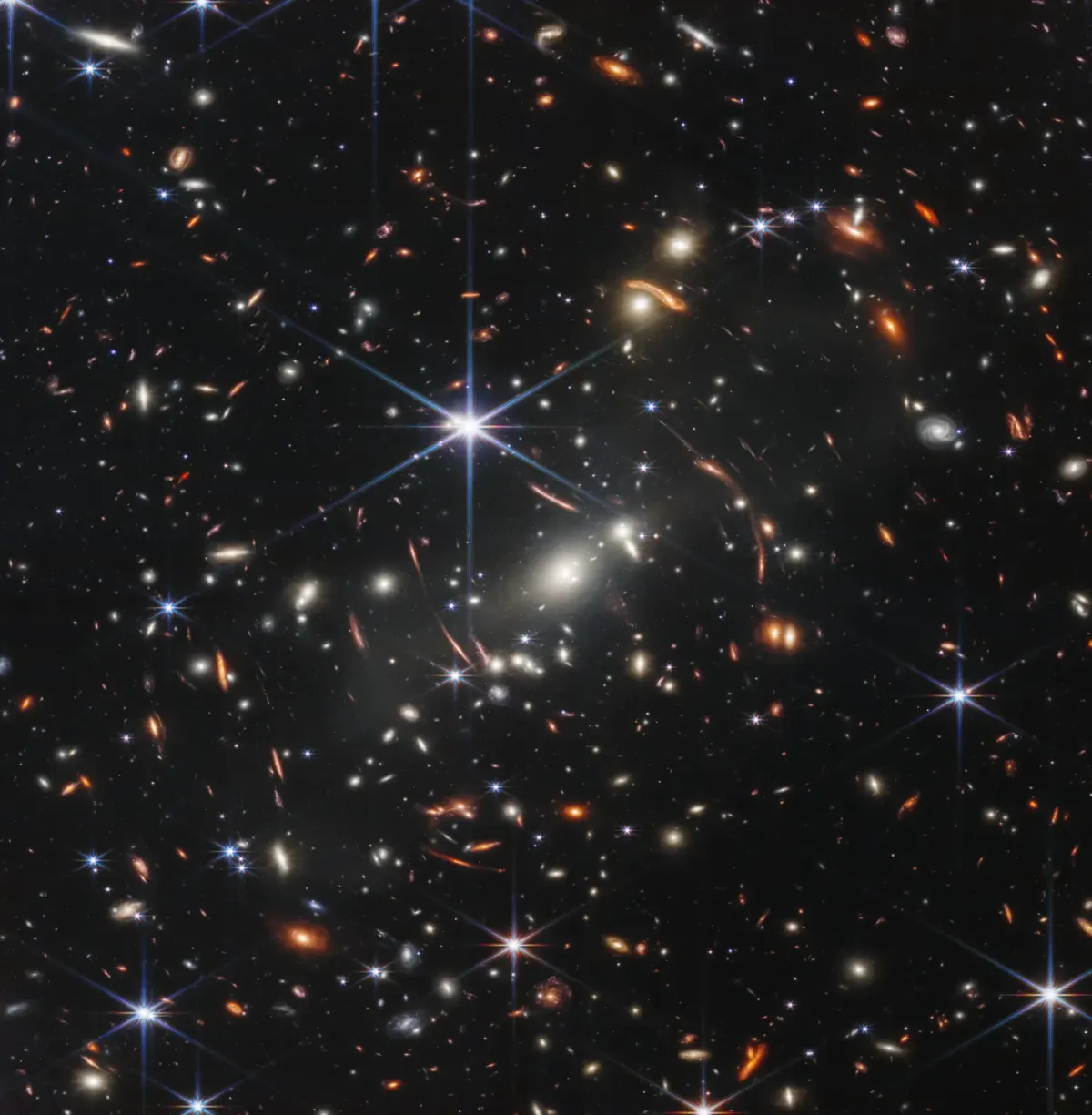
Look up on a clear night. The stars may seem close, like little lights scattered above us. But each one belongs to a much larger story. The universe contains galaxies, stars, planets, gas, dust and things we cannot see. It has been changing for about 13.8 billion years. This guide to the universe explained begins with one big question: how did everything take shape?
The universe means all of space, time, matter and energy. It is not sitting inside a larger empty room. Space itself is part of the universe, and space has been expanding. Scientists study this story by observing light from distant objects. Because light takes time to travel, looking far into space also means looking back in time.
How Did the Universe Begin?
The leading explanation is called the Big Bang. It describes an early universe that was extremely hot and dense. Then space expanded, and the universe cooled. The Big Bang was not an ordinary explosion into empty space. It was the expansion of space itself.
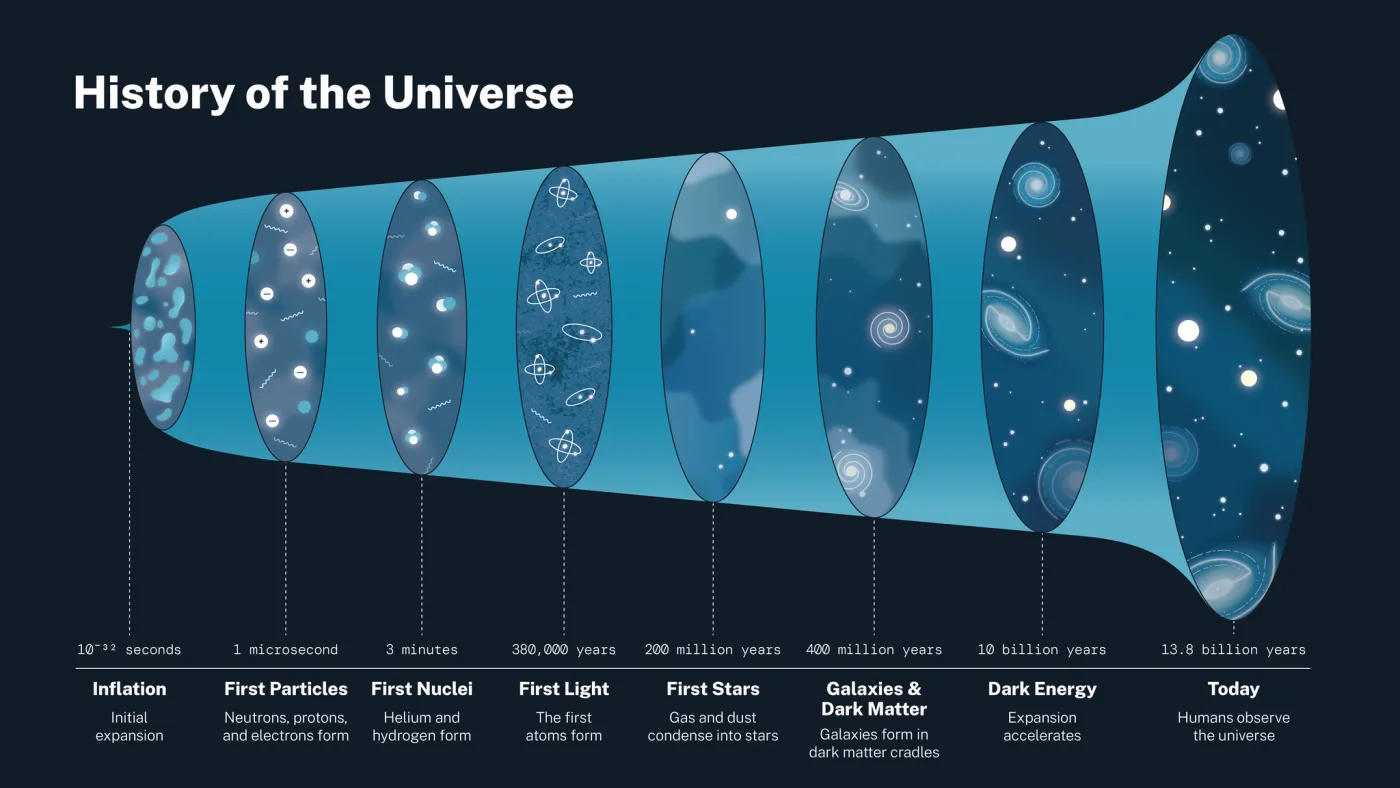
In the first moments, the universe was too hot for atoms to exist. It contained particles and energy. Within minutes, protons and neutrons began joining to form simple atomic nuclei, mainly hydrogen and helium. But the universe stayed opaque for much longer. Light kept bouncing off free electrons instead of travelling freely.
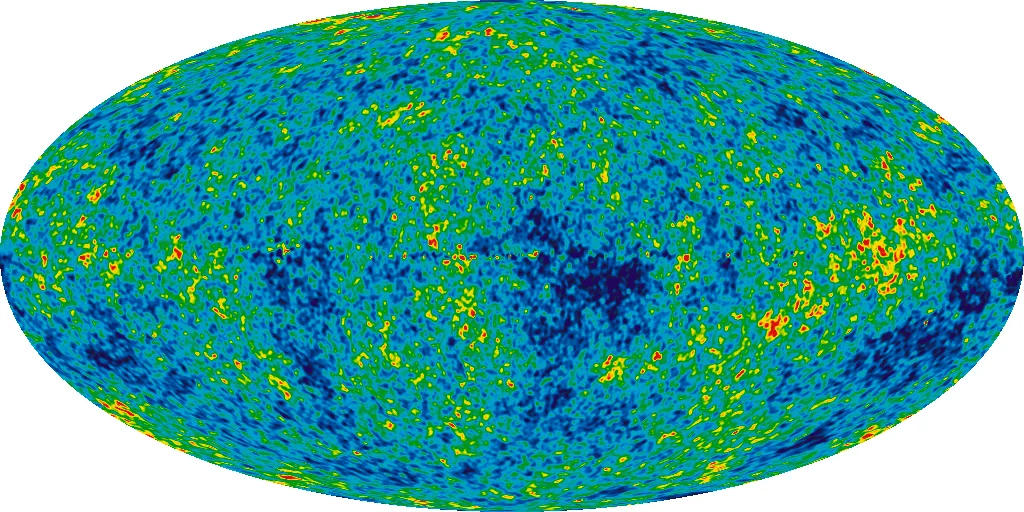
About 380,000 years after the Big Bang, the universe had cooled enough for electrons to join atomic nuclei. Atoms formed, and light could travel across space. That ancient light still reaches us. Scientists call it the cosmic microwave background. NASA describes it as the oldest light we can detect. Tiny differences in this glow reveal small changes in the density of the young universe. Those early differences later helped matter gather under gravity.
How Did Stars and Galaxies Form?
Gravity slowly drew matter into denser regions. Huge clouds of gas gathered and became more compact. Their centres grew hotter. When the conditions became right, nuclear fusion began. Fusion joins light atoms and releases energy. That is how a star shines.
The first stars appeared after the universe became transparent. Over time, stars gathered with gas and dust into galaxies. Galaxies come in different shapes. Some have spiral arms. Others look round or irregular. Our Sun belongs to one of them: the Milky Way. It is one star among the galaxy's hundreds of billions of stars.
Stars also changed what the universe could make. Their cores built heavier elements from simpler ones. When some stars reached the ends of their lives, they sent material back into space. Later stars, planets and other objects formed from gas enriched by earlier generations of stars.
Our Solar System formed about 4.6 billion years ago from a cloud of gas and dust. The Sun formed near the centre. Remaining material gathered into planets, moons, asteroids and comets. Earth is one small planet in this system. Our home is part of the Milky Way, which is one galaxy among many.
What Are Dark Matter and Dark Energy?
Here is a surprising part of the story. The matter we can see is only a small part of the universe's contents. Stars and gas do not explain all the gravity that scientists measure in galaxies and galaxy clusters. So researchers infer that extra, unseen matter is present. They call it dark matter.
Dark matter is not the same as gravity. Gravity is the effect that mass has on other matter and light. Dark matter is the name for unseen matter whose gravity appears to affect how galaxies move and how large cosmic structures form. It does not give off, reflect or absorb light in the way ordinary matter does. Scientists have strong evidence for its gravitational effects, but its nature remains unknown.
Dark energy is a different mystery. Observations show that the expansion of the universe is speeding up. Scientists use the name dark energy for whatever is driving this acceleration. It is not a kind of dark matter, and researchers do not yet know what it is.
These mysteries are not gaps that science has ignored. They are active questions. Telescopes and surveys measure distant galaxies, the pattern of the cosmic microwave background, and the history of cosmic expansion. Each new observation helps test our picture of the universe.
NASA's James Webb Space Telescope studies very distant galaxies, helping researchers learn how early galaxies grew.
The next discoveries may change parts of this picture. But one fact remains striking: every planet, star and galaxy we see is part of the same expanding cosmos. When you look at the night sky, you are not looking outside the universe. You are looking at home.
📄 Source & Citation
Sources: NASA – Overview of the Universe · NASA – Dark Matter · NASA – Dark Energy · NASA – Webb and the Early Universe
Comments
No comments yet. Be the first to share your thoughts.
Leave a comment