

Two giant arches, two very different stories
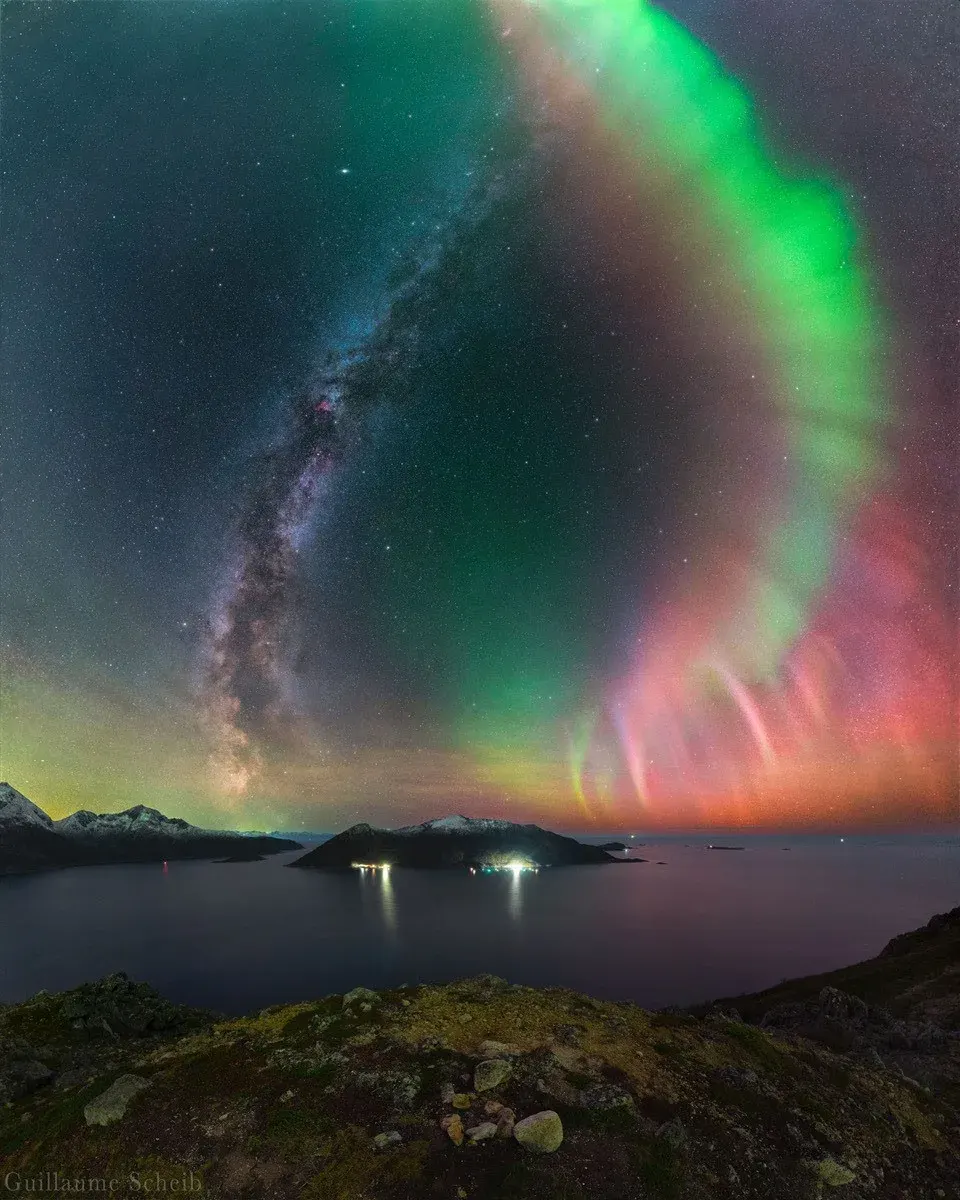
The night sky above northern Norway offered a remarkable sight. Two giant arches appeared together, creating the impression of a celestial contest.
But these arches have very different origins.
The textured arch on the left is the central band of our Milky Way Galaxy. The smoother arch on the right is an auroral ribbon in Earth's upper atmosphere.
NASA featured this photograph on November 17, 2026, through its Astronomy Picture of the Day (APOD) programme. Photographer Guillaume Scheib captured the scene from Kvaløya in northern Norway, about a month before NASA published it.
Although the two structures appear close together in the photograph, they are separated by an enormous difference in distance and age.
The Milky Way: An ancient structure across space
The arch on the left belongs to our home galaxy, the Milky Way.
It is the central band of a vast system containing stars, gas and dust. NASA describes this galactic structure as ancient, predating Earth itself.
Its textured appearance makes it stand out against the darker night sky.
Unlike the aurora beside it, the Milky Way is extremely far away. It is not an atmospheric display above Norway. It is part of the enormous galaxy in which our Solar System exists.
The aurora: A young ribbon in Earth's atmosphere
The smoother arch on the right has a much more local origin.
It is an auroral ribbon, a glowing structure found in Earth's upper atmosphere. NASA describes it as only hours old when photographed.
The ribbon is composed of energized atoms and molecules. Its appearance creates a striking contrast with the distant, textured band of the Milky Way.
One structure represents an ancient galaxy. The other is a relatively short-lived atmospheric display.
That difference is what makes the photograph particularly remarkable.
What connects the Milky Way and the aurora?
Despite their different locations, the two structures share an important connection: the Sun.
Our Sun is a star within the Milky Way. It ejects energetic particles that create auroras.
This provides the link between the two subjects in the photograph.
The Milky Way is the distant galactic home of our Sun. The aurora is a display in Earth's upper atmosphere created by energetic particles from that same star.
Their appearance together is a chance alignment from our viewpoint on Earth. They are not physically connected structures.
Look beyond the two arches
The photograph contains more than the Milky Way and aurora.
Far behind the middle of the auroral arch is the Big Dipper, a familiar pattern of stars in the night sky.
Another distant object appears even farther away. It is the Andromeda Galaxy, visible as a bright spot near the top of the photograph, slightly left of centre.
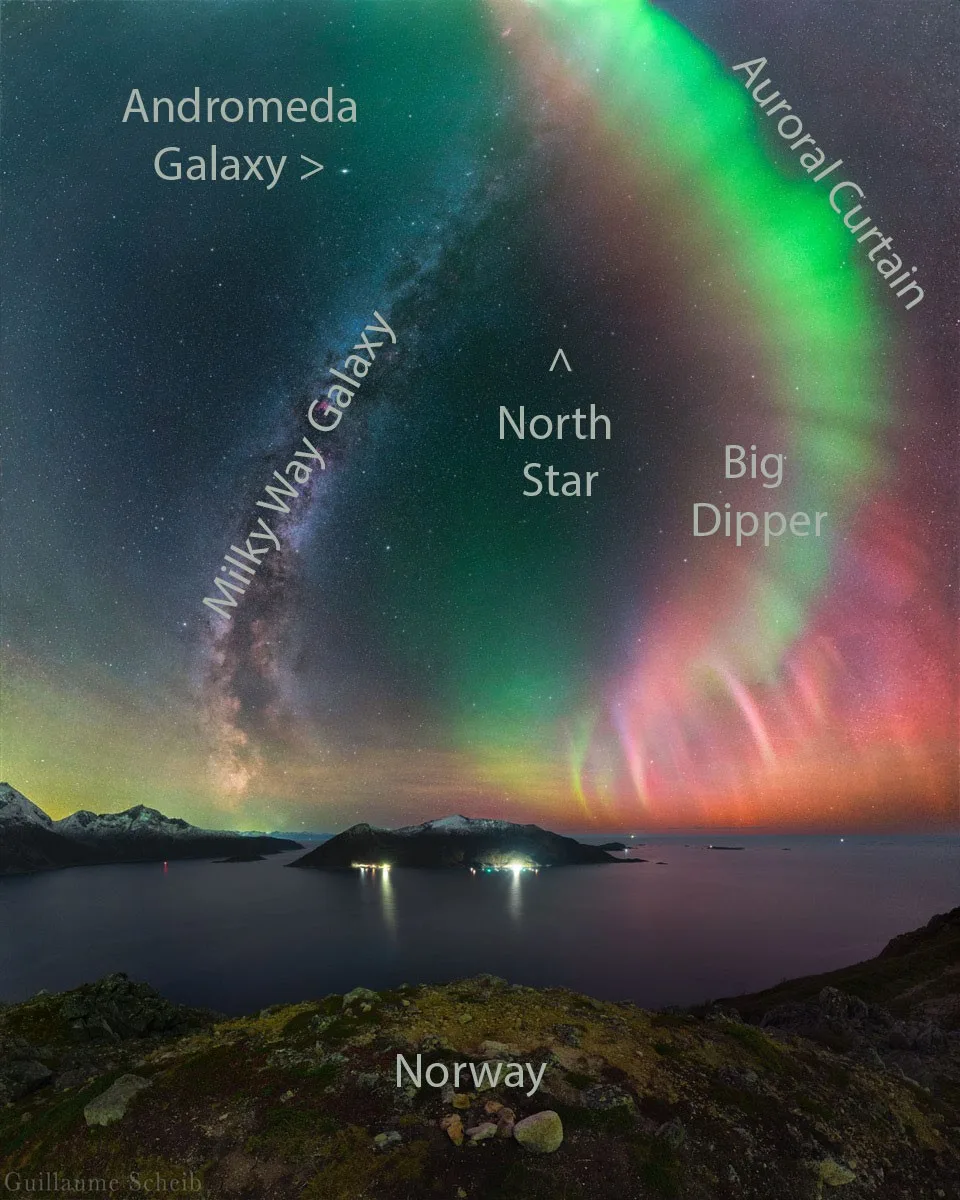
These details add another layer to the image. A single photograph brings together an atmospheric phenomenon, our home galaxy and another galaxy beyond it.
One photograph reveals different scales of the universe
NASA's Milky Way versus Aurora image highlights a remarkable contrast.
The Milky Way represents an ancient collection of stars, gas and dust across vast distances. The auroral ribbon represents a much younger display in Earth's upper atmosphere.
The Big Dipper and Andromeda Galaxy complete the scene, adding further astronomical landmarks to the composition.
All four appear together from one location in northern Norway. Yet they represent very different distances, structures and timescales.
The photograph is a reminder that the night sky can bring distant and nearby phenomena into one extraordinary view.
📄 Source & Citation
Primary source: NASA, Milky Way versus Aurora, Astronomy Picture of the Day, November 17, 2026. science.nasa.gov
Comments
No comments yet. Be the first to share your thoughts.
Leave a comment