

An extreme planet reveals its atmospheric chemistry
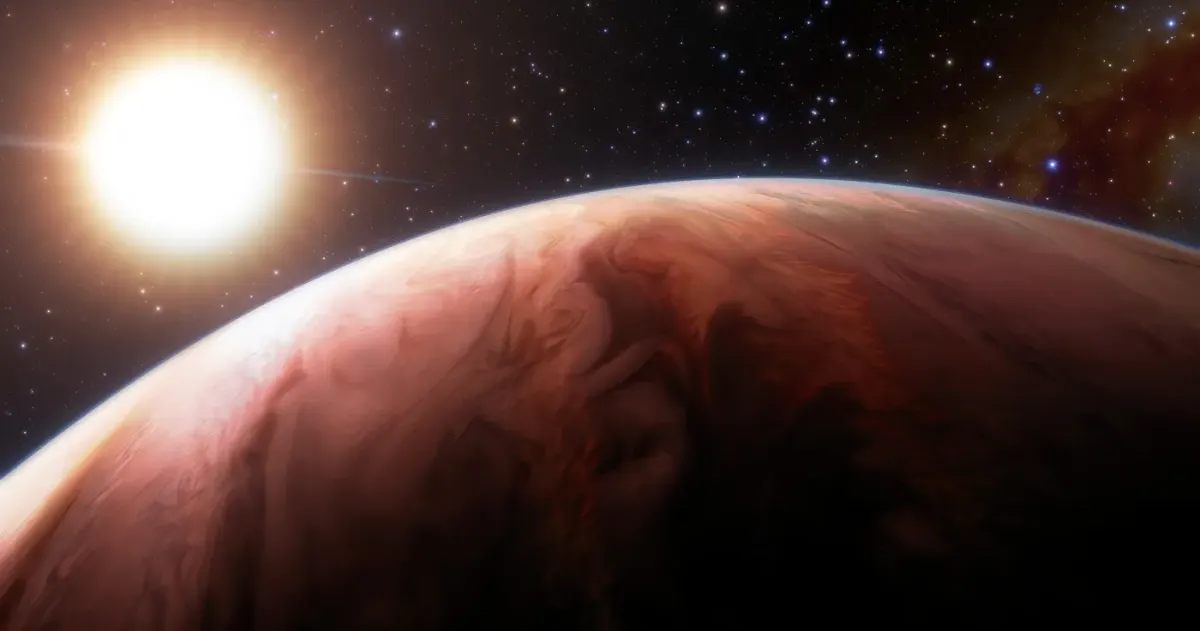
An ultra-hot Jupiter is giving astronomers a closer look at the chemistry of distant worlds. New observations of HAT-P-70b have revealed several chemical species in its dayside atmosphere. They also provide evidence that extreme heat is breaking apart water molecules.
The study, titled Thermal emission spectroscopy of the ultra-hot Jupiter HAT-P-70b: NIRPS constraints on its refractory and volatile content, examines the planet using near-infrared thermal emission observations.
The research team detected signals from iron, magnesium, vanadium, silicon and hydroxyl. However, the observations did not reveal a significant water signal.
The findings offer new information about how extreme temperatures shape the atmospheres of giant planets beyond our Solar System.
A world with temperatures above 2,500 degrees
HAT-P-70b belongs to a class of planets known as ultra-hot Jupiters. These are giant gas planets that orbit very close to their host stars and experience extremely high temperatures.
The planet has an estimated equilibrium temperature of about 2,562 kelvin. It completes one orbit in approximately 2.74 days.
At such high temperatures, many substances that would normally exist as solids can become gases. Metals such as iron, magnesium and silicon can remain in the atmosphere as gaseous species.
The planet's dayside is especially important. It faces the host star and receives intense radiation. Its cooler nightside provides a very different environment, where some chemical compounds can condense and leave the gas phase.
NIRPS observations reveal five atmospheric signals
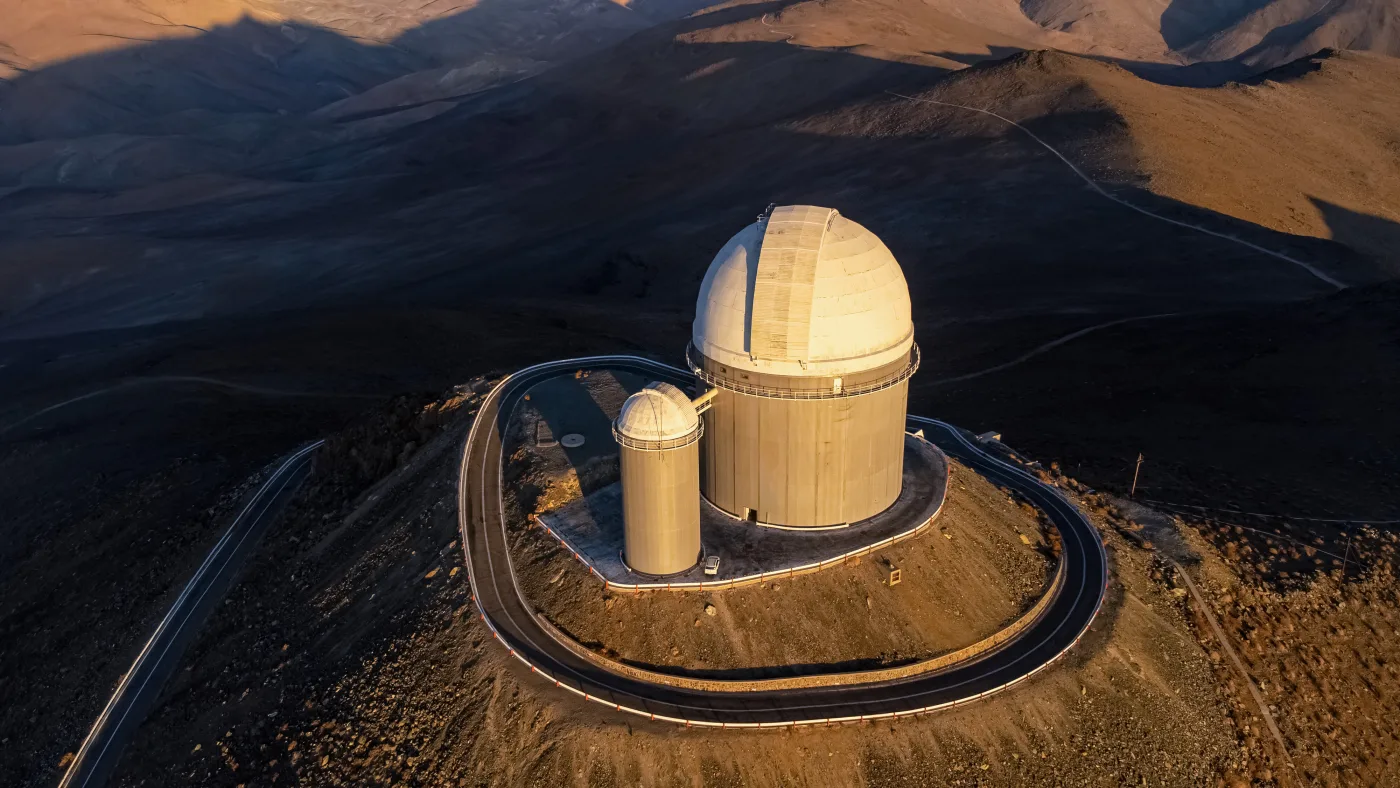
The researchers used the Near-InfraRed Planet Searcher, known as NIRPS. This high-resolution spectrograph is installed on the European Southern Observatory's 3.6-metre telescope at La Silla, Chile.
The team combined six observing visits. Four observations covered the planet's western dayside after secondary eclipse, while two covered its eastern dayside before secondary eclipse.
By analysing the thermal emission spectrum, the researchers identified signals from five species:
- Iron (Fe)
- Magnesium (Mg)
- Vanadium (V)
- Silicon (Si)
- Hydroxyl (OH)
The study reports the first detections of silicon and hydroxyl in HAT-P-70b's atmosphere. Iron, magnesium and vanadium were also robustly detected.
The observations did not produce a significant water signal. This result became one of the study's central findings.
Water may be more than 90% dissociated
Why would an extremely hot planet show hydroxyl but no significant water signal?
The answer may lie in thermal dissociation.
At very high temperatures, water molecules can break apart into hydrogen and oxygen. These products can then take part in further chemical reactions that produce hydroxyl, also known as OH.
The researchers detected OH but did not find a significant H₂O signature. Their atmospheric retrieval estimates that more than 90% of the water in the probed atmospheric layers is dissociated.
This means that much of the water may no longer remain in its original molecular form under the conditions examined.
There is an important limitation. The team performed an injection-recovery test and found that the observations were not sensitive enough to recover an injected water signal. Therefore, the absence of a significant water detection must be interpreted carefully.
The result supports strong water dissociation, but the observations do not provide a direct detection of water molecules.
A strong temperature inversion shapes the atmosphere
The study also reveals a pronounced thermal inversion in the planet's dayside atmosphere.
A thermal inversion occurs when temperature increases with altitude through a region of the atmosphere, rather than decreasing.
The retrieved temperature profile shows a temperature contrast of roughly 2,000 kelvin across the photospheric region.
The researchers found no evidence for a double-inversion temperature profile in their analysis.
This temperature structure is consistent with the extreme conditions expected in ultra-hot Jupiter atmospheres. It also helps explain why the planet's atmospheric chemistry differs from that of cooler gas giants.
Why is titanium less abundant?
Another important result concerns titanium.
The researchers did not detect titanium-bearing species through their cross-correlation search. Their atmospheric retrieval also found titanium to be significantly underabundant compared with solar values.
One possible explanation is a process called cold-trapping.
Titanium can condense more readily than some other refractory elements. On the cooler nightside, titanium-bearing compounds may change from gas into condensed material and rain out into deeper atmospheric layers.
Atmospheric circulation can transport material between the nightside and dayside. However, the researchers suggest that this process may not return all the titanium to the observable dayside atmosphere.
The team also notes an important uncertainty: inaccuracies in titanium oxide spectral line data could affect the measurements. The result should therefore be understood as evidence consistent with partial titanium depletion, not proof that titanium is completely absent.
Rock-forming elements show a solar-like pattern
The study also examined the relative abundances of iron, magnesium, silicon and vanadium.
The retrieved Fe/Si, Mg/Si and V/Si ratios are broadly consistent with solar values within the measurement uncertainties.
These elements are important because iron, magnesium and silicon are major rock-forming elements. Their relative abundances can help scientists investigate the chemical building blocks of planets.
The result supports the idea that giant planets may preserve important elemental ratios from the material associated with their formation. However, the researchers note that the stellar elemental abundances of HAT-P-70 itself were not available for a direct comparison.
A closer look at the atmospheres of distant worlds
The HAT-P-70b study demonstrates how high-resolution thermal emission spectroscopy can reveal the chemical and temperature structure of an exoplanet.
It identifies silicon and hydroxyl for the first time in this planet's atmosphere. It also provides evidence for strong water dissociation, a pronounced thermal inversion and possible titanium cold-trapping.
The findings show how different atmospheric processes can operate together on an extremely hot gas giant.
HAT-P-70b is therefore a valuable laboratory for studying the chemistry of ultra-hot Jupiters and understanding how their atmospheres respond to extreme temperatures.
📄 Source & Citation
Primary research paper: Valentina Vaulato and colleagues, Thermal emission spectroscopy of the ultra-hot Jupiter HAT-P-70b: NIRPS constraints on its refractory and volatile content, Astronomy & Astrophysics manuscript, November 17, 2026.
Research identifier: arXiv:2611.18835
Comments
No comments yet. Be the first to share your thoughts.
Leave a comment