 Sanjay Verma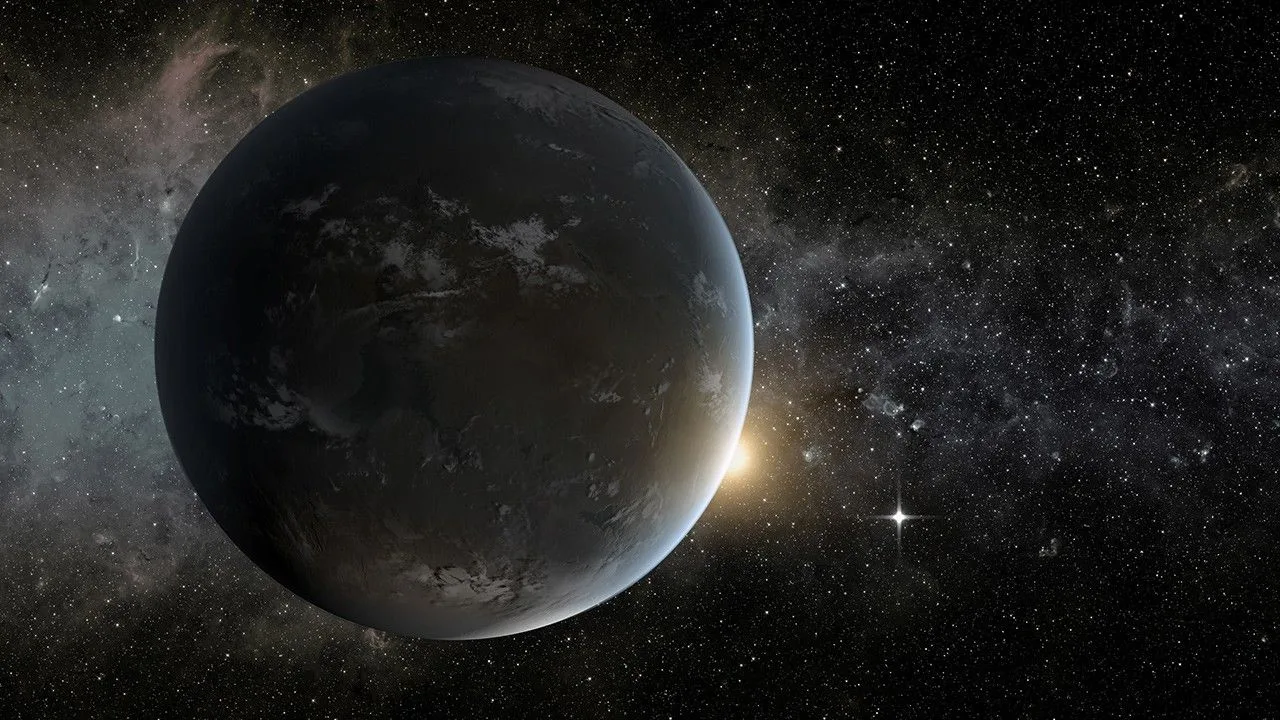
In This Article
- The World That Sits Right on the Boundary
- What Is a Super-Earth and Why Does It Matter?
- How Did Scientists Find GJ 3378 b?
- What Is the Cosmic Shoreline and Why Does It Threaten This Planet?
- What This Planet Means for the Search for Life
Imagine a planet where a year lasts only 21 days, the sky glows a deep, permanent red, and the entire world may or may not have any air at all. That is GJ 3378 b, a super-Earth exoplanet confirmed by NASA's Exoplanet Catalog in 2026 — and one of the most intriguing nearby worlds found in years. It sits 25 light-years away, inside the zone where liquid water could exist, which makes it a serious candidate in the search for life beyond Earth. But it also sits perilously close to a line scientists call the cosmic shoreline, where a planet can lose its entire atmosphere to its star's relentless radiation.
🪐 GJ 3378 b — Planet Profile
The World That Sits Right on the Boundary
GJ 3378 b orbits a star called GJ 3378, a red dwarf — a type of star that is smaller, dimmer, and cooler than our Sun. Red dwarfs are the most common type of star in the galaxy. Because they produce less heat, their habitable zone — the ring of space where temperatures are right for liquid water on a planet's surface — sits much closer to the star than ours does around the Sun.
GJ 3378 b orbits at just 0.097 AU from its star. To put that in perspective, Earth sits 1 AU from the Sun, and Mercury, our innermost planet, sits at about 0.39 AU. GJ 3378 b is ten times closer to its star than Mercury is to ours. And yet, because its star is so much cooler, that tight orbit still places it inside the liquid-water habitable zone.
The planet completes one full orbit every 21.5 days. That means a year on GJ 3378 b is shorter than a single month on Earth. Its orbit is also perfectly circular — an eccentricity of 0.0, which means the planet does not swing in close and pull away, but stays at a steady, stable distance from its star year after year. So far, the numbers paint a promising picture. But the story has a major complication, and it changes everything.
What Is a Super-Earth and Why Does It Matter?
The term "super-Earth" sounds like it means a larger, more powerful version of our planet. The reality is both simpler and more interesting. A super-Earth is any planet with a mass between roughly 1 and 10 times Earth's mass. It is not a description of the planet's surface or its conditions. It is purely a size category.
GJ 3378 b has a mass of 2.3 times Earth, which places it in the lower end of the super-Earth range. Its estimated radius is about 1.32 times Earth's. That combination, a mass only slightly more than twice ours and a radius just a third larger, points toward a planet that is likely rocky and dense, not a gassy world like Neptune.
Why does rocky composition matter? Because gas planets, no matter where they orbit, are not places life as we know it could survive. Rocky planets have surfaces. They can hold oceans, build atmospheres, and shelter chemical reactions. The more a planet's mass and radius point toward a dense, rocky structure, the more seriously scientists take it as a candidate for habitability. GJ 3378 b passes that first test. But before celebrating, it is worth understanding just how hard it was to get even these basic measurements right.
How Did Scientists Find GJ 3378 b?
No telescope can take a photograph of GJ 3378 b. At 25 light-years away, the planet is far too small and far too close to its star for any camera to resolve. Instead, scientists found it the way a doctor detects a heartbeat without seeing the heart — by measuring the effects it produces.
The method is called radial velocity. Every planet pulls on its star with gravity as it orbits. That pull causes the star to wobble very slightly — toward us and away from us in a regular rhythm. Scientists can detect that wobble by measuring tiny shifts in the color of the star's light. When the star moves toward Earth, its light shifts slightly toward blue. When it moves away, the light shifts slightly toward red. These shifts are unimaginably small, but precise enough instruments can catch them.
"The joint RV model reduces the orbital period to 21.45 days and the minimum mass to 2.3 Earth masses. The reduced mass increases the likelihood that the planet has a terrestrial composition."
— Paul Robertson et al., arXiv:2605.16499 · 2026Four of the world's most powerful spectrographs contributed data to confirm GJ 3378 b: HPF on the Hobby-Eberly Telescope at McDonald Observatory in Texas, the NEID spectrometer on the WIYN Telescope at Kitt Peak National Observatory, and the CARMENES and SPIRou spectrographs. The 2026 analysis by Paul Robertson and 20 colleagues combined all four datasets and found something surprising: the planet's mass was significantly lower than earlier estimates had suggested. The revised mass — 2.3 Earth masses instead of the previous estimate of 5.26 — made the planet not only more likely to be rocky, but also shifted where scientists believe it sits relative to a critical boundary.
What Is the Cosmic Shoreline and Why Does It Threaten This Planet?
Picture a beach where the ocean meets the land. On one side, everything is wet. On the other, everything is dry. Now imagine a similar boundary in space, where planets on one side keep their atmospheres and planets on the other side lose them.
That boundary exists, and scientists call it the cosmic shoreline. It describes a relationship between two things: how much energy a planet receives from its star, and how strong the planet's own gravity is. A planet with strong enough gravity can hold onto its atmosphere even when its star blasts it with radiation. A planet without sufficient gravity, orbiting close to an energetic star, gradually loses its air to space — stripped away particle by particle over millions of years.
GJ 3378 b sits very close to this line. The original, higher mass estimate placed the planet safely on the atmosphere-retaining side. The revised, lower mass of 2.3 Earth masses moves it much closer to the edge — and possibly onto the wrong side. That single revision transformed GJ 3378 b from a probable habitable world into one of the most important test cases in modern planet science. The question it raises is not abstract. It determines whether planets around red dwarf stars can be habitable at all — and red dwarf stars host the majority of rocky planets scientists have found so far.
What This Planet Means for the Search for Life
GJ 3378 b does not answer the question of whether life exists beyond Earth. But it sharpens the question in a way that matters enormously. Scientists now have a nearby super-Earth, close enough for future telescopes to study in detail, sitting right at the boundary between worlds that can be habitable and worlds that cannot.
The planet's proximity — 25 light-years is considered very close on cosmic scales — means it is a realistic target for atmospheric characterization with the next generation of giant telescopes. If instruments can measure the spectrum of light passing through or reflecting off GJ 3378 b's atmosphere, scientists can determine whether an atmosphere exists at all, and if so, what it is made of.
- Rocky composition likely — a mass of 2.3 Earths and an estimated radius of 1.32 Earths points strongly toward a dense, rocky world rather than a gas or water planet.
- Location is genuinely promising — the planet sits within the conservative liquid-water habitable zone of its star, with a stable, circular orbit that delivers consistent temperatures.
- Atmosphere is the defining unknown — whether GJ 3378 b still holds an atmosphere after billions of years of stellar radiation is the single question that determines whether this world matters for life.
"The shortened orbital distance remains within the conservative circumstellar liquid-water habitable zone, while the reduced mass increases the likelihood that the planet has a terrestrial composition." — Robertson et al., arXiv, 2026.
Every confirmed planet once seemed like a number in a catalog. GJ 3378 b is still that — a set of measurements, a wobble in a star's light, a name drawn from a database. But it is also 25 light-years of answered distance. Close enough that the question it raises is not theoretical: somewhere out there, on a world that circles a dim red star in just three Earth weeks, the answer to whether life requires a planet exactly like ours is already written. We are only now learning how to read it.
📄 Source & Citation
Primary Source: Robertson P, et al. (2026). A revised mass and period for the habitable zone super-Earth GJ 3378b: a planet straddling the cosmic shoreline. arXiv preprint, arXiv:2605.16499. https://arxiv.org/abs/2605.16499
NASA Catalog Entry: GJ 3378 b — NASA Science Exoplanet Catalog, confirmed June 5, 2026.
Authors & Affiliations: Paul Robertson (lead) and 20 co-authors. Instruments: HPF/Hobby-Eberly Telescope (McDonald Observatory, Texas), NEID/WIYN Telescope (Kitt Peak National Observatory), CARMENES spectrograph, and SPIRou spectrograph.
Original Discovery: Moutou C, et al. (2024). Characterising planetary systems with SPIRou: temperate sub-Neptune exoplanet orbiting the nearby fully convective star GJ 1289 and a candidate around GJ 3378. Astronomy & Astrophysics, 688: A196.
Key Themes: Super-Earth · Habitable Zone · Red Dwarf Stars · Cosmic Shoreline · Radial Velocity · Exoplanet Atmospheres
Supporting References:
[1] NASA Exoplanet Discovery Methods — overview of radial velocity and other detection techniques, science.nasa.gov.
[2] NASA Search for Life — context on habitability and what scientists look for in candidate worlds, science.nasa.gov.
[3] NASA Exoplanet Archive — full parameter tables and confirmation status for GJ 3378 b and related planets, IPAC/Caltech.
No comments yet. Be the first to share your thoughts.
Leave a Comment