 Sanjay Verma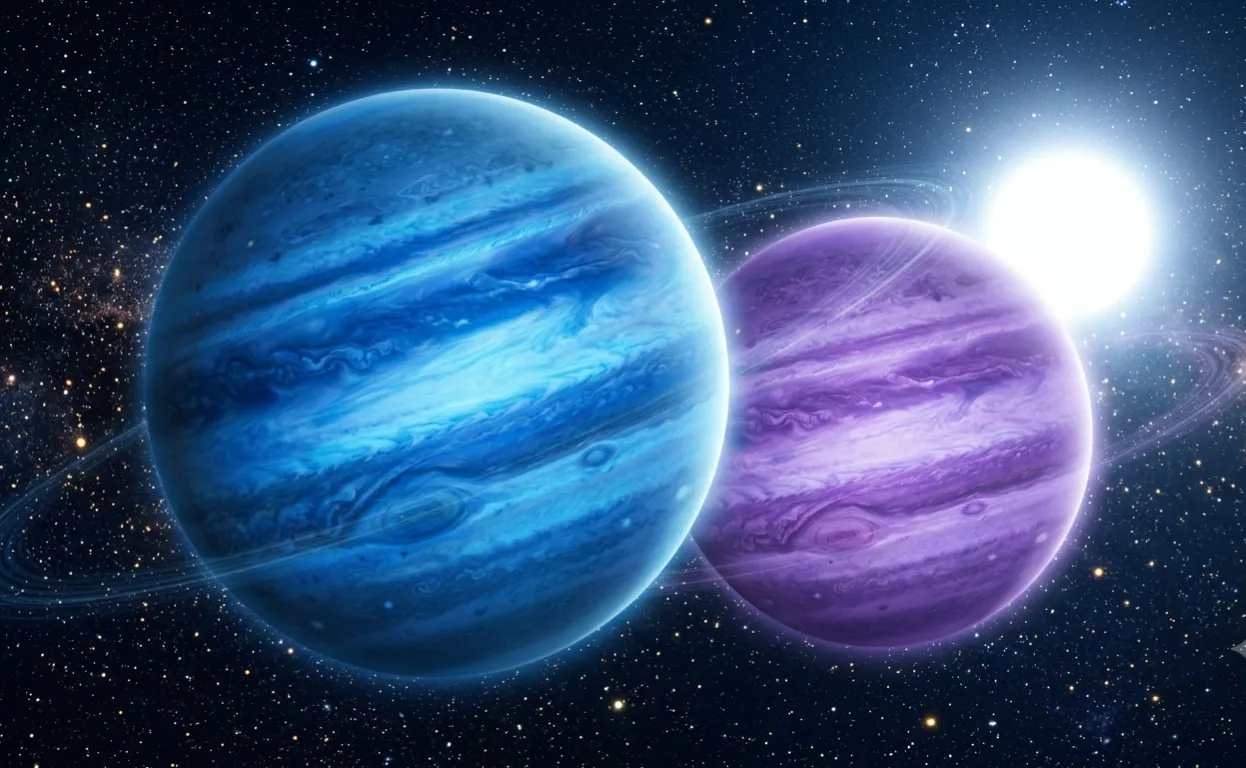
In This Article
- The Two Planets That Should Not Exist
- Why Giant Planets Are Supposed to Be Heavy
- How Did Scientists Weigh Planets 341 Light-Years Away?
- What These Ghost Planets Could Mean for Science
- The Questions That Still Need Answering
Imagine a planet the size of Jupiter, but so light that a cup of its material would weigh less than a grape. That is not science fiction. A team of astronomers just confirmed two such super-puff planets orbiting the same star, and the discovery, published in Monthly Notices of the Royal Astronomical Society, is forcing scientists to ask some uncomfortable questions about how planets are made.
The Two Planets That Should Not Exist
The star in question is called TOI-791, an ordinary-looking sun located about 341 light-years from Earth. On paper, nothing about it looks special. But it is hiding two planets, named TOI-791 b and TOI-791 c, that have left astronomers genuinely puzzled.
Both planets are roughly the size of Jupiter, the largest planet in our solar system. Planet b is just slightly smaller than Jupiter, and planet c is actually a bit bigger. But when scientists measured how heavy they are, the numbers came back shockingly low. Planet b weighs about 9.5 times the mass of Earth. Planet c weighs about 18.6 Earth masses. For comparison, Jupiter weighs 318 times Earth's mass. These planets are enormous in size but almost empty inside.
These planets are not just unusual. They are now officially among the least dense giant planets ever measured anywhere in the universe. And the fact that two of them ended up orbiting the same star is almost impossibly rare. But the mystery does not stop at how light they are.
Why Giant Planets Are Supposed to Be Heavy
Giant planets are supposed to form in one of two ways. In the most widely accepted model, known as core accretion, a solid rocky core builds up first, then pulls in huge amounts of gas from the cloud of material around the young star. This process should produce a planet with a dense core surrounded by a thick, heavy atmosphere. The end result should be something with real weight to it.
The other idea, called gravitational instability, suggests that chunks of the gas cloud collapse directly into a planet. But computer simulations have repeatedly shown that this process struggles to form planets in the size range where TOI-791 b and c sit. Neither theory comfortably explains a Jupiter-sized planet that is lighter than foam.
There are also only eight known star systems in the entire universe that contain more than one giant transiting planet. TOI-791 is now the ninth. Among that small group, every single pair of giant planets shows gravitational tug-of-war behaviour with each other, which strongly hints that this kind of interaction might actually be necessary for large planets to stay stable when they share a tight neighbourhood. The plot thickens when you ask how anyone managed to weigh them at all.
How Did Scientists Weigh Planets 341 Light-Years Away?
You cannot put a distant planet on a scale. But nature provides a clever workaround. Because TOI-791 b and c orbit close enough to each other, their gravity slightly tugs on one another as they travel around their star. This causes each planet to arrive at the front of its star a little early sometimes, and a little late at other times, compared to a perfectly regular clock. Scientists call these small shifts transit timing variations, or TTVs.
For TOI-791, these wobbles in timing reach up to 50 minutes. By carefully measuring how big the shifts are and how they change over time, the team was able to work backwards and calculate the mass of each planet with real precision. The answer came back surprisingly low every time they tried it, even when they tested the method using different assumptions. The low masses are not a measurement error. They are the real answer.
"TOI-791 b and c are two of the lowest density giant planets ever detected."
Dransfield et al., University of Oxford · MNRAS, 2026Confirming the planets also required catching them in the act of crossing in front of their star, which is harder than it sounds. Both planets take months to complete a single orbit, and each crossing in front of the star lasts more than eleven hours. Most ground-based telescopes cannot watch a single star for that long without losing sight of it as the Earth rotates. This is where a telescope at the bottom of the world came in.
The ASTEP telescope sits on the Antarctic Plateau at a French-Italian research station called Concordia. During the Antarctic winter, the sun never sets, which means ASTEP can watch the same star for days without interruption. It successfully captured multiple complete crossings of both planets, including transits lasting over eleven hours, making them the longest planetary transits ever recorded in full from any ground-based telescope on Earth.
What These Ghost Planets Could Mean for Science
Scientists currently have two competing ideas for why super-puff planets look the way they do. The first says these planets have massive, puffed-up hydrogen and helium atmospheres that account for more than one-fifth of their total mass. To build such thick gas layers, a planet would need to form far out from its star, where temperatures are cold enough for huge amounts of gas to be captured and held. This would mean TOI-791 b and c formed far away and then slowly drifted inward to where we see them today.
The second idea is stranger. It suggests these planets are actually normal in density, but they appear large because they are surrounded by thick rings of dust and ice, viewed almost face-on from Earth. Think of Saturn's rings, but so wide and thick that they make the planet look far bigger than it really is. The challenge with this explanation for TOI-791 is that it would require both planets to have similar ring systems, which seems like a lot to ask of coincidence.
What makes TOI-791 especially exciting for future science is that the James Webb Space Telescope could potentially see through the atmospheres of both planets as they cross in front of their star. The light that filters through carries a chemical fingerprint. By reading that fingerprint, scientists could detect which gases are present and in what amounts. The ratio of carbon to oxygen in particular, for example, could reveal where in the early solar disc each planet originally formed, acting almost like a geological record written in chemistry rather than rock. [INTERNAL LINK: What is transmission spectroscopy and how does JWST use it?]
The Questions That Still Need Answering
The researchers are careful to acknowledge that the story is not complete. The current series of timing measurements only captures part of what is called the "chopping" signal, a short-term wobble caused by the two planets repeatedly passing close to each other in their orbits. The deeper, long-period gravitational signal that would nail down the full orbital history of the system takes roughly 88 years to complete one full cycle. No one will be measuring that anytime soon.
The age of the star also matters enormously. A similar system called Kepler-51, which hosts three known super-puff planets, is thought to be relatively young. Young planets are still contracting and cooling, so they can legitimately be larger and less dense than their older, more settled counterparts. If TOI-791 turns out to be a young system, the low densities become more explainable. If the star is old, then something much stranger is going on.
- Masses are confirmed but not final — continued transit monitoring will sharpen the mass measurements over time as more timing data is collected.
- Rings versus atmosphere is still open — only space-based observations, ideally with JWST, can distinguish between a genuinely inflated atmosphere and a ring-induced illusion.
- The star's age is the missing key — measuring how old TOI-791 is will determine whether the planets are still young and contracting or truly as strange as they appear today.
"TOI-791 is a fascinating laboratory to investigate a pair of dynamically interacting, multi-transiting, low density co-natal planets, and future in-depth investigations into both planets will add new pieces to the puzzle of giant planet formation." — Dransfield et al., MNRAS, 2026.
Science has always found its most important answers not in the things that fit neatly into existing models, but in the strange ones that refuse to behave. Two nearly weightless giants, spinning in perfect rhythm around a distant star, are exactly that kind of puzzle. Whatever TOI-791 b and c turn out to be, they are already telling us that the universe builds planets in ways we have not yet imagined.
📄 Source & Citation
Primary Source: Dransfield G., Petit A. C., Triaud A. H. M. J., Guillot T., et al. (2026). ASTEP confirmation of a pair of long-period Jupiter-sized planets with extremely low densities transiting TOI-791. Monthly Notices of the Royal Astronomical Society, 549, 1–22. https://doi.org/10.1093/mnras/stag864
Authors & Affiliations: Georgina Dransfield (University of Oxford, University of Birmingham, lead author) and 50+ collaborators from institutions including Observatoire de la Côte d'Azur, MIT, NASA Ames Research Center, Université de Liège, and the Concordia Station Antarctica.
Data & Code: TESS photometry via MAST portal. TTV analysis notebooks available at github.com/acpetit/TOI-791. Follow-up photometry at ExoFOP (TIC 306472057).
Key Themes: Super-puff planets · Transit timing variations · Warm Jupiters · Mean-motion resonance · Giant planet formation
Supporting References:
[1] Masuda K. et al. (2024). A fourth planet in the Kepler-51 system revealed by transit timing variations. Astronomical Journal, 168, 294.
[2] Lithwick Y., Xie J., Wu Y. (2012). Extracting planet mass and eccentricity from TTV data. Astrophysical Journal, 761, 122.
[3] Trifonov T. et al. (2023). TOI-2525 b and c: a pair of massive warm giant planets. Astronomical Journal, 165, 179.
No comments yet. Be the first to share your thoughts.
Leave a Comment