

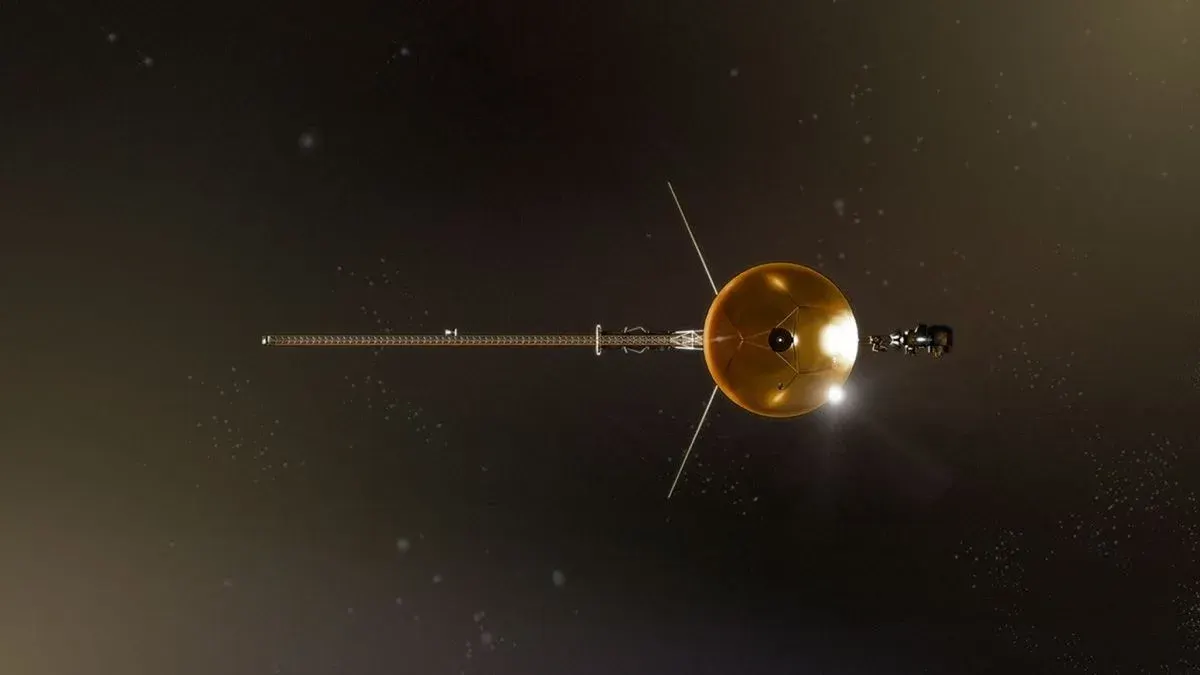
NASA's Voyager 1 spacecraft is about to reach a big milestone. On Wednesday, 18 November 2026, it will be one light-day away from Earth. That means even light, the fastest thing in the universe, needs a full day to travel from us to the spacecraft.
No other human-made object has ever gone this far. To mark the moment, NASA is inviting people around the world to send Voyager a "signal" of their own, and to watch a special live event.
What Is Happening
Voyager 1 was launched in 1977, almost 50 years ago. Since then, it has never stopped moving away from us. On 18 November, it will be more than 16 billion miles from Earth. That is about 25.9 billion kilometres.
How far is that, really? Light could go around Earth more than seven times in one second. Yet it still needs 24 hours to reach Voyager 1. So when engineers send a command, they must wait a day for it to arrive, and another day for the answer to come back.
How You Can Join In
NASA calls the first event "Shine Bright for Voyager's Light-Day." It takes place on Tuesday, 17 November, after sunset wherever you live. The idea is to create a wave of golden light that moves around the planet as night falls.
NASA has made a special website, go.nasa.gov/shinebright. Open it on a phone or tablet, and the screen will flash "VGR" in Morse code. VGR is Voyager's call sign, a short name used for radio contact. Morse code is an old way of sending letters as short and long flashes or beeps.
NASA asks people to take a photo or video of their light signal. You can then share it on social media and tag @NASA.
The second event is a live talk on Thursday, 19 November, at 12 p.m. EST. In India, that is 10:30 p.m. on the same day. It will be held at NASA's Jet Propulsion Laboratory (JPL) in California and shown online at nasa.gov/live.
Five speakers will take part, including project manager Suzanne Dodd and NASA science leader Nicky Fox. They will explain how the two Voyagers are doing and what they are finding. They will also talk about how hard it is to run such old spacecraft so far away. Viewers will also get a sneak peek of a new Voyager film, planned for 2027.
Why It Matters
Voyager 1 and its twin, Voyager 2, were built to visit the giant outer planets. They used a rare lineup of the planets that happens only once every 176 years. This let them swing from one planet to the next.
Voyager 1 flew past Jupiter in 1979 and Saturn in 1980, sending back close-up pictures of both planets and their moons. Voyager 2 went on to Uranus and Neptune. It is still the only spacecraft to have visited those two planets.
Later, both spacecraft left the heliosphere. This is a giant bubble around our solar system, made by the stream of particles blowing out from the Sun. Voyager 1 crossed into interstellar space, the space between the stars, in 2012. Voyager 2 followed in 2018.
Today, they are the only working spacecraft sending back measurements from outside that bubble. Every new reading tells scientists something about a place no other spacecraft has explored.
What Comes Next
Voyager 1 is still moving away from us, so the gap will keep growing after 18 November. NASA's Deep Space Network, a set of giant radio dishes on Earth, keeps in touch with both spacecraft.
Keeping them going is not easy. The spacecraft are old, and their power is limited. Next year, in 2027, the mission will turn 50. NASA plans to mark it with the new documentary on its NASA+ streaming service.
📄 Source & Citation
Primary Source: Dodson, G. Q. (2026). NASA Invites Media, Public to Join Voyager 1 One-Light Day Activities. NASA News Release M26-086. https://www.nasa.gov/news-release/nasa-invites-media-public-to-join-voyager-1-one-light-day-activities/
Authors & Affiliations: Voyager is built and operated by NASA's Jet Propulsion Laboratory, managed by Caltech, and funded by NASA's Heliophysics Division.
Original Reporting: NASA Headquarters, via NASA Science, Voyager mission page.
Key Themes: Voyager 1 · Interstellar space · Public events
Comments
No comments yet. Be the first to share your thoughts.
Leave a comment