

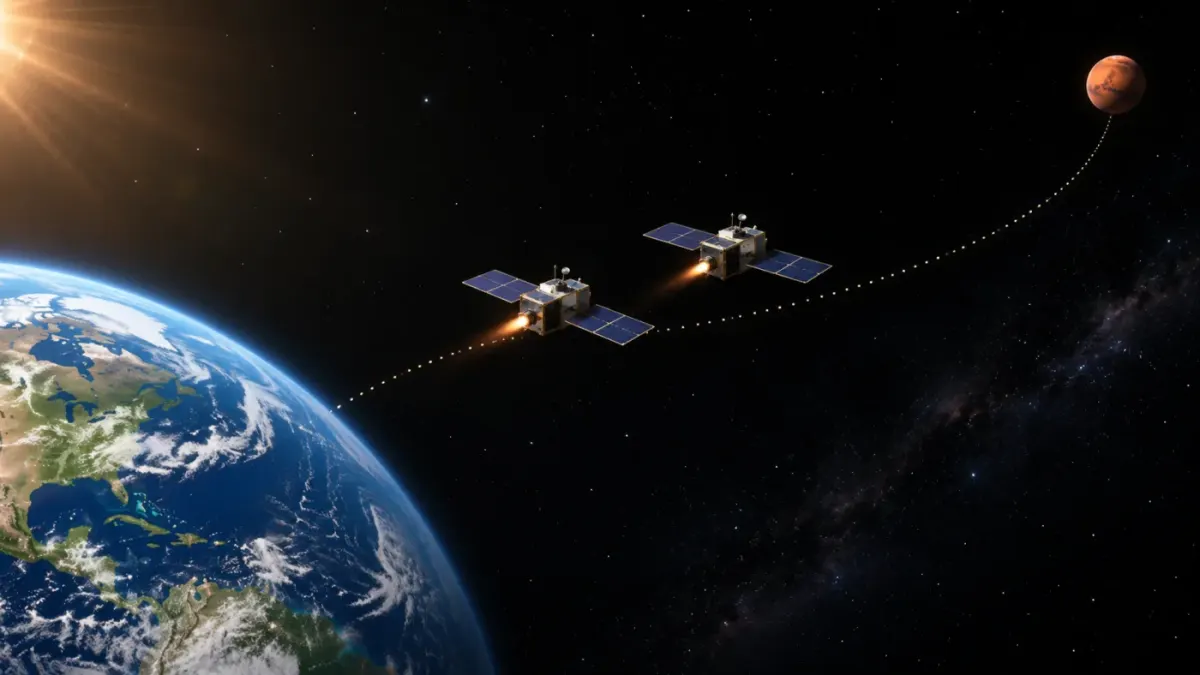
Two small NASA spacecraft have just swung past Earth and fired their engines to head for Mars. The twin probes belong to a mission called ESCAPADE, and they are now on a 10-month trip to the Red Planet.
What makes this special is the route. Instead of flying straight to Mars, the spacecraft waited near Earth for a whole year. Then they came back and used Earth itself to speed up. NASA has never sent a spacecraft to Mars this way before.
What Happened
ESCAPADE is short for Escape and Plasma Acceleration and Dynamics Explorers. Its two spacecraft are identical, and the team calls them Blue and Gold. Each one made a powered Earth flyby. That means it swung close past Earth to borrow speed from its gravity, while also firing its own engine.
The first spacecraft flew closest to Earth at about 5 a.m. EST on 7 November 2026 (3:30 p.m. in India). It passed about 1,000 miles (1,600 km) above the ground. The second followed two days later, on 9 November, at about 650 miles (1,050 km) up.
Each engine burn lasted about 9 minutes. That push, plus the boost from Earth's gravity, put both spacecraft on course for Mars.
How the Trip Works
The spacecraft launched on 13 November 2025 from Cape Canaveral in Florida, on Blue Origin's New Glenn rocket. But Earth and Mars were on opposite sides of the Sun at the time. That is a bad moment to start a trip to Mars.
So the twins first went to a waiting spot about a million miles (1.6 million km) from Earth. There they looped around a point in space called L2. This year, when Earth and Mars lined up better, they came back to Earth for the flyby.
Normally, missions to Mars must launch in a short window that comes only about once every two years. This new plan means a mission could launch almost anytime and then wait for the right moment. The route was designed by a company called Advanced Space.
Why It Matters
Mars once had thicker air and water on its surface. Today its air is very thin. Scientists think the solar wind is part of the reason. The solar wind is a stream of tiny charged particles that blows out from the Sun at about a million miles per hour.
Earth has a strong magnetic field that acts like a shield against this wind. Mars does not have one around the whole planet. So the solar wind can slowly strip gas away from the top of its air, and ESCAPADE will measure how this happens.
“This is the first time NASA has used a powered Earth flyby to propel a spacecraft toward Mars.”
— Asal Naseri, NASA HeadquartersHaving two spacecraft is the clever part. One spacecraft can only measure one place at a time. With two, scientists can see how conditions around Mars change from place to place and moment to moment. Rob Lillis of the University of California, Berkeley, leads the mission's science. He says it will be the first science mission to fly two orbiters together around Mars.
This helps with future human trips too. Space weather, the changing conditions caused by the Sun, can harm astronauts and machines. Learning how it behaves at Mars will help keep future explorers safe.
What Comes Next
The spacecraft will fire their engines again on 7 and 9 September 2027 to slow down and enter orbit around Mars. Each of these burns should last about 11 minutes.
Science work is planned to begin in June 2028. At first, the twins will follow each other along the same path around Mars. About six months later, one will move higher up to watch the solar wind coming in. The other will stay closer to Mars to see how the planet reacts, for a five-month campaign.
The trip to Mars is long, and a lot can still happen on the way. But for now, both spacecraft are on track.
📄 Source & Citation
Primary Source: Thomas, V. (2026). NASA's ESCAPADE Completes Powered Earth Flybys, Now En Route to Mars. NASA Science. https://science.nasa.gov/science-research/heliophysics/nasas-escapade-completes-powered-earth-flybys-now-en-route-to-mars/
Authors & Affiliations: Mission led by the University of California, Berkeley's Space Sciences Laboratory (principal investigator Rob Lillis), with Rocket Lab, NASA Goddard Space Flight Center, Embry-Riddle Aeronautical University, Advanced Space and Blue Origin.
Original Reporting: NASA, via NASA Science, ESCAPADE mission page.
Key Themes: Mars exploration · Solar wind · Space weather
Comments
No comments yet. Be the first to share your thoughts.
Leave a comment