 Sanjay Verma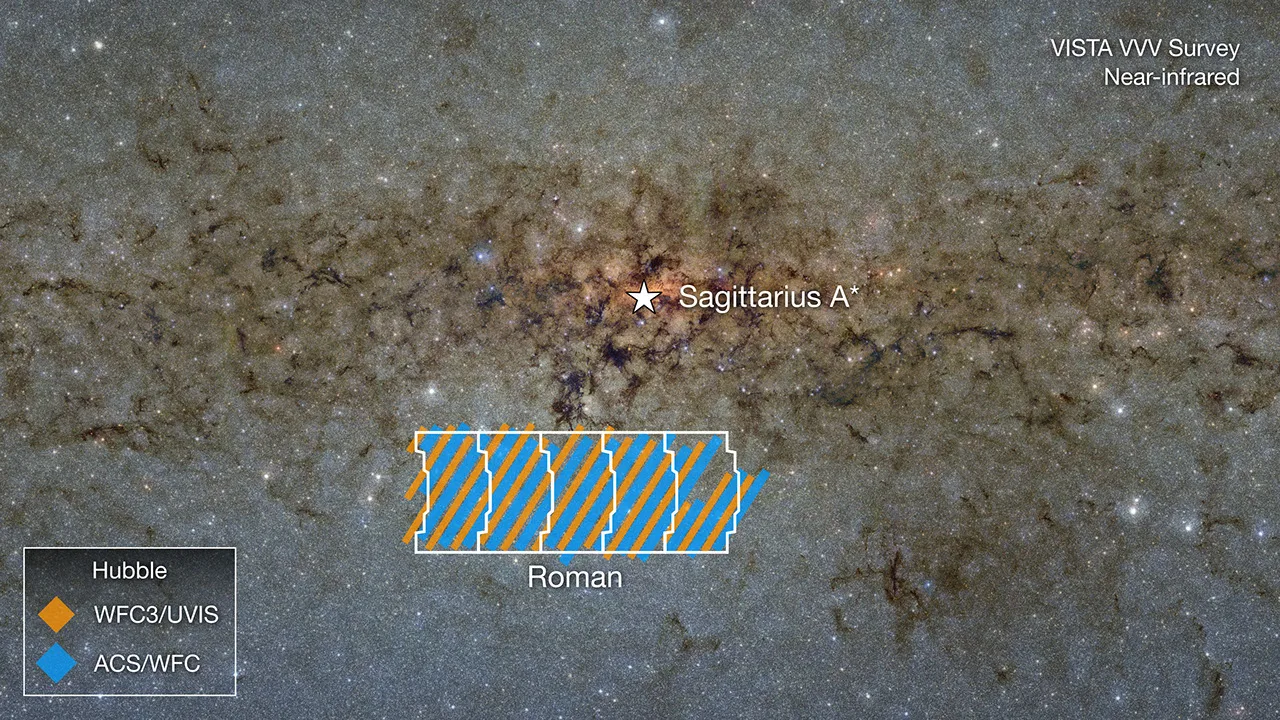
In This Article
- What Is the Roman Space Telescope?
- Why the Milky Way's Center Is So Hard to Photograph
- How Will Roman Find Hidden New Planets?
- What Hubble's Early Photos Add to the Hunt
- What Comes Next for Roman
NASA is getting ready to send a new eye into space. The Roman Space Telescope is set to launch as soon as September 2026. Its first big job is to stare deep into the busy, crowded heart of our Milky Way galaxy. The goal is to find thousands of new planets that nobody has ever seen before. To help it, the older Hubble Space Telescope has already taken pictures of the same patch of sky, so scientists will know what every star looked like before Roman even gets there.
What Is the Roman Space Telescope?
The full name is the Nancy Grace Roman Space Telescope. It is named after the woman who helped make the Hubble telescope possible. Roman is being built at NASA's Goddard Space Flight Center. It has a mirror about the same size as Hubble's, but it can take in a much wider view of the sky in one shot. That means Roman can photograph a piece of space about a hundred times bigger than Hubble can with one click of the camera. It is built to look at faraway things very fast, again and again.
Why the Milky Way's Center Is So Hard to Photograph
The middle of our galaxy is one of the hardest places to study from Earth. Huge clouds of dust block the view, and millions of stars sit so close together that they blur into one bright smear. From here, the bulge looks like a fuzzy patch in the sky. To pick out one planet around one star in that crowd, a telescope needs sharp eyes, a wide view, and a lot of time. Roman is built exactly for this. Older telescopes could only peek at small bits of it. Roman will sweep across the area in big, careful passes for months at a time.
How Will Roman Find Hidden New Planets?
Roman will use a clever trick called microlensing. Here is how it works in simple words. Sometimes a star drifts in front of another star that sits far behind it. The closer star's gravity acts like a tiny lens. It bends and brightens the light from the far star for a short time. If the closer star has a planet, the planet adds a small extra bump to that brightness pattern. By watching that bump, scientists can tell a planet is there even though they cannot see it directly. Roman will take a snapshot of millions of stars every 12 minutes. If a bump shows up, Roman will catch it.
"The great thing about microlensing is that we'll be able to do a complete census of objects as small as Mars that are moving between us and these fields in the bulge, no matter what it is."
— Jay Anderson, Space Telescope Science Institute · Astrophysical Journal, 2026What Hubble's Early Photos Add to the Hunt
This is where the Hubble Space Telescope steps in. Before Roman ever opens its eyes, Hubble has already photographed the same patch of sky. Sharp Hubble pictures show every star one by one in the messy crowd. When Roman later spots a microlensing bump, scientists can go back to those old Hubble photos and see exactly which star moved in front of which. That changes a guess into a real answer. They can even work out how heavy each star is, instead of just a rough ratio. The big Hubble survey of this area started in spring 2025 and covers more sky than any other Hubble project before it.
What Comes Next for Roman
The launch is the next big step. After Roman reaches space, it will take a few months to set up and start work. Then come six watch seasons of 72 days each, when the telescope will keep its eye on the same crowded patch of sky and take a snapshot every 12 minutes. By the end, Roman could have the deepest, sharpest map of the middle of our galaxy ever made. Some of the planets it finds will be tiny, cold, and far from any sun. Others might be in places where life has a chance. Either way, the way people see our home galaxy is about to change in a big way.
- Roman launches soon — NASA is aiming for as early as September 2026, with the Milky Way's busy core as the first big target.
- Microlensing is the key trick — Roman will catch tiny brightness bumps caused when stars and planets line up with stars behind them.
- Hubble has set the stage — Old Hubble photos of the same sky patch will help scientists turn Roman's flashes into real planet discoveries.
"This Hubble survey will build a catalog of 20 to 30 million point sources. But, by the end of the Galactic Bulge Time-Domain Survey, Roman may measure about 200 to 300 million, and it will produce some of the deepest images ever taken of any part of the sky." — Sean Terry, Astrophysical Journal, 2026.
📄 Source & Citation
Primary Source: Terry, S. et al. (2026). A Hubble Space Telescope survey of the Roman Galactic Bulge Time-Domain Survey field. The Astrophysical Journal Letters. https://doi.org/10.3847/2041-8213/ae53e8
Authors & Affiliations: Sean Terry (University of Maryland, College Park & NASA Goddard Space Flight Center), Jay Anderson (Space Telescope Science Institute, Baltimore), and the NASA Roman/Hubble survey team.
Data & Code: All Hubble survey images are publicly available in the Mikulski Archive for Space Telescopes (MAST) at https://archive.stsci.edu/about-mast.
Key Themes: Roman Space Telescope · Galactic Bulge · Microlensing · Exoplanet Census · Hubble Survey
Supporting References:
[1] Penny, M. T. et al. (2019). Predictions of the WFIRST microlensing survey I: Bound planet detection rates. The Astrophysical Journal Supplement Series, 241(1):3.
[2] NASA Roman Mission Team (2026). Hubble survey sets up Roman's future look near Milky Way's center. NASA Science.
[3] Spergel, D. et al. (2015). Wide-Field InfrarRed Survey Telescope (WFIRST) final report. arXiv:1503.03757.
No comments yet. Be the first to share your thoughts.
Leave a Comment