 Sanjay Verma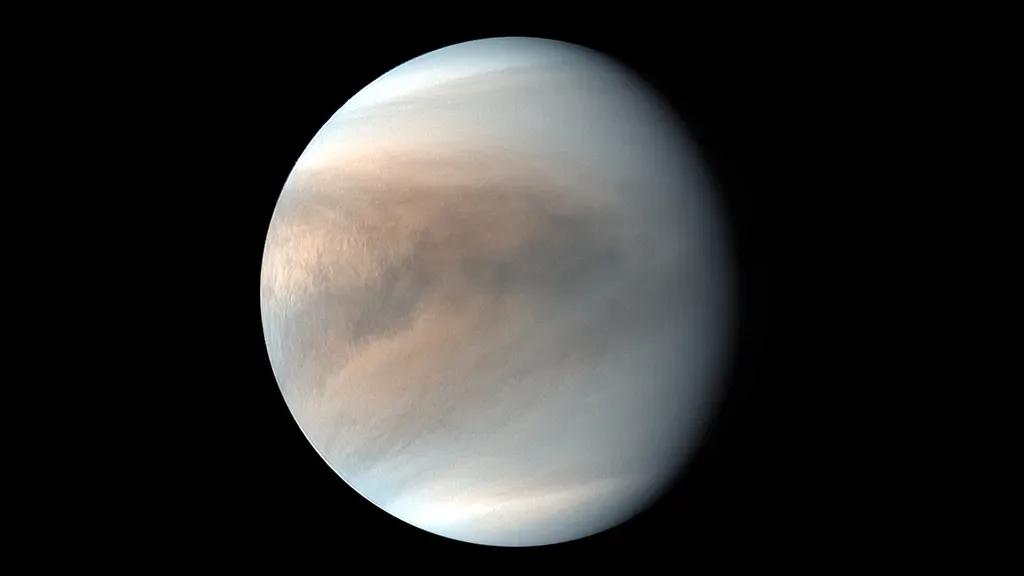
In This Article
- The Giant Cloud Wall on Venus
- What a "Shock in the Sky" Really Means
- How Does One Big Wave Make a Cloud Wall?
- Why the Wall Helps Power Venus's Crazy Winds
- What Scientists Want to Check Next
Venus is wrapped in thick clouds made of sulfuric acid. For more than 40 years, photos of the planet have shown a strange thing: a giant wall of clouds that runs in a sharp straight line, about 6000 km long. On one side it is dark and thick. On the other side, much thinner. Now a team of scientists has finally worked out what makes it. The Venus clouds are hiding the biggest atmospheric shock ever found anywhere in our solar system.
The Giant Cloud Wall on Venus
Japan's spacecraft Akatsuki has been watching Venus since 2016. Its camera saw the cloud wall on a flight in August 2016 and again many times after that. The wall stretches across the middle part of the planet, from above to below the equator. It moves around Venus every 4.9 days, which is faster than the clouds around it. When old data from other missions was checked again, scientists realised the same wall had been showing up since 1983. Nobody could explain it. The wall sometimes lasts more than 100 days at a time before fading away.
What a "Shock in the Sky" Really Means
The team found that the wall is a giant "hydraulic jump." That sounds fancy, but you have seen a small one before. Turn on your kitchen tap and let the water hit the bottom of the sink. A thin, fast layer spreads out, then suddenly jumps up into a small ring of deeper water. That ring is a hydraulic jump. It happens when fast-moving water runs into slower water and has nowhere to go but up. The same thing can happen with air in the sky. On Venus, a fast layer of air smashes into a slower layer and a big wall of clouds forms right at the meeting point.
How Does One Big Wave Make a Cloud Wall?
The wall starts with a planet-wide wave in the air called a Kelvin wave. Think of it as a really long, slow ripple that wraps all the way around Venus. When this wave gets too strong and the air below it has just the right layers, the wave can no longer travel smoothly. It trips and forms a step. Right at that step, air gets pushed up by a few kilometres in about 20 minutes. As the air rises, it cools down. The sulfuric acid in the air then turns into tiny droplets and a thick cloud is born. That sharp edge is what you see in the spacecraft photos.
"The cloud front results from the largest hydraulic jump in the solar system. A planetary-scale wave becomes unstable and triggers sulfuric acid condensation along the front."
— Takeshi Imamura, University of Tokyo · JGR: Planets, 2026Why the Wall Helps Power Venus's Crazy Winds
Venus has one strange feature that has puzzled scientists for ages. The whole planet itself spins very, very slowly. One full spin takes 243 Earth days. But the clouds zoom around the planet in just 4 days. That means the clouds move 60 times faster than the ground below them. This is called superrotation, and nobody knows for sure what keeps it going. The new study shows the cloud wall pushes air westward every time it forms. Over time, that push helps speed up the clouds. So the wall is not just pretty to look at. It may be one of the engines that drives the wild winds of Venus.
What Scientists Want to Check Next
Two new missions are getting ready to take a closer look. Europe's EnVision spacecraft and NASA's VERITAS mission are both set for the 2030s. Both will have special cameras built to see through Venus's thick clouds in the same colours that Akatsuki used. If the new study is right, the cloud wall should show up again and again in the new data. Scientists also want to know if the same wall makes all the other lower clouds too, and if shocks like this happen on Mars or other planets. Venus has kept this secret for 40 years. The next big clue may be just one mission away.
- A giant cloud wall: Venus has a 6000-km wall of thick clouds that has been seen by spacecraft since 1983 and now finally has an answer.
- It is a sky shock: The wall is formed by a hydraulic jump, the same kind of jump you see in a kitchen sink, but on a planet-wide scale.
- It powers Venus's winds: Every time the wall forms, it pushes the air along and may help keep the planet's crazy fast winds going.
"This previously unrecognized coupling between clouds and atmospheric dynamics represents a fundamental process likely to operate across planetary atmospheres." — Imamura et al., JGR: Planets, 2026.
📄 Source & Citation
Primary Source: Imamura, T., Maejima, Y., Sugiyama, K.-i., Satoh, T., Peralta, J., McGouldrick, K., Horinouchi, T., & Ikeda, K. (2026). A planetary-scale hydraulic jump driving Venus' cloud front. Journal of Geophysical Research: Planets, 131, e2026JE009672. https://doi.org/10.1029/2026JE009672
Authors & Affiliations: Takeshi Imamura (University of Tokyo, Japan) with collaborators from Kobe University, Japan Aerospace Exploration Agency (JAXA), University of Seville (Spain), University of Colorado Boulder (USA), Hokkaido University, and the National Institute for Environmental Studies, Japan.
Data & Code: Akatsuki spacecraft images are available in JAXA's DARTS archive. Model data and Python code are open on Zenodo at https://doi.org/10.5281/zenodo.18207350.
Key Themes: Venus Atmosphere · Hydraulic Jump · Kelvin Wave · Superrotation · Sulfuric Acid Clouds
Supporting References:
[1] Peralta, J. et al. (2020). A long-lived sharp disruption on the lower clouds of Venus. Geophysical Research Letters, 47(11):e2020GL087221.
[2] Horinouchi, T. et al. (2020). How waves and turbulence maintain the super-rotation of Venus' atmosphere. Science, 368(6489):405–409.
[3] O'Neill, M. E. et al. (2021). Hydraulic jump dynamics above supercell thunderstorms. Science, 373(6560):1248–1251.
No comments yet. Be the first to share your thoughts.
Leave a Comment