
 Sanjay Verma
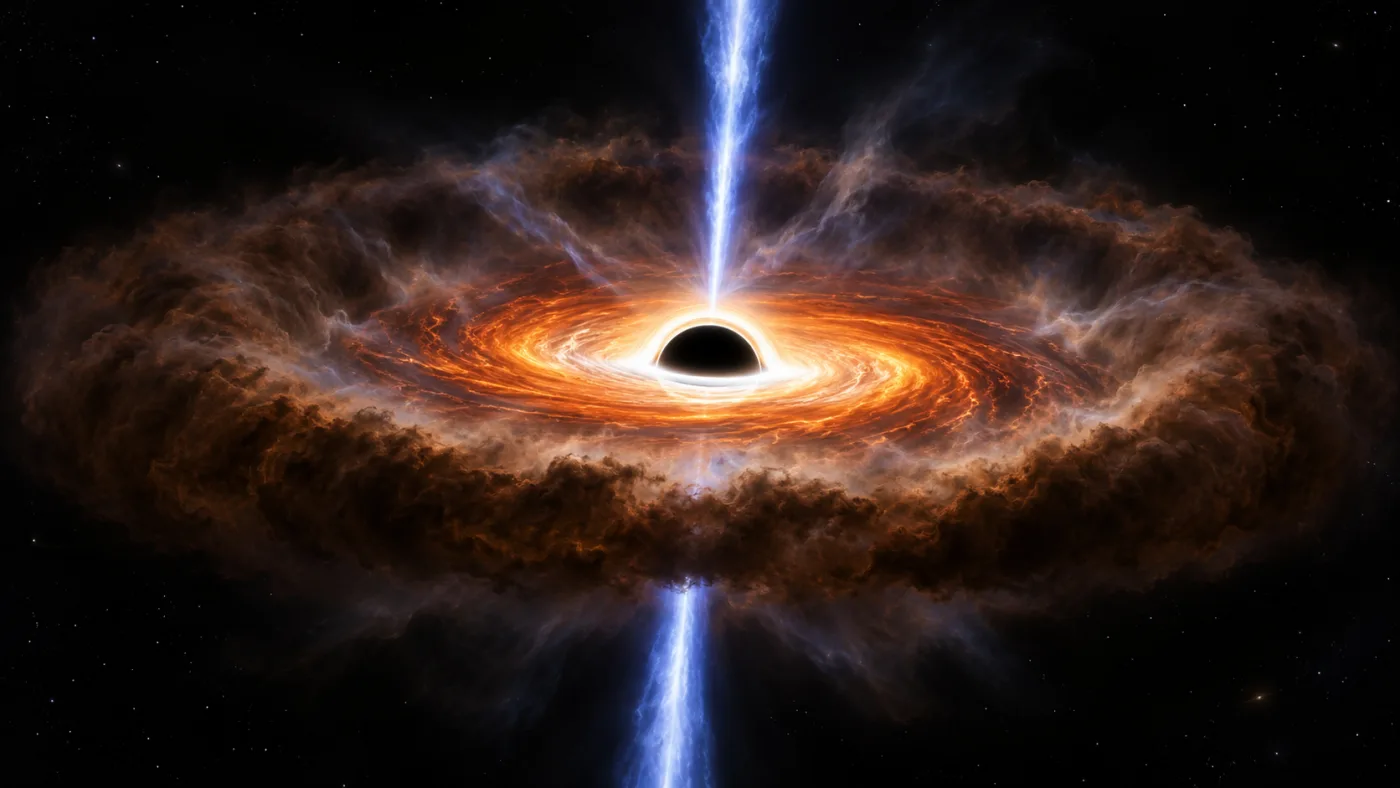
Some black holes are messy eaters. As gas falls into them, they shoot out two huge jets of tiny particles far into space. Now a scientist says these jets may slowly cut off the black hole's own food supply.
The idea comes from David Garofalo, a space scientist at Kennesaw State University in the USA. He worked out how long this would take and where it would happen. His answer: about 4 million years, and very close to the black hole.
What the Researchers Found
A black hole does not suck in everything like a vacuum cleaner. Instead, gas slowly swirls around it in a flat, spinning ring called an accretion disk. Think of water swirling around a drain before it goes down.
When lots of gas falls in, the disk gets very hot and glows brightly. When only a little gas falls in, the disk turns dim. Scientists see both kinds in radio galaxies. These are galaxies whose black hole shoots out jets that give off radio waves.
The paper looks at the most powerful radio galaxies. It says a bright one can turn into a dim one in about 4 million years, while its jets keep going. For this to happen so fast, the food supply must be controlled very close to the black hole.
How close is that? About 0.1 to 0.3 parsecs. A parsec is a distance unit astronomers use, equal to about 3.26 light-years. So the food is controlled less than one light-year from the black hole.
Four million years sounds like a long time. But these galaxies can be more than 10 billion years old. For a galaxy, 4 million years is like less than two weeks in an 80-year human life.
How They Did It
This study did not use a telescope. It is a theory paper, which means the scientist used maths and known rules of science to test an idea.
Gas in the disk does not fall straight in. It creeps inward very slowly, rubbing against the gas around it. Gas that starts farther out takes much longer to reach the black hole.
Garofalo asked a simple question. Where must the gas start so it takes about 4 million years to arrive? The maths pointed to 0.1 to 0.3 parsecs. That is where a cloud of fast-moving gas meets a thick ring of dust around the black hole.
Once the food drops below about 1% of the most the black hole can steadily eat, the disk changes quickly. It turns from a thin, bright disk into a puffy, hot and dim cloud. This last step takes 100,000 years or less.
He also checked whether the jets have enough energy to do the job. They do. Over 4 million years, a powerful jet gives out more energy than is needed to stir up the cold gas near the black hole.
Why It Matters
Scientists have long wondered why some radio galaxies have bright centres and others have dim ones, even when their jets look alike. One popular idea says the dim ones feed on thin, hot gas from far away. This paper gives another answer: the jet itself may dim the black hole.
“…the same FRII jet associated with the HERG phase also drives the transition…”
— David Garofalo, Kennesaw State UniversityIn simple words, the same jet that makes the galaxy powerful may also make its centre go dim. The idea also matches what telescopes see. Radio telescopes such as ALMA have found lots of cold gas in these galaxies.
In this idea, the gas does not need to be blown away. The jet only has to shake it up and heat it, so less of it falls in. It is like a child waving their arms at the dinner table. The food is still there, but less of it reaches their mouth.
What We Still Don't Know
This is a short paper that other scientists have not checked yet. This checking step is called peer review. The numbers are rough estimates, not exact measurements.
The maths also depends on guesses about how thick the disk is and how easily gas slides through it. Different guesses would give different answers. The paper also builds on one idea of how these galaxies change, and not every scientist agrees with it.
Still, the paper makes a prediction that can be tested. Galaxies with weaker jets should stay bright for longer. Astronomers could check this by comparing the ages of jets in bright and dim radio galaxies.
📄 Source & Citation
Primary Source: Garofalo, D. (2026). A Sub-Parsec Origin for Rapid Accretion-State Transitions in Radio-Loud AGN. arXiv preprint (Research Note), not yet peer reviewed. https://arxiv.org/abs/2611.08497
Authors & Affiliations: David Garofalo (Department of Physics, Kennesaw State University, USA), sole author.
Key Themes: Black hole jets · Accretion disks · Radio galaxy evolution
Comments
No comments yet. Be the first to share your thoughts.
Leave a comment