 Sanjay Verma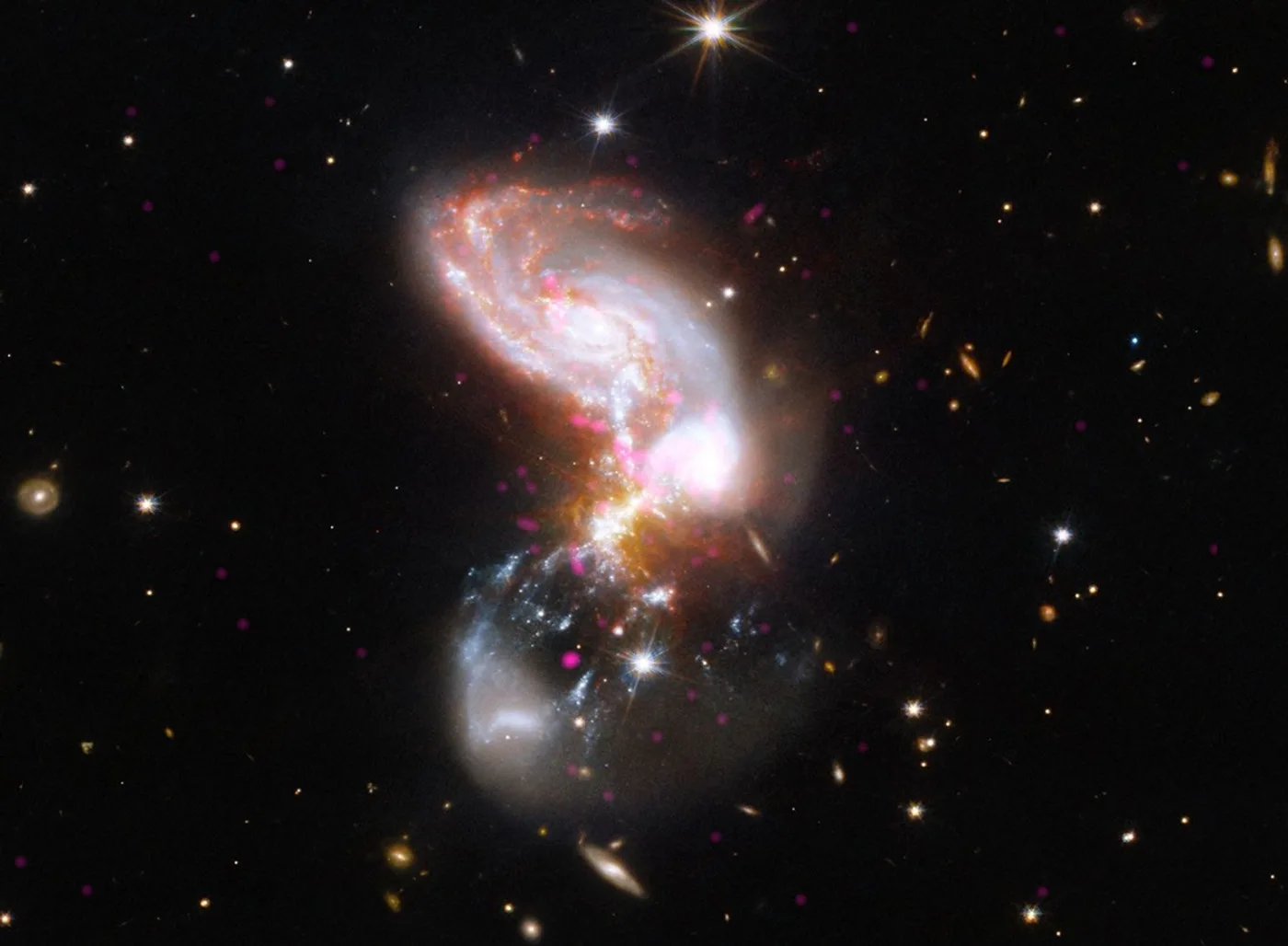
In This Article
- Two Galaxies Caught Mid-Collision
- Why Optical Light Alone Always Falls Short
- How Does Chandra See Through the Dust Hiding a Galaxy Merger?
- Why This Ancient Collision Matters for Our Own Galaxy's Future
- The Questions That Still Need Answering
Picture two galaxies slamming into each other at hundreds of kilometers per second, wrapped in so much dust that ordinary telescopes barely register the impact. That is exactly what NASA's Chandra X-ray Observatory just caught inside a system called galaxy merger target II Zw 096. By combining X-ray, optical, and infrared data, astronomers pulled back the curtain on a firestorm of star birth and black hole activity that light alone could never reveal.
Two Galaxies Caught Mid-Collision
For decades, galaxy mergers like this one looked like little more than smudges in visible light. Thick lanes of interstellar dust swallow the optical glow before it ever reaches Earth, hiding the most violent parts of the interaction from view.
II Zw 096 is a textbook case. From the ground it resembles a faint, shapeless blur roughly 500 million light-years away. Only by stacking X-ray data with sharper optical and infrared imaging does the true structure emerge: one galaxy's spiral arms twisting into the other in a shape astronomers have compared to an exploding firework. The picture is beautiful. What it hides underneath is even stranger.
Why Optical Light Alone Always Falls Short
Visible-light telescopes excel at capturing starlight from colliding galaxies, but starlight is precisely what dust blocks best. In a system as chaotic as II Zw 096, dense clouds of gas and dust wrap around the collision zone like a blanket, and ordinary cameras simply cannot see through it.
X-rays behave differently. They slice through that same dust and expose the fiercest activity underneath, including shock-heated gas and exploding stars. That is the gap the Chandra X-ray Observatory was built to close, and it is why layering X-ray, optical, and infrared views together has become the standard approach for studying collisions in progress.
How Does Chandra See Through the Dust Hiding a Galaxy Merger?
The trick is wavelength, not brightness. Chandra detects X-rays given off by gas heated to millions of degrees, radiation energetic enough to punch straight through dust clouds that block visible light. In the new image, that magenta X-ray glow marks two things: shock-heated gas from the collision, and black hole activity as a growing black hole pulls in surrounding material.
Layered underneath, Hubble Space Telescope optical data, shown in blue and white, traces the galaxies' remaining stars, while James Webb Space Telescope infrared light exposes stellar nurseries still buried in dust. No single telescope could have produced this picture alone. Each one is tuned to a different kind of light, and each reveals a piece the others cannot.
"Systems like II Zw 096 show us how powerful galaxy collisions shaped the early universe."
Source: Megan Watzke, NASA Science · 2026Why This Ancient Collision Matters for Our Own Galaxy's Future
Systems like II Zw 096 are not just cosmic curiosities. Astronomers think collisions exactly like this one were common when the universe was young, and that they built many of the large galaxies seen today, our own Milky Way included.
So what does that mean for us? The Milky Way is not standing still either. It is on a slow collision course with the nearby Andromeda Galaxy, and current estimates put that merger roughly four billion years away. Watching this collision unfold now, in exquisite multi-wavelength detail, gives astronomers something like a preview of our own galaxy's distant future.
The Questions That Still Need Answering
Not everything about II Zw 096 is settled. Astronomers are still working out how much of its black hole activity is driven by the merger itself versus processes already underway before the two galaxies met.
It is also unclear how quickly the dust hiding the interaction will clear, or what kind of galaxy will eventually emerge once the collision finishes, a process that can take hundreds of millions of years. What is clear is that every new combined image brings that eventual shape into sharper focus.
- Hidden violence exposed — X-rays reveal black hole activity and shocked gas that visible light alone cannot show.
- Multi-wavelength teamwork — Chandra, Hubble, and Webb combine to expose the full anatomy of a galaxy merger.
- A preview of home — the Milky Way and Andromeda are on their own multi-billion-year collision course.
Studying colliding systems like II Zw 096 helps astronomers piece together how galaxy mergers shaped the early universe, and offers a rough sketch of what the Milky Way's own distant future might look like. Source: Adapted from NASA/Chandra X-ray Center, 2026.
Long before there were telescopes named Chandra, Hubble, or Webb, galaxies were already finding each other in the dark and becoming something new. II Zw 096 is a reminder that collision does not always mean destruction. Sometimes it is simply how the universe grows up.
📄 Source & Citation
Primary Source: Watzke, M. (2026). Galactic Gems Glisten in New Gallery From NASA's Chandra. NASA Science. science.nasa.gov/missions/chandra/galactic-gems-glisten-in-new-gallery-from-nasas-chandra
Authors & Affiliations: Megan Watzke, Chandra X-ray Center, Smithsonian Astrophysical Observatory; NASA Marshall Space Flight Center (Chandra program management)
Data & Images: Full gallery available via science.nasa.gov/gallery and the Chandra X-ray Center photo album
Key Themes: Galaxy mergers · Chandra X-ray Observatory · black hole activity · multiwavelength astronomy · star formation
Supporting References:
[1] NASA HQ Web Team (2026). NASA's Chandra Spots Galactic Gem. NASA.gov, Sep 11, 2026.
[2] NASA Chandra X-ray Center (2026). Chandra X-ray Observatory mission overview. science.nasa.gov.
No comments yet. Be the first to share your thoughts.
Leave a Comment