

Imagine our planet with no life at all. No trees. No fish. No people. Would it still have seas? Would it still be warm? A new study of Earth without life gives a big answer. Yes.
Can scientists build an Earth on a computer? A team led by the University of Washington did just that. Their pretend Earth is a lot like ours. It kept its seas and mild weather for billions of years. But one big thing was missing. Oxygen.
Who did this?
The study came out in September 2026. It was printed in The Planetary Science Journal.
It was led by Samantha Gilbert-Janizek. She works at the University of Washington in the USA. Scientists from NASA helped too.
They wanted to answer one question. Does a planet need life to stay nice? Some people think it does. They say life works like a gardener, keeping Earth just right. This team wanted to test that.
Building a fake Earth
The team copied every part of our planet on a computer. The hot metal centre. The rocky layers. The seas. The air. But they left out one thing. Life.
Then they hit play. The pretend Earth grew old, from a baby planet to 5 billion years old.
At 4.5 billion years, they stopped and checked. That is about the age of the real Earth. They compared 19 things with the real Earth of long ago, before factories. Things like heat, the gas in the air, and the size of the seas.
The pretend Earth matched 17 of them. Two small things about sea water were a little off.
The model even followed what went on deep inside. The pretend Earth started with twice as much water as today. Over time, half of it sank into the hot rock below. That left one sea's worth on top. Just like today.
Its metal centre slowly cooled too. That kept the planet's magnetic field going. This field is like a shield around Earth.
Earth's secret heater
So how did an empty planet stay warm? It has a secret heater. It is made of volcanoes, rain and rocks.
Volcanoes give off a gas called carbon dioxide. This gas traps heat, like a blanket. Rain slowly washes it out of the air and into rocks.
Too hot? More rain falls. More gas gets washed away. The planet cools down.
Too cold? Less rain falls. The volcanoes keep puffing. On a cold night, we pull a blanket over us to stay warm. In the same way, the volcano gas acts like a thicker blanket. It keeps the planet warm.
This heater kept the pretend Earth warm for billions of years. It worked even when the young Sun was weaker than today. It is far slower than the Earth wobbles that bring ice ages.
The missing gases
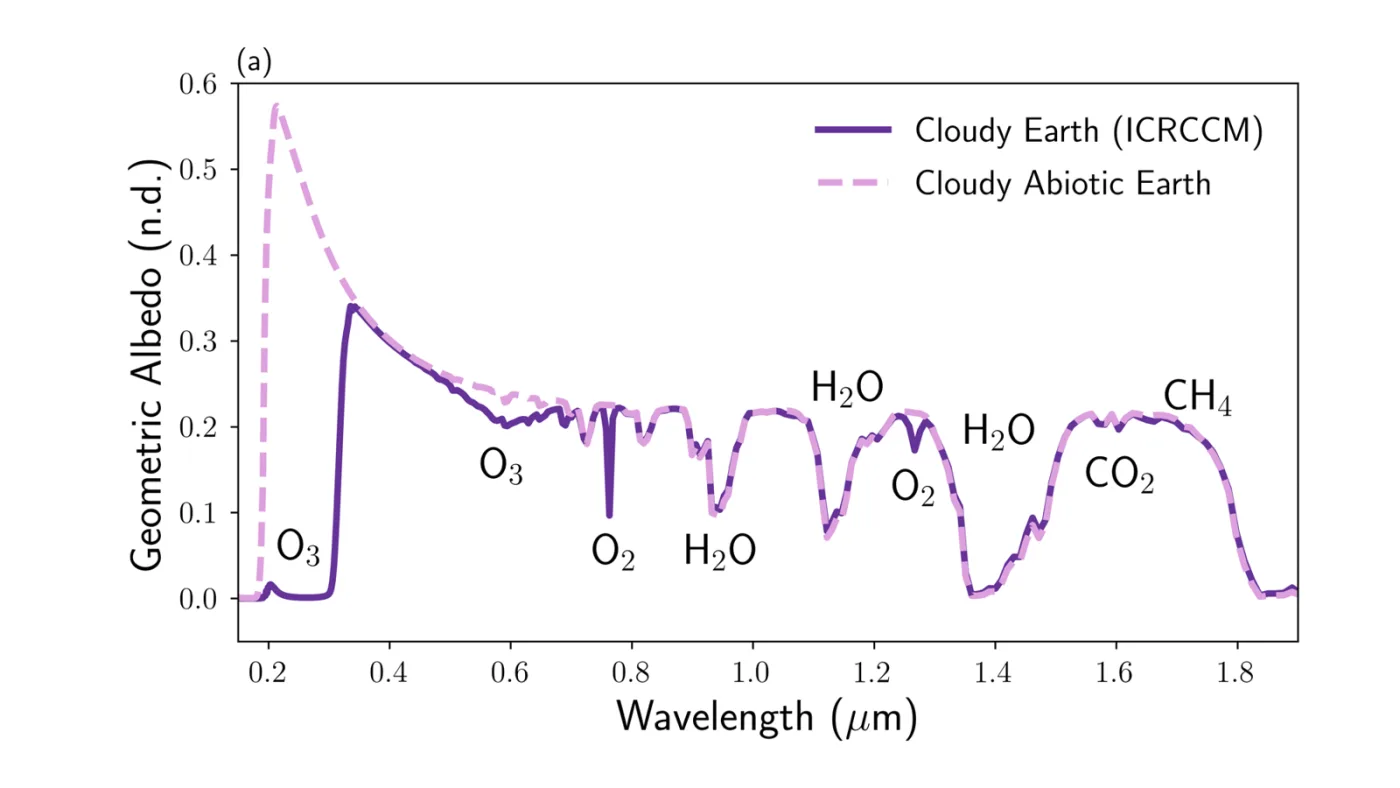
Next, the team asked a fun question. How would the pretend Earth look to a far-away telescope? They compared its light with light from the real Earth.
Both showed water. Both showed carbon dioxide. But only the real Earth showed oxygen, ozone and methane. On Earth, these gases come mostly from living things.
Why it matters
Scientists are hunting for life on planets around other stars. NASA is even planning a giant telescope to look at them in the 2040s. Some of these planets, like GJ 3378 b, might have water.
But this study gives a clear warning. Finding water is not enough. A planet can have seas and still be empty. To find life, we must look for the gases that life makes.
The model is not perfect. It has fewer clouds than the real Earth. It also leaves out methane, which warms a planet. The team plans to fix this next. They will also test planets around other stars.
One day, a telescope may spot a planet that does not match this empty Earth. That could be our first sign of life out there.
📄 Source & Citation
Primary source: Gilbert-Janizek, S., Barnes, R. K., Driscoll, P. E., Wogan, N. F., Mandell, A. M., Birky, J. L., Carone, L., & Garcia, R. (2026). A Whole-planet Model of the Earth without Life for Terrestrial Exoplanet Studies. The Planetary Science Journal, 7, 216. https://doi.org/10.3847/PSJ/ae9d79
Original reporting: University of Washington, Carnegie Institution for Science, SETI Institute, NASA Ames Research Center, NASA Goddard Space Flight Center and the Austrian Academy of Sciences, via The Planetary Science Journal.
Comments
No comments yet. Be the first to share your thoughts.
Leave a comment