

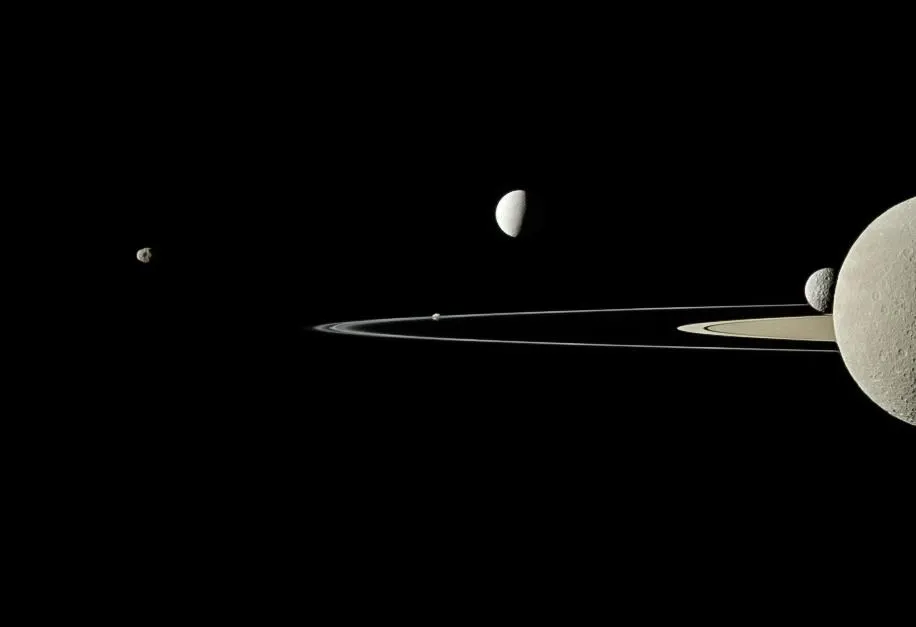
Saturn's moons are a record-breaking family. According to NASA, Saturn has 293 confirmed moons as of August 2026. No other planet comes close. If you learned the name of one moon every day, it would take you almost ten months to meet them all.
Saturn is the sixth planet from the Sun and the second biggest, after Jupiter. It is a giant ball made mostly of hydrogen and helium, the two lightest gases, wrapped in bright rings. It has no solid ground at all.
So how did we find Saturn, and how did it end up with so many moons? The story takes us from ancient skywatchers to giant modern telescopes.
Seen since ancient times
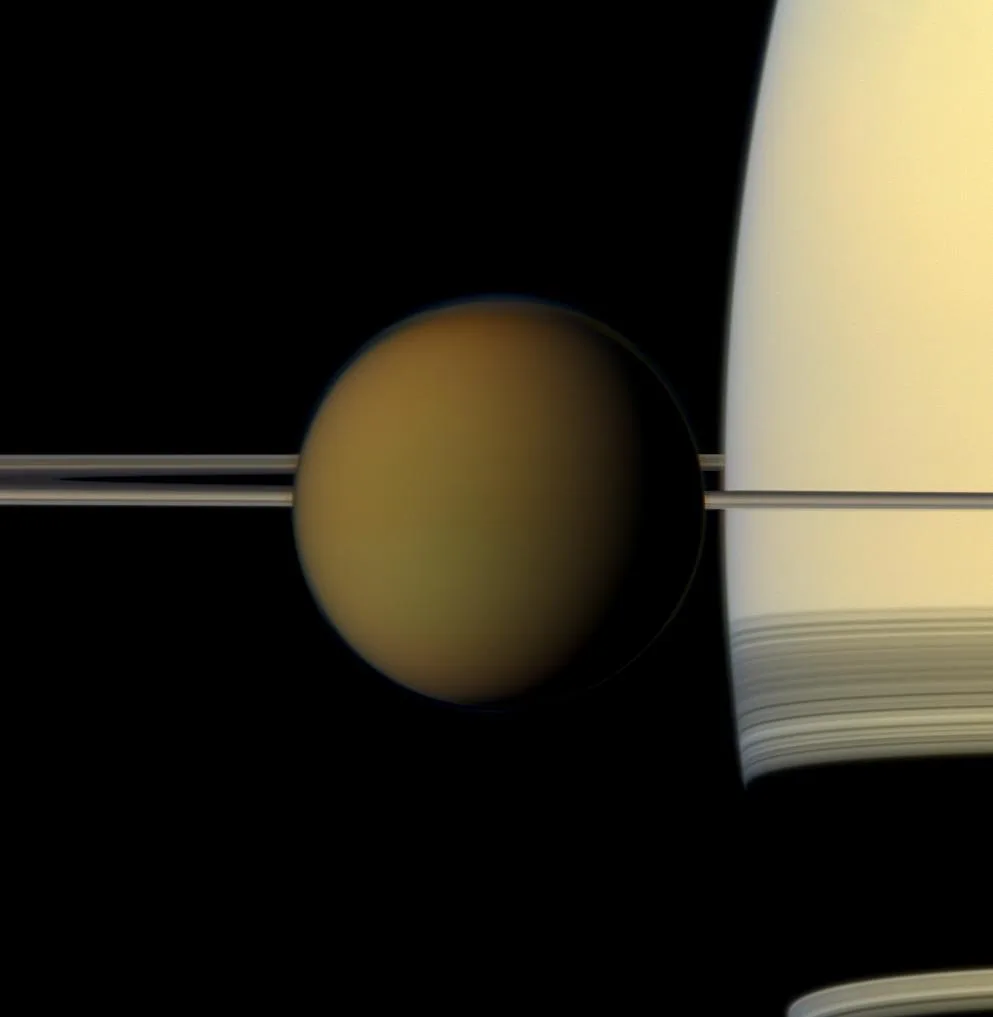
Nobody "discovered" Saturn. It is bright enough to see with just your eyes, so people have known it since ancient times. In fact, it is the farthest planet that can be seen without a telescope. The Romans named it after their god of farming and wealth.
The first close look came in 1610. The Italian scientist Galileo Galilei pointed his small, early telescope at Saturn. He saw strange bumps on each side of the planet and called them "ears." Two years later, the ears had vanished, which puzzled him greatly.
The mystery was solved by the Dutch astronomer Christiaan Huygens. With a better telescope, he worked out by 1659 that the "ears" were really a ring around Saturn. The ring had seemed to disappear because, from Earth, it was seen edge-on, like looking at a coin from the side.
The big moons and their names
In 1655, Huygens also spotted Saturn's first known moon, Titan. Over the next 250 years, astronomers found eight more large moons with telescopes. Here they are, with the year each was found and who found it:
- Titan (1655, Christiaan Huygens). The biggest, larger than the planet Mercury, with a thick haze and lakes of liquid methane.
- Iapetus (1671, Giovanni Cassini). One side is dark and the other bright, like a two-toned ball.
- Rhea (1672, Giovanni Cassini)
- Tethys and Dione (1684, Giovanni Cassini)
- Mimas and Enceladus (1789, William Herschel). Mimas has one giant crater. Enceladus sprays jets of water and hides a global ocean under its icy shell.
- Hyperion (1848, William and George Bond, and William Lassell)
- Phoebe (1898, William Pickering). It is covered in craters and was the first of Saturn's moons found using photographs.
These names come from Greek myths. In 1847, the astronomer John Herschel named the seven moons known at the time after the Titans and Giants of Greek stories. Today, new moons close to Saturn still get names from this family.
Space missions found more. NASA's Voyager spacecraft spotted the small moons Prometheus, Pandora and Atlas in 1980, close to the rings. Later, NASA's Cassini spacecraft studied the moons up close from 2004 to 2017.
Why the count keeps growing
Most of Saturn's moons are tiny, some only a few kilometres across. NASA says the smallest are about the size of a sports arena. They are so faint that only big modern telescopes can find them.
That is why the number jumps every few years. In March 2025, astronomers confirmed 128 new moons in one go, raising the total to 274. In March 2026, 11 more were announced, and by August 2026 NASA's count had reached 293.
Most of these small outer moons follow long, tilted paths, and many orbit the "wrong" way, opposite to Saturn's spin. Scientists think they are probably leftover pieces of bigger objects that Saturn's gravity captured long ago.
Naming so many moons needed a new plan. The International Astronomical Union, the group that officially names objects in space, now gives the outer moons names of giants from Norse, Gallic and Inuit stories. That is why Saturn has moons called Ymir, Tarvos and Ijiraq. Many of the tiniest ones only have codes, such as S/2004 S 13.
What happens next
Astronomers expect to find even more of Saturn's tiny moons as telescopes improve. Scientists are also keen to explore Titan and Enceladus, which NASA calls high-priority places to visit. Both may have hidden oceans that could possibly support life.
The moon king's crown is safe for now. And its family is still growing.
📄 Source & Citation
Primary source: NASA Science (2026). Saturn Moons. NASA Science, last updated 22 September 2026. https://science.nasa.gov/saturn/moons/
Original reporting: NASA Science, via NASA's Saturn overview page.
Comments
No comments yet. Be the first to share your thoughts.
Leave a comment