

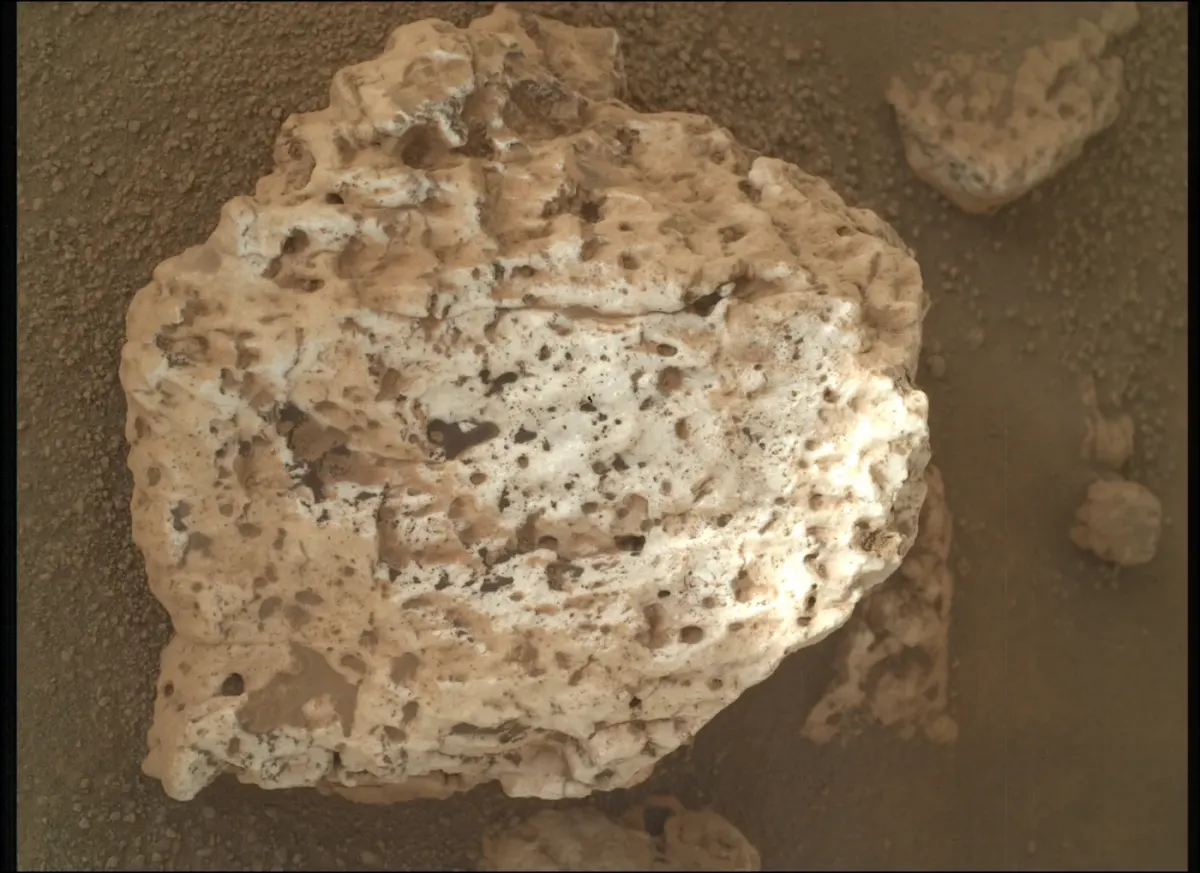
NASA's Perseverance rover has found tiny crystals of corundum, the mineral that makes rubies, in rocks on Mars. The team shared the story in a NASA blog post dated 4 November 2026. It follows a study published this year in Geophysical Research Letters. The work was led by Ann Ollila of Los Alamos National Laboratory in the USA, with scientists from several countries.
It is the first time corundum has been found on Mars. And the crystals even contain a little chromium, the same ingredient that turns corundum red and makes it a ruby.
Corundum is a very hard mineral made of aluminium and oxygen. Only diamond is harder among natural minerals. When it holds a little chromium, it becomes red ruby. With other traces mixed in, it becomes sapphire.
Before you start dreaming of a Mars jewellery shop, there is a catch. The crystals are smaller than about 0.17 millimetres, roughly the width of two human hairs. That is too small for the rover's camera to see. Roger Wiens, who leads the rover's SuperCam instrument, says the team has not found "collectable rubies" yet.
A glow that gave it away
While crossing the rim of Jezero crater, Perseverance came across several pale, loose rocks. Scientists call loose rocks like these float rocks, because they have been moved from where they formed. The three rocks, nicknamed Hampden River, Coffee Cove and Smiths Harbour, were studied in March, April and July 2025.
All three are rich in plagioclase, a common light-coloured mineral that is also found in many rocks on Earth. The team first shared the find at a science meeting in Texas in March 2026.
Perseverance carries several tools for studying rocks, including PIXL, SHERLOC and SuperCam. SuperCam shines a laser at rocks from a distance to learn what they are made of.
As a bonus, the way it works also lets it catch faint glows from the rock. When it hit these rocks, the team was startled. The rocks gave off a strong red glow at two very exact colours of light, 692.7 and 694.1 nanometres.
A nanometre is a billionth of a metre, and scientists use it to measure the colour of light. These two colours are a deep red, close to the edge of what our eyes can see.
SuperCam can also time how long the glow lasts after each laser flash. Chromium in corundum glows for a tiny moment longer than most materials. That timing confirmed the light came from chromium inside corundum.
The team knew this glow well. Before the rover left Earth, they put a real ruby in front of SuperCam's laser. The whole room lit up with a brilliant red flash. Back on Earth, scientists also compared the Mars signal with real rubies in the lab, and the two matched closely.
A puzzle for scientists
Finding corundum on Mars is a surprise. On Earth, it usually forms where tectonic plates, the giant moving pieces of Earth's outer shell, squeeze and heat rocks deep underground. Mars does not have moving plates like Earth.
There is a second puzzle. Corundum needs rock that is rich in aluminium but low in silica, the material in sand and glass. Plagioclase rocks usually have plenty of silica, so finding corundum inside them is unusual.
So how did it get there? One idea is a huge impact. When a big asteroid smashes into a planet, the heat can bake nearby rock for a long time and change it.
Perseverance is exploring some of the oldest ground in Jezero crater, where scars from such impacts are expected. The study also says hot water likely played a part at some stage, but other causes are not ruled out.
What happens next
The team now often aims this glow test at pale rocks along the crater rim. Each new find could help show how giant impacts and water changed the young Mars.
The glow method may be useful for other hunts too. Scientists hope it can spot other rare elements hidden in Mars rocks, which carry clues about how those rocks formed. Jezero crater once held a lake, which is why NASA sent Perseverance there in 2021 to look for signs of ancient life.
Mars may not be paved with gems. But it has quietly shown us its rubies, one red flash at a time.
📄 Source & Citation
Primary source: Ollila, A. M., Beyssac, O., Fau, A., et al. (2026). Corundum Discovered by SuperCam and the Perseverance Rover at Jezero Crater, Mars. Geophysical Research Letters, 53. https://doi.org/10.1029/2026GL122537
Original reporting: Roger C. Wiens (Purdue University), "Rubies on Mars?", via NASA Science.
Comments
No comments yet. Be the first to share your thoughts.
Leave a comment