

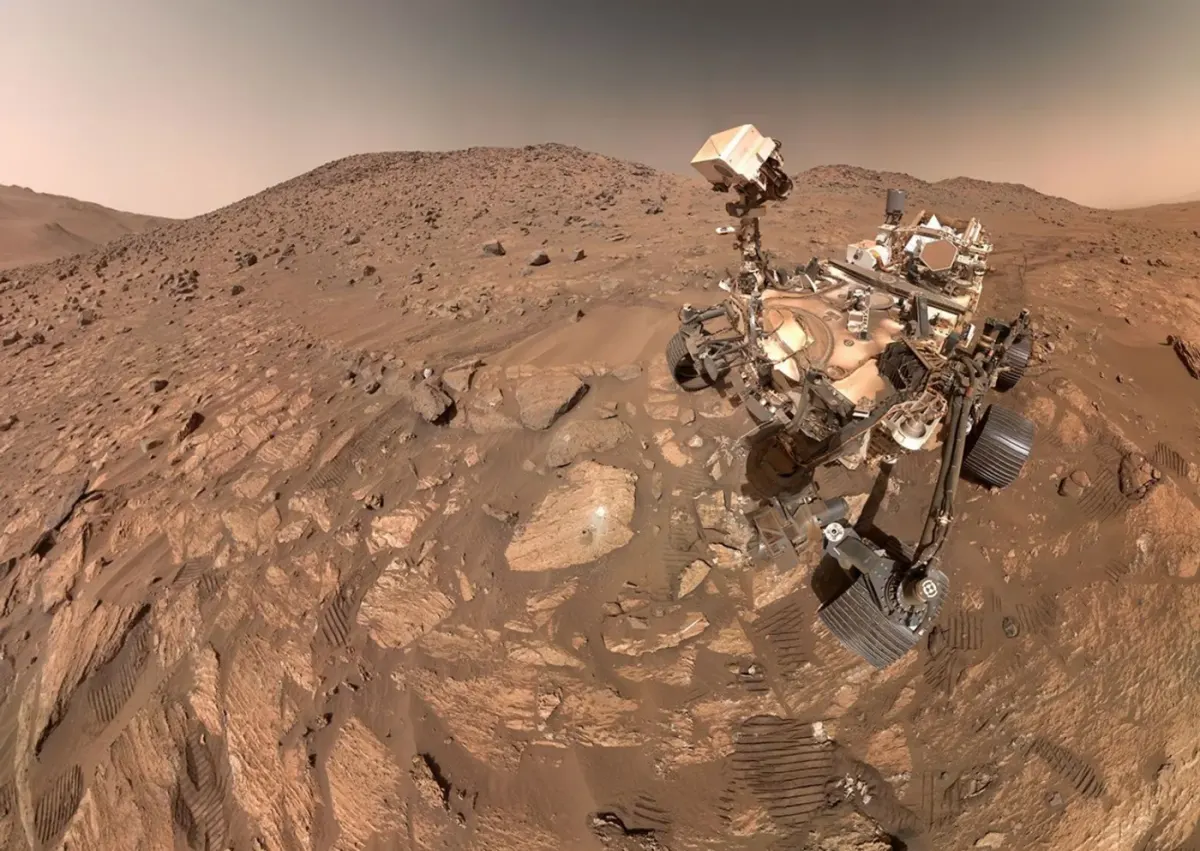
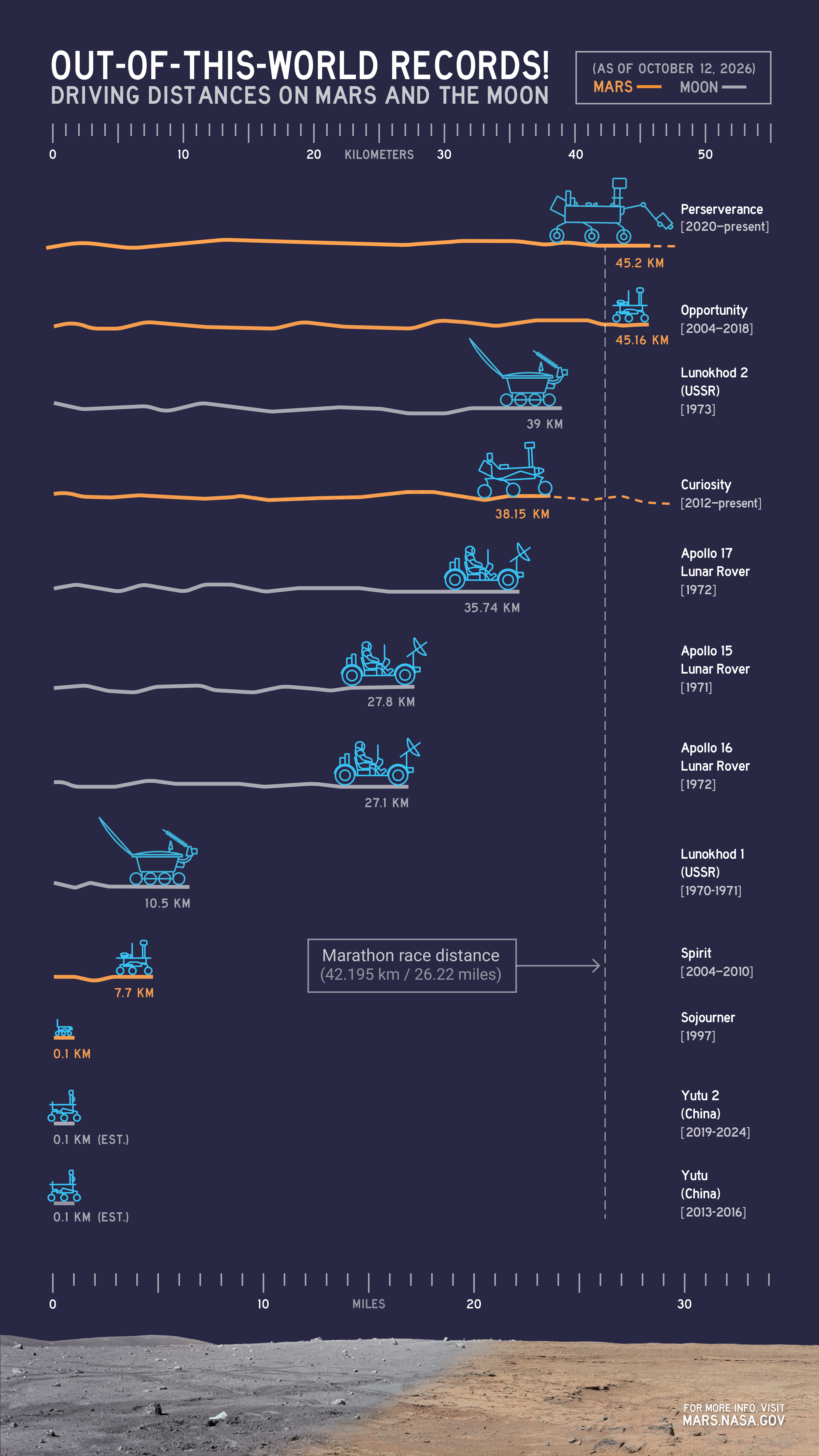
NASA's Perseverance rover has set a new record on Mars. On 11 October 2026, its odometer reached 45.22 kilometres (28.10 miles), NASA's Jet Propulsion Laboratory said. No rover or vehicle has ever driven farther on another world.
The old record belonged to NASA's Opportunity rover, which drove 45.16 km between 2004 and 2018. Opportunity needed almost 15 years to get there. Perseverance did it in about five and a half.
For comparison, 45 km is a little more than a marathon. A person could walk it in a long day. But on Mars, every metre has to be driven slowly and carefully over rocks, sand and slopes, with no mechanic for millions of kilometres.
The rover even beat the Moon. Astronauts on Apollo 17 drove their lunar buggy 35.7 km in 1972, and the Soviet Lunokhod 2 rover covered 39 km in 1973. Perseverance has now passed both.
The record fell on the rover's 2,006th day on Mars, during a 91-metre drive. For a sense of scale, the first Mars rover, Sojourner, drove about 100 metres in its whole 1997 mission. Curiosity, still working in Gale crater since 2012, has driven more than 38 km.
A rover that drives itself
The secret is a self-driving system called AutoNav. Planners on Earth pick stopping points, but the rover finds its own way between them. It takes pictures as it rolls, builds a 3D map of rocks and holes, and plans a safe path. The team calls this "thinking while driving."
Perseverance has driven more than 90% of its distance this way. The older rovers Spirit and Opportunity drove only about 5% of theirs on their own. Perseverance can cover up to 412 metres in a single sol. A sol is a day on Mars, about 40 minutes longer than a day on Earth.
The rover was not even built to drive this far. Its mission team says its health is still good, with all its driving systems working. The newest software helps it steer less and roll more, which saves time on each drive.
“The original mission called for no more than 12.4 miles of driving.”
— Steven Lee, Perseverance project manager, NASA's Jet Propulsion LaboratoryWhy it went to Jezero
Perseverance launched on 30 July 2020 and landed on 18 February 2021 in Jezero crater. The crater is 45 km wide, about the size of a large city. More than 3.5 billion years ago, rivers spilled over its wall and filled it with a lake. NASA looked at more than 60 possible landing sites before choosing it.
Places that once held water are the best spots to look for signs of ancient life. Perseverance has found evidence of an old lake, a river delta and a river channel. In 2024, it studied a rock called Cheyava Falls with clues that tiny living things might have once been there. Scientists say those clues need much more study before anyone can be sure.
A sample from that rock, called Sapphire Canyon, was described in the journal Nature in September 2025 as holding a potential biosignature. That is a possible sign of past life, but not proof. The rover has also made oxygen from the Martian air with an experiment called MOXIE. And its two microphones recorded the first sounds ever heard from the surface of Mars.
Making oxygen on Mars matters for the future. Astronauts will one day need it to breathe, and rockets need it to burn fuel for the trip home.
The rover has also collected 29 samples of rock and soil, each about the width of a fingertip. They are stored in tubes in case a future mission brings them back to Earth. It even carried a small helicopter, Ingenuity, which made 72 flights and became the first aircraft to fly on another planet.
What happens next
NASA has extended the mission from October 2026 to roughly the end of 2028. Right now, Perseverance is crossing an area called Lac de Charmes, off the crater's western rim. It is heading toward a spot called Idubi, where the team hopes to find traces of ancient hot springs.
After that, it will head south to Rainbow Falls, a 100-metre block of very old crust pushed up by the impact that made Jezero. You can follow its journey on NASA's live location map.
Every new kilometre is now a new record. And Perseverance is still rolling.
📄 Source & Citation
Primary source: NASA Jet Propulsion Laboratory (2026). NASA's Perseverance Sets Off-World Record for Total Distance Driven. NASA/JPL news release 2026-070, 12 October 2026. https://www.jpl.nasa.gov/news/nasas-perseverance-sets-off-world-record-for-total-distance-driven/
Original reporting: NASA Science, via Mars 2020: Perseverance Rover mission page.
Comments
No comments yet. Be the first to share your thoughts.
Leave a comment