

Some of the first giant black holes in the universe may be smaller than astronomers feared. A team led by Madisyn Brooks of the University of Connecticut found a hidden group of more ordinary black holes in young galaxies. The study appeared in The Astrophysical Journal in 2026 and was featured by the American Astronomical Society's AAS Nova on 10 November.
Why does that matter? The James Webb Space Telescope had spotted black holes in very young galaxies that seemed far too heavy, some about one-tenth the weight of their whole galaxy. If every early black hole was like that, our ideas about how black holes are born would be in trouble.
A supermassive black hole is a giant black hole at the centre of a galaxy. Today, these weigh from a few million to more than 10 billion times as much as the Sun. Yet they are usually about 1,000 times lighter than their galaxies.
The Webb "monsters" were seen when the universe was less than a billion years old, out of 13.8 billion today. That is like a photo of a 70-year-old taken when they were about five.
Black holes near us have had more than 13 billion years to grow, by merging, swallowing stars and gulping down gas. The Webb monsters had less than a billion. If they all started small, it is hard to see how they got so big so fast.
Finding the hidden ones
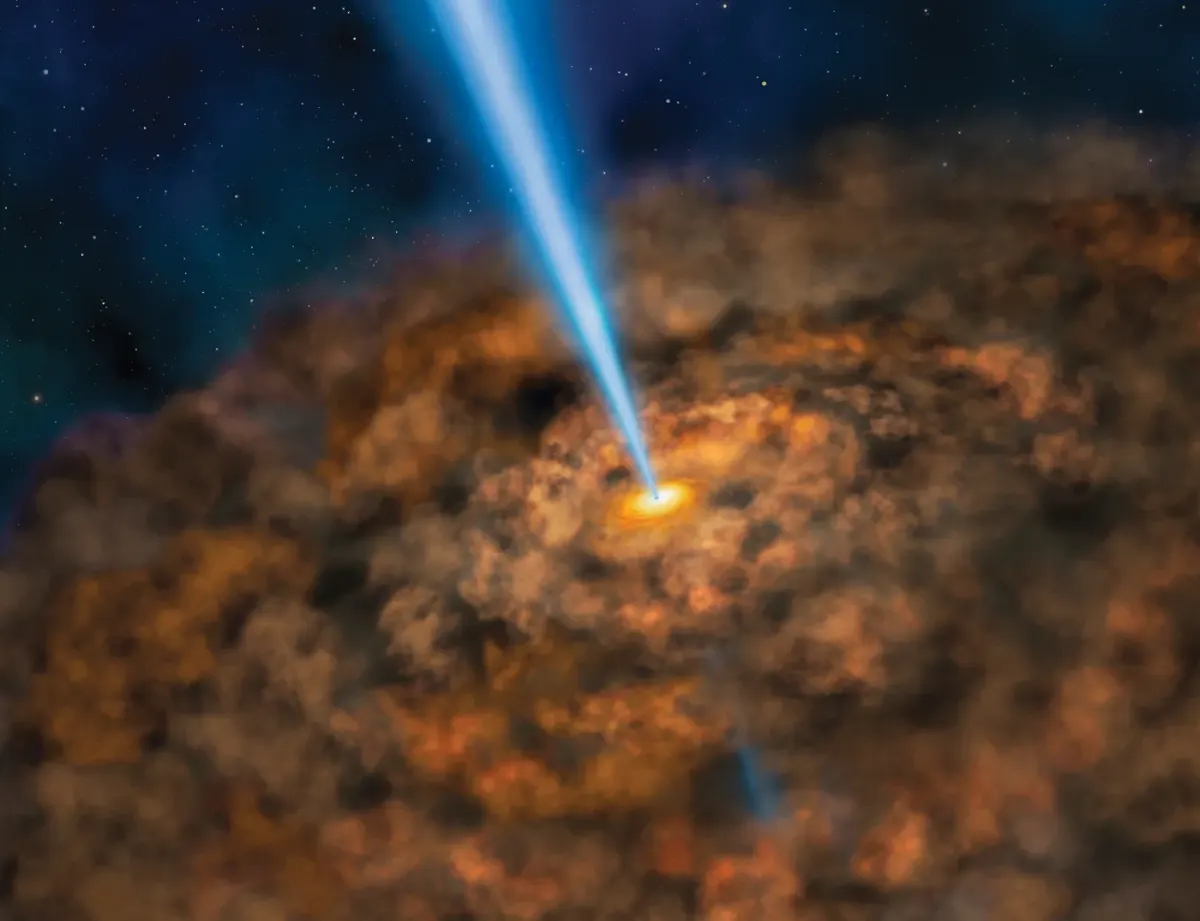
Black holes give off no light of their own. But a feeding black hole is wrapped in a hot, glowing disk of gas that lights up nearby gas clouds racing around it.
Some of those clouds move toward us and some move away. This stretches their light into a wide band called a broad emission line, a clear sign of a feeding black hole. NASA has a simple picture guide to how this works.
It is like an ambulance siren, which sounds higher as it comes toward you and lower as it drives away. Light does the same thing: clouds coming toward us look slightly bluer, and clouds moving away look slightly redder. The faster they move, the wider the band, and fast clouds mean a heavy black hole.
The problem is that smaller black holes eat less, so they glow less. Their signal can be too faint to spot in a single galaxy, so the big, bright ones are found first.
Imagine guessing the average height in a packed stadium when you can only see people tall enough to stand above the crowd. You would decide everyone is very tall. Astronomers worried the same thing was happening with early black holes.
The problem gets worse with distance. Light from faraway galaxies has travelled so long that we see them as they were long ago. Astronomers call them high-redshift galaxies, because the expanding universe stretches their light toward red. They hold the best clues about the first black holes, but they are the hardest to study.
The team picked galaxies that showed no sign of a black hole on their own. The data came from four Webb surveys: CEERS, JADES, RUBIES and GLASS. They sorted the galaxies into 16 groups by distance and brightness, then stacked each group.
In each stacked group, they looked for a wide band in a red glow from hydrogen gas, called H-alpha. If it showed up, many galaxies in that group were hiding a feeding black hole.
Smaller than expected
Five of the 16 stacked groups showed the wide band. The hidden black holes turned up more often in the most distant galaxies. That suggests many young galaxies have feeding black holes that are too faint to see one by one.
Next, the team estimated how heavy they were. The typical hidden black hole weighed roughly 160,000 to 1.3 million times as much as the Sun. Their galaxies weighed roughly 70 million to 360 million Suns.
The black holes were weighed from the width and brightness of the wide band, as in earlier studies. The galaxies were weighed with SED fitting, which compares the colours of their light with computer models to count their stars. NASA explains how light reveals what objects are made of.
Most hidden black holes were less than 1% of their galaxy's mass, about the same as one egg next to a 5-kilogram bag of rice. That may be close to what we see in galaxies near us today.
The authors suggest early black holes were not all oversized. Black holes spotted one at a time tend to be the heaviest of the bunch, and stacking ordinary galaxies gets around this. Even the typical hidden black hole was at most about 10 times heavier than the usual rule for nearby galaxies.
What happens next
The results also touch a big mystery: where do giant black holes come from? They may grow from small seed black holes, left behind when big stars die, which weigh a few to about 100 Suns. Or they may start from heavier seeds, perhaps made when a huge gas cloud collapses all at once.
The new results fit both ideas: small seeds eating at a steady, realistic pace, or heavier seeds that grew more slowly. To decide, astronomers need data on even more distant black holes, because the farthest groups gave the strongest clues.
There are limits. Stacking gives an average for a group, not for single galaxies, and the masses are estimates worked out from light. Future Webb studies reaching deeper into the past should help test the idea.
The young universe still had its monsters. It may just have had plenty of quieter neighbours too.
📄 Source & Citation
Primary source: Brooks, M., Trump, J. R., Simons, R. C., et al. (2026). Beyond the Monsters: A More Complete Census of Black Hole Activity at Cosmic Dawn. The Astrophysical Journal, 1002. https://arxiv.org/abs/2511.19609
Original reporting: Astrobites (Margaret Verrico), reposted by the American Astronomical Society, via AAS Nova.
Comments
No comments yet. Be the first to share your thoughts.
Leave a comment