

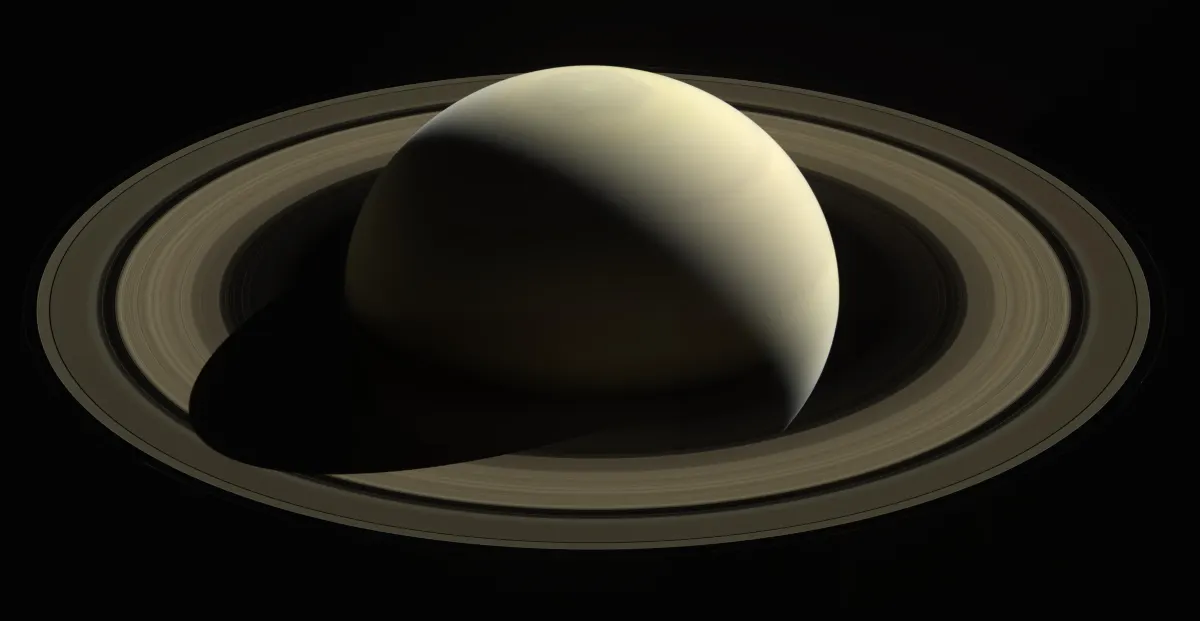
Saturn has a new puzzle. Using the Hubble Space Telescope, scientists have found a giant 10-sided wave in the air around the planet's south pole. The study, published in September 2026, is based on Hubble pictures taken in 2023. It is also a good reason to brush up on some Saturn facts.
The shape is called a decagon, which simply means a shape with 10 sides. It is the first large pattern with regular sides ever seen in Saturn's southern half. And it keeps changing over time.
Saturn already had one famous shape. Its north pole is circled by a six-sided hexagon, first seen by the Voyager spacecraft in the early 1980s. Now the south pole has its own geometry lesson.
So what kind of planet makes shapes like these? Here is a simple guide, using facts from NASA's Saturn pages.
A giant you could float
Saturn is the sixth planet from the Sun and the second biggest, after Jupiter. It is about nine times wider than Earth. NASA puts it this way: if Earth were the size of a small coin, Saturn would be about as big as a volleyball.
It is also very far away. Saturn sits about 1.4 billion km from the Sun, so sunlight takes about 80 minutes to reach it. Yet you can still see it without a telescope. It is the farthest planet that people can spot with their eyes alone, and it has been known since ancient times.
Saturn is made mostly of the two lightest gases, hydrogen and helium. It has no solid ground at all, so a spacecraft would have nowhere to land. Here is the strangest fact: Saturn is less dense than water. In a bathtub big enough to hold it, it would float.
Deep inside, the pressure is so strong that it squeezes gas into liquid. At the very centre, scientists think there is a hot, dense core of metals like iron and nickel. Saturn formed about 4.5 billion years ago, along with the rest of the solar system. It is named after the Roman god of farming and wealth.
Its day is short, about 10.7 hours. But its year is very long. One trip around the Sun takes about 29.4 Earth years, so a 10-year-old on Earth would not even be one year old on Saturn.
Saturn is also tilted, by about 26.7 degrees, a little more than Earth's 23.5 degrees. That tilt means Saturn has seasons, just like we do. Each season lasts about seven Earth years.
Rings, moons and wild weather
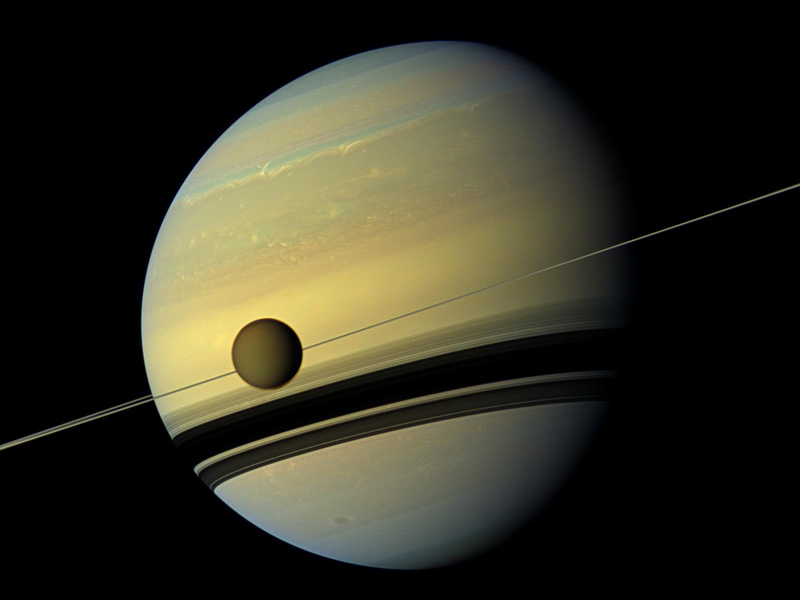
Saturn's rings are made of billions of chunks of ice and rock. Some are as small as dust, some as big as a house, and a few are as large as mountains. The rings stretch up to 282,000 km from the planet, yet the main rings are only about 10 metres thick. A wide gap called the Cassini Division, about 4,700 km across, splits the two brightest rings.
Saturn also has more moons than any other planet: 274 confirmed as of March 2025, with more waiting to be named. Titan, the biggest, is larger than the planet Mercury and has lakes of methane. Enceladus sprays jets of water and hides a global ocean under its icy shell. Scientists think these two moons could possibly support life.
The weather is wild too. Winds near Saturn's equator can blow at 500 metres per second. That is about 1,800 km/h, roughly four and a half times faster than Earth's strongest hurricane winds. The north pole hexagon alone is about 30,000 km across, more than twice as wide as Earth.
What happens next
Four spacecraft have visited Saturn. Pioneer 11 came first in 1979, then Voyager 1 and 2 in 1980 and 1981. The last was Cassini, which orbited it from 2004 until 2017. Today, telescopes like Hubble keep watch from afar, which is how the new 10-sided wave was found.
Scientists still want to know how these giant shapes form and why they change. Saturn's aurorae, its northern and southern lights, are not fully understood either. They glow inside a huge magnetic bubble, made by a magnetic field about 578 times stronger than Earth's. Some are powered by particles thrown out by its moons and by the planet's fast spin.
Saturn has been watched for thousands of years. It still has new tricks to show us.
📄 Source & Citation
Primary source: NASA Science (2026). Saturn Facts. NASA Science, last updated 2026. https://science.nasa.gov/saturn/facts/
Original reporting: NASA Science, via NASA's Saturn overview page.
Comments
No comments yet. Be the first to share your thoughts.
Leave a comment