

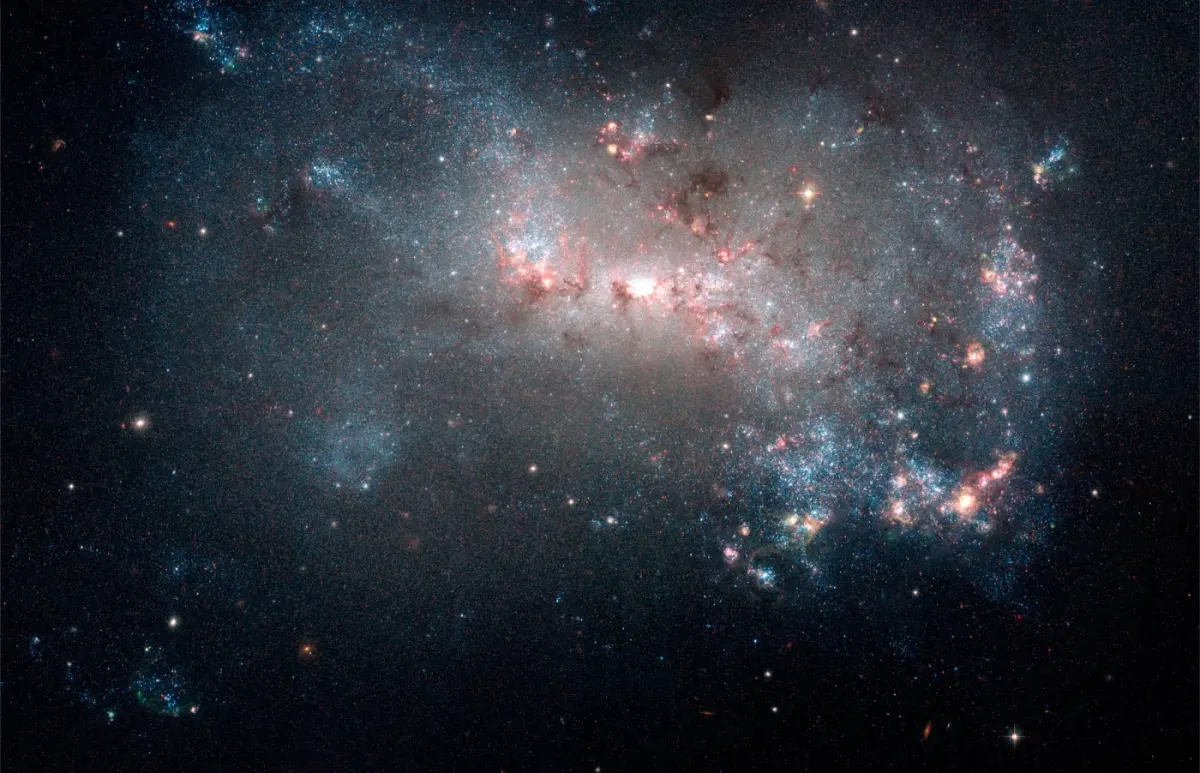
Don't judge a galaxy by its size. That is the message of NASA's Astronomy Picture of the Day for 11 November 2026, which shows the dwarf galaxy NGC 4449. This small galaxy is busy making stars, and it seems to be losing a surprising amount of oxygen into space.
The picture comes with fresh news. A study published in early November in The Astrophysical Journal looked at 37 nearby dwarf galaxies, including NGC 4449. It found that these little galaxies hold on to only a small part of the oxygen their stars make.
A dwarf galaxy is a small galaxy with far fewer stars than our own. Our Milky Way is about 100,000 light-years across and holds hundreds of billions of stars. Dwarf galaxies are about one-tenth that size, with only a few billion stars. Yet they are the most common kind of galaxy in the universe.
A small galaxy on fire
NGC 4449 lies about 12 million light-years away, in the northern constellation Canes Venatici, the Hunting Dogs. Its light left the galaxy 12 million years ago, long before the first humans walked on Earth. The astronomer William Herschel first spotted it on 27 April 1788.
In the Hubble Space Telescope picture, the galaxy looks like a messy bow tie. Pink clouds of glowing hydrogen gas mark places where new stars are being born. Bright blue-white clusters of young, heavy stars are scattered all around, with dark lanes of dust in between.
NGC 4449 is a starburst galaxy, which means it is making stars much faster than normal for its size. Most starburst galaxies make stars mainly in their centres, but NGC 4449 is lit up with young stars all over. Astronomers think run-ins with neighbouring galaxies, and possibly a smaller galaxy it swallowed, set off this burst. At less than 20,000 light-years across, it is often compared with the Large Magellanic Cloud, a small galaxy that circles our Milky Way.
At this pace, its star-making gas would run out in about a billion years. Scientists also think it looks a lot like the small, busy galaxies of the early universe.
Where did the oxygen go?

Stars work like factories. Deep inside, they turn light elements into heavier ones, such as oxygen. When big stars die, they explode as supernovae and throw that oxygen into space. Computer models predict that much of it should stay inside the galaxy, ready to build new stars and planets.
But in the 37 dwarf galaxies, much of the expected oxygen was missing. The team works on a project called Galaxies Losing Oxygen via Winds, or GLOW.
They think the oxygen was blown out of the galaxies altogether by galactic winds. These are powerful flows of gas pushed outward by massive stars and exploding supernovae. These winds start with stellar winds, streams of gas flowing off single massive stars, and get stronger when stars explode.
“You need energy from massive stars and supernova explosions to drive material out of the host galaxies.”
— Grace Telford, University of UtahWhy are dwarf galaxies so bad at holding on? They have little mass, so their gravity is weak. It is like trying to hold sand in an open hand on a windy day. Big galaxies have their own ways of pushing gas around, such as the powerful jets from their central black holes.
These winds seem to work even better than models predict. So tiny galaxies may play a big role in spreading oxygen and other heavy elements across the universe. Some of that material could one day end up in new stars and planets far away.
To track the missing oxygen, the team used old Hubble pictures sharp enough to show single stars in each galaxy. They added data from NASA's retired Spitzer Space Telescope and from radio telescopes.
What happens next
The study was led by Kristen Wingfield McQuinn of Rutgers University, working with Grace Telford of the University of Utah. McQuinn plans to use NASA's upcoming Nancy Grace Roman Space Telescope to find even fainter and smaller galaxies. She will then study their stars more closely with Hubble and the James Webb Space Telescope.
Telford plans to use Hubble to study single massive stars in small galaxies, including some from the GLOW list. Those stars could show exactly how the winds get their push.
Small galaxies are easy to overlook next to giant spirals. But as NGC 4449 shows, the little ones may be quietly scattering the raw materials of stars and planets across space.
📄 Source & Citation
Primary source: McQuinn, K. B. W., Telford, O. G., et al. (2026). GLOW study of oxygen loss in nearby dwarf galaxies. The Astrophysical Journal. https://doi.org/10.3847/1538-4357/ae93a6
Original reporting: NASA Astronomy Picture of the Day (11 November 2026) and NASA Hubble news, via NASA Science.
Comments
No comments yet. Be the first to share your thoughts.
Leave a comment