

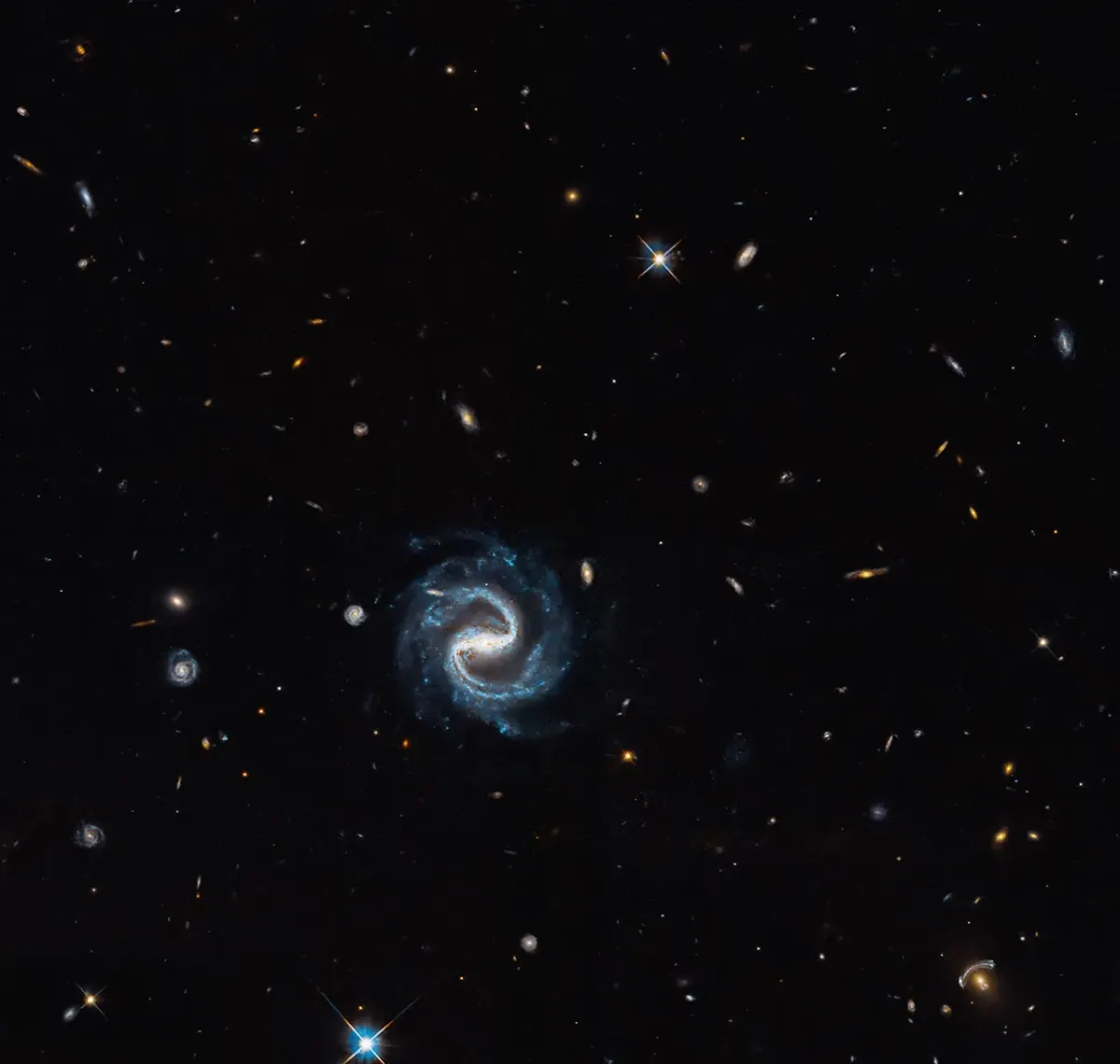
A natural magnifying glass in space
A galaxy can act like a giant magnifying glass. Its gravity can bend light from a galaxy behind it. The result can be bright arcs, rings or repeated images.
NASA shared a new gallery of these sights on 12 November 2026. The images came from the Hubble Space Telescope. Some of these cosmic lenses will receive follow-up observations from NASA’s Nancy Grace Roman Space Telescope.
This is more than a gallery of beautiful galaxy shapes. These bent rays of light can help astronomers measure invisible matter.
How gravity bends distant light
This effect is called gravitational lensing. Albert Einstein predicted it through his theory of gravity.
Imagine looking at a distant lamp through a glass marble. The marble bends the light and changes its shape. In space, a massive galaxy can do something similar.
When a distant galaxy lines up with a closer one, its light bends around the nearer galaxy. The background galaxy may then appear stretched into arcs. Sometimes, it can appear several times.
The foreground galaxy acts as the lens. Its gravity bends the light. The amount of bending helps scientists estimate its mass. This includes dark matter, which cannot be seen directly.
Different lenses tell different stories
NASA’s gallery shows several kinds of gravitational lenses. Each one has its own shape.
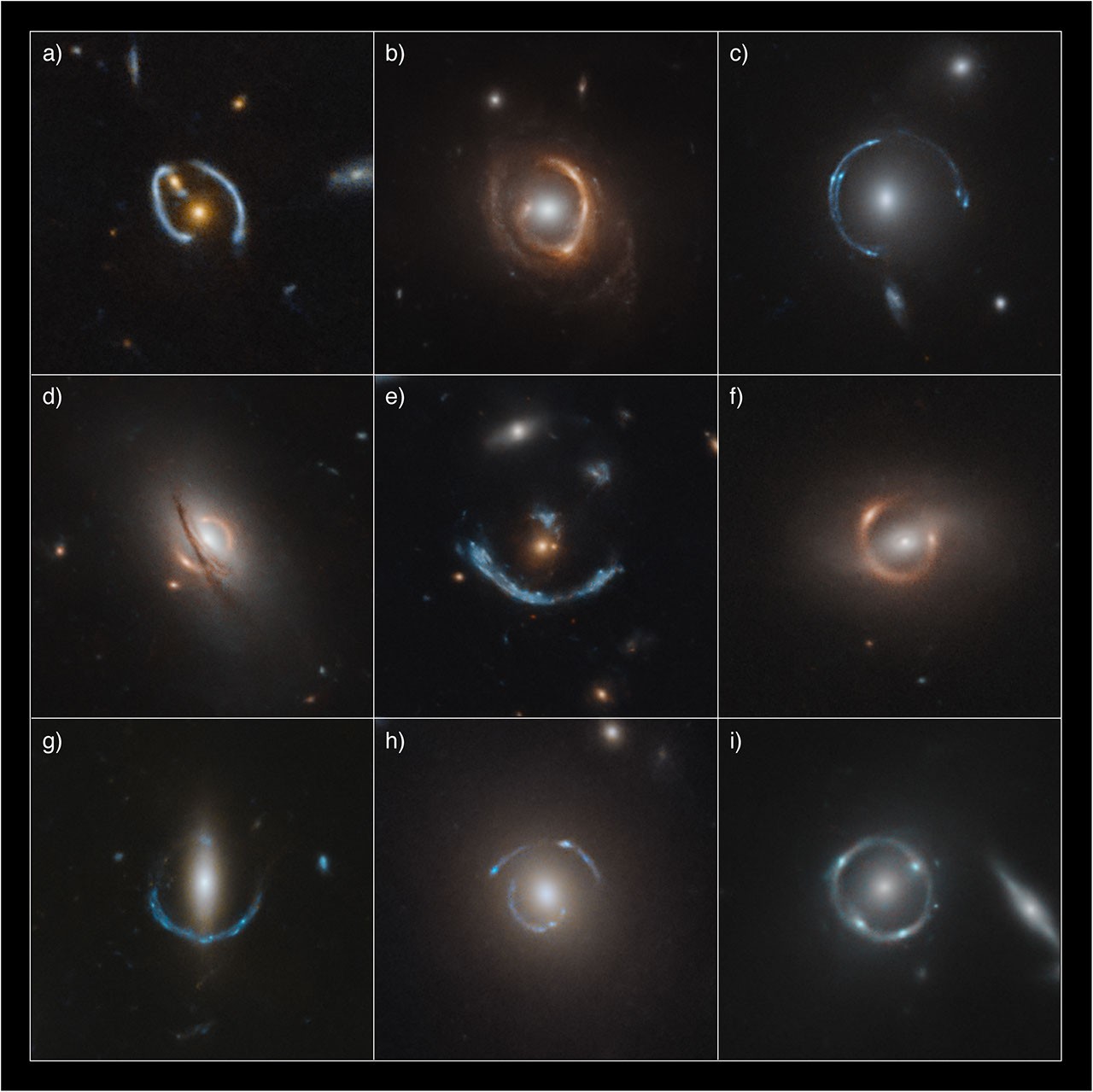
Panel A shows a pair of arcs. They come from one background galaxy. Two foreground galaxies bend its light together.
Panel F shows an Einstein ring. Here, the background galaxy almost surrounds the foreground galaxy. This happens when the alignment is especially close.
Panel I shows a background galaxy appearing four times. Panel C also shows four images. Its bright knots may be strong star-forming regions.
Another lens, in panel D, has a visible dust lane. This feature is rare in a lensing galaxy. Hubble’s sharp visible-light view reveals it.
The colours also carry clues. NASA says blue arcs point to young stars. Red arcs point to older stars. These details may help scientists study how galaxies changed over time.
Hubble and Roman will work together
Hubble and Roman will study these lenses in different ways.
Hubble mainly sees visible and ultraviolet light. It also has some infrared coverage. Its sharp view helps scientists study individual lenses in detail.
Roman will mainly observe infrared light. It will also see some visible light. Its much wider view will capture many more lenses across the sky.
This gives the two telescopes different jobs. Roman can find a larger group of interesting lenses. Hubble can then study selected objects more closely.
Infrared light also passes through dust more easily. Roman may help researchers understand panel D. Its observations could show whether the arcs form a fuller Einstein ring.
The search for hidden dark matter
Scientists want to study tiny flaws in the bent galaxy arcs. These small changes may point to clumps of dark matter.
The cold dark matter theory predicts many such clumps. Their masses could range from one million to one billion Suns.
For comparison, NASA says the dark matter halo around the Milky Way has about 1.3 trillion solar masses.
But scientists have not confirmed these clumps through this gallery. The images provide targets for detailed study. Researchers will build models to examine the bends.
The team also plans to develop a computer tool. It will search Roman’s future images for similar arcs. Hubble’s gallery will help prepare that search.
The lenses were first found by the Dark Energy Spectroscopic Instrument. It operates at Kitt Peak. Hubble later observed them. Roman is expected to study them next.
For now, these curved streaks are clues, not final answers. Yet each one carries information about matter we cannot see. A distant galaxy’s light may help reveal what lies hidden around another.
📄 Source & Citation
Primary source: NASA (2026, 12 November). NASA’s Hubble Offers Cosmic Sampler of Targets for Roman. science.nasa.gov
Comments
No comments yet. Be the first to share your thoughts.
Leave a comment