

A star system that has kept astronomers waiting
T Coronae Borealis could offer scientists a rare opportunity. Its next eruption may help researchers study particles from a stellar explosion. A new study also suggests that tiny particles called neutrinos could provide an early signal.
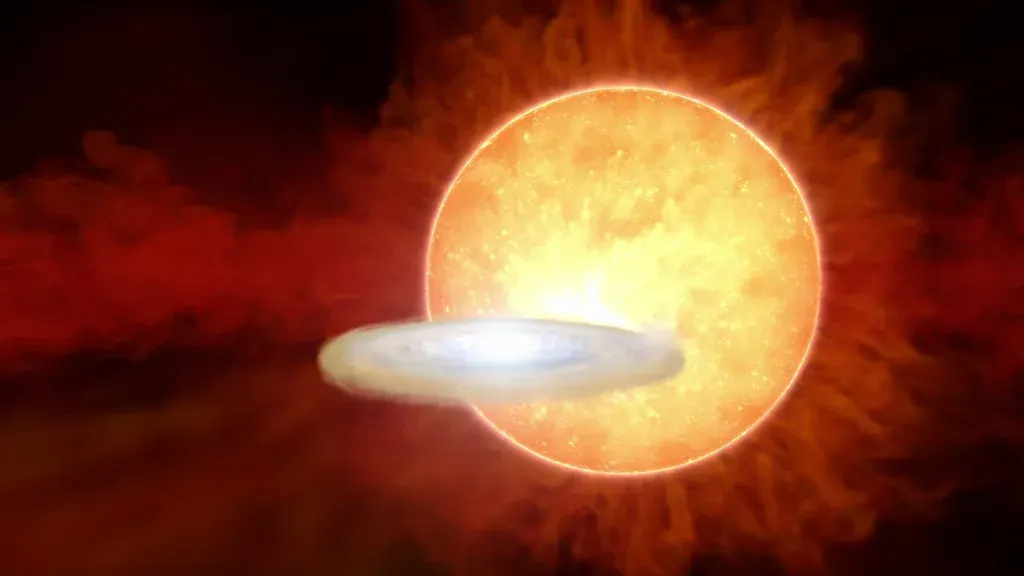
T Coronae Borealis is also known as T CrB or the Blaze Star. It is a binary star system in the Milky Way. It contains a red giant and a white dwarf. The system is about 3,000 light-years from Earth, according to the accessible research summary.
T CrB is known as a recurrent nova. This means it can undergo powerful eruptions more than once. Its previous recorded eruptions occurred in 1866 and 1946.
Astronomers have been watching for its next outburst. However, predicted time windows have passed without the expected eruption. Scientists cannot confirm an exact date for its return.
How does T Coronae Borealis erupt?
The two stars play different roles.
The red giant releases gas into its surroundings. The white dwarf pulls in some of this material through gravity. Over time, gas builds up on the white dwarf's surface.
Pressure and temperature increase as more material collects. Eventually, a thermonuclear reaction triggers a powerful nova eruption.

The explosion sends material into the surrounding environment. Fast-moving gas can collide with material released by the red giant. These collisions may accelerate particles to very high energies.
Scientists want to understand how this process works. High-energy gamma rays and neutrinos may provide important clues.
Two possible ways to produce high-energy particles
A study published in The Astrophysical Journal Letters on 14 April 2026 examines two possible particle-acceleration mechanisms in T CrB.
The research was conducted by Prantik Sarmah, Sovan Chakraborty and Xilu Wang. It compares external shocks with magnetic reconnection.
1. External shocks
In this model, fast-moving nova material collides with gas around the binary system. These collisions can accelerate protons.
The resulting particle interactions can produce gamma rays and neutrinos. The study predicts that the gamma-ray signal could be detectable. However, the corresponding neutrino signal would largely remain difficult to detect.

2. Magnetic reconnection
The second model involves magnetic fields near the white dwarf. Magnetic reconnection can release stored magnetic energy. This energy may accelerate protons and produce high-energy particles.
The model predicts that gamma rays produced near the white dwarf may be absorbed by surrounding matter. Neutrinos, however, can escape more easily.
The researchers find that this scenario could produce a neutrino signal within the reach of detectors such as IceCube and KM3NeT.
Neutrinos could provide an earlier signal
One of the study's most interesting predictions concerns timing.
If both particle-acceleration mechanisms operate during the eruption, neutrinos from magnetic reconnection could escape before gamma rays from the external shock become visible.
The researchers estimate a possible time difference of around 9–10 hours.
This could give observatories an opportunity to prepare for follow-up observations. Scientists could use the early signal to direct telescopes towards T CrB.
However, this timing is a theoretical prediction. It is not a confirmed detection or a guaranteed advance warning.
What could scientists learn?
Detecting neutrinos would provide valuable information about the physical processes inside the system.
Neutrinos interact very weakly with matter. They can travel through dense material that may absorb other forms of radiation.
This makes them useful messengers from extreme environments.
A neutrino detection could help researchers test whether magnetic reconnection contributes to particle acceleration. A lack of detection could also help constrain the proposed models.
There is an important uncertainty, however. The magnetic-reconnection scenario requires a strong magnetic field near the white dwarf. The strength of that field remains an important question.
The predicted signal also depends on the physical conditions during the eruption. Therefore, scientists cannot guarantee that detectors will observe neutrinos from T CrB.
A rare opportunity for multi-messenger astronomy
The next eruption of T Coronae Borealis could help scientists study more than a bright stellar explosion.
By observing neutrinos and gamma rays together, researchers may learn how particles gain energy in recurrent novae.
The study offers a possible way to investigate these processes. Its predictions will be tested only when the system erupts and observatories can collect new data.
For now, T CrB remains a system worth watching. Its next outburst could provide an important test of how stars produce high-energy particles.
📄 Source & Citation
Research paper: Sarmah, P., Chakraborty, S., & Wang, X. (2026). High-energy Neutrino Predictions for T Coronae Borealis: Probing Particle Acceleration in Novae. The Astrophysical Journal Letters. https://doi.org/10.3847/2041-8213/ae595a
Comments
No comments yet. Be the first to share your thoughts.
Leave a comment