

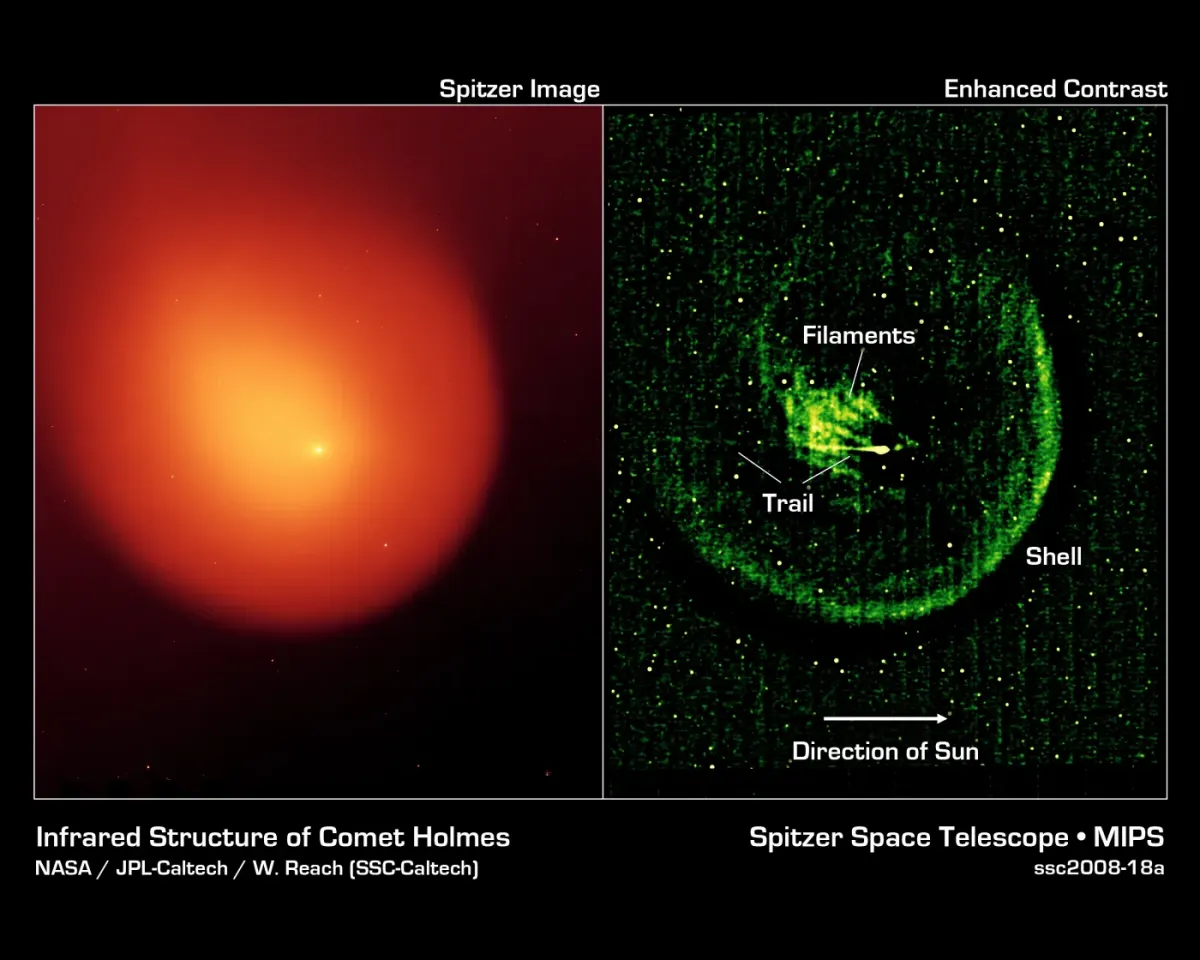
A comet that usually hides from view suddenly became thousands of times brighter in 2026. Comet 220P/McNaught erupted twice in just over two months. Scientists think escaping gas may have torn away parts of its dusty outer crust.
The first outburst began on May 31. The second followed in August. Together, the events made the comet about 16,000 times brighter than usual, according to the research team’s institute. Yet the comet’s entire icy heart did not appear to break apart.
A faint comet puts on a sudden show
Before the first outburst, 220P/McNaught was extremely faint. On May 31, its brightness rose from magnitude 17.39 to 11.05 in less than 14 hours. That means it became more than 300 times brighter.
By June 2, a large cloud had formed around it. Astronomers call this cloud a coma. It forms when sunlight warms a comet and releases gas and dust.
The dust was spreading at about 390 metres per second, the study found. Then came another surprise. A second outburst began in August. The comet brightened from magnitude 14 on July 28 to magnitude 6.1 by August 6.
How escaping gas may have broken the crust
A comet is made of ice, dust and rocky material. As sunlight warms it, some buried ice changes straight into gas. This is called sublimation.
Gas can build pressure beneath the comet’s outer crust. If the pressure grows strong enough, it may crack or lift pieces of the surface. Dust and small rocky grains then escape into space.

That fresh dust reflects sunlight. The comet can suddenly look much brighter, even if its solid centre stays mostly intact.
The researchers estimate that the May event released around 10 billion to 100 billion kilograms of material. That sounds enormous. But their analysis suggests it was only a small fraction of the comet’s total mass.
Images showed a nearly round cloud, with no clear signs of large separate fragments. The team therefore favours a local burst of surface activity, not the destruction of the whole nucleus. The exact trigger remains uncertain.
Why this outburst matters
Comet 220P/McNaught is a Jupiter-family comet. It takes about five and a half years to orbit the Sun. Its eruptions offer scientists a rare chance to study how these icy bodies change.
Another comet, 17P/Holmes, also brightened dramatically in 2007. But the two events may have had different causes. They should not be treated as identical.
The new measurements may help researchers understand how strong a comet’s outer layers are, and how easily they break. More observations are needed to learn what triggered the two eruptions.
For now, 220P/McNaught has shown us something striking: a comet can brighten enormously without breaking apart completely.
📄 Source & Citation
Primary source: Trigo-Rodríguez, J. M., Wesołowski, M., Gritsevich, M. & Carson, P. (2026). Photometry and analysis of comet 220P/McNaught during the 2026 outbursts. Monthly Notices of the Royal Astronomical Society 553(1), stag1814. Published 3 November 2026. https://doi.org/10.1093/mnras/stag1814
Image reference: NASA Astronomy Picture of the Day, 24 August 2026
Comments
No comments yet. Be the first to share your thoughts.
Leave a comment