

A star is born inside a cloud. But its arrival does not leave that cloud untouched.
As a young star grows, it can release powerful streams of gas and energy. These streams push into the surrounding material, heating it, compressing it and sometimes clearing it away. The process can change the birthplace of the star itself.
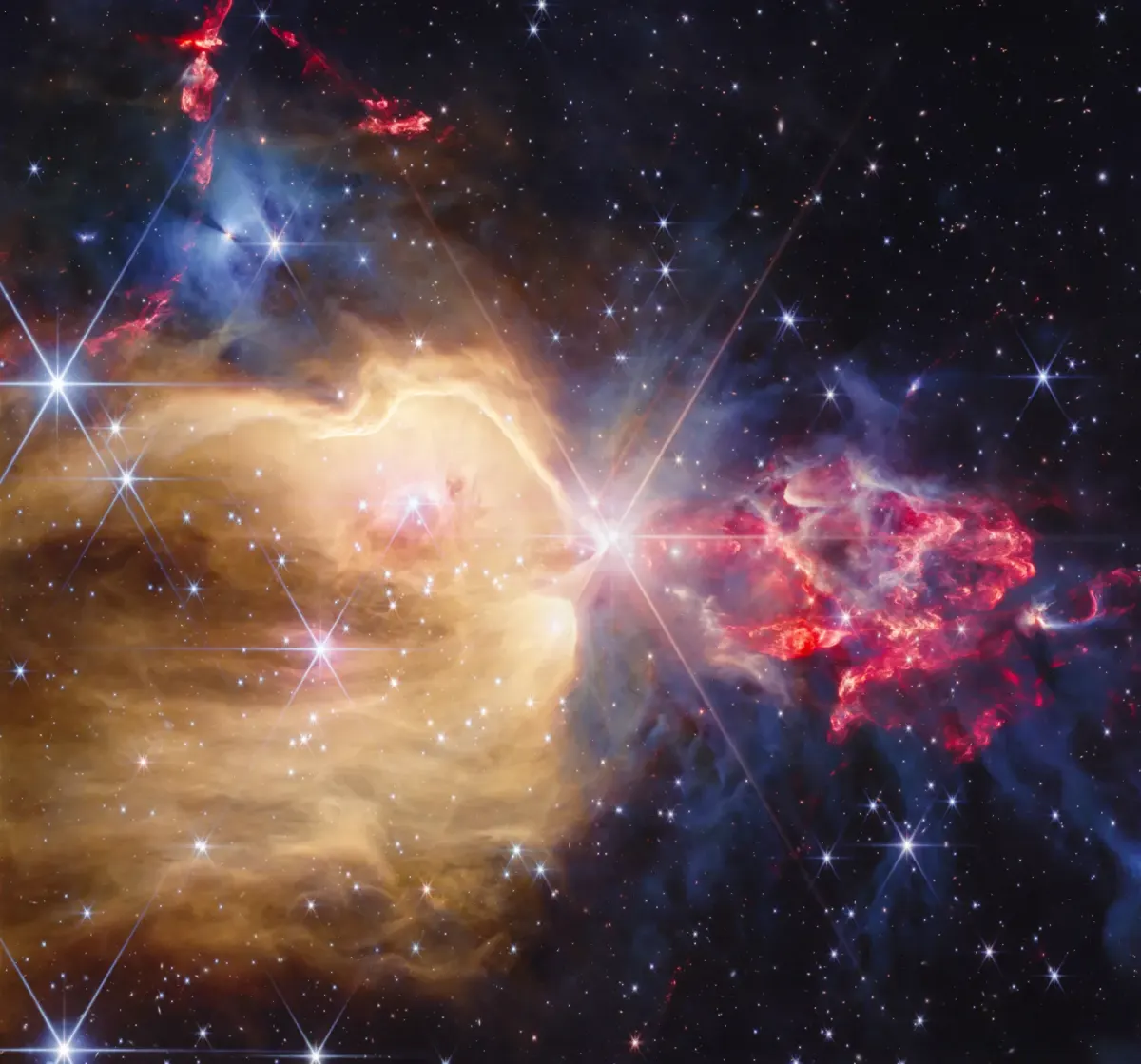
NASA’s James Webb Space Telescope has captured this activity in remarkable detail in NGC 7129, a star-forming region about 3,300 light-years from Earth in the constellation Cepheus.
The image, featured by NASA’s Astronomy Picture of the Day on November 16, 2026, offers a close look at stars at different stages of development. It also shows how their activity shapes the environment around them.
The scene is not simply a picture of stars being born. It is a record of creation and change happening together.
A nursery hidden inside clouds
NGC 7129 is a region filled with gas, dust and young stellar objects. These objects are at different points in the long process of becoming stars.
Stars begin forming when gravity pulls dense material together inside cold clouds. As the material gathers, the central region becomes denser and hotter. Eventually, a young object called a protostar takes shape.
A protostar is an early stage of a star. It is still gathering material from its surroundings. It has not yet settled into the stable phase in which it produces energy by fusing hydrogen in its core.
For a long time, thick clouds of dust can hide these young objects from ordinary visible-light telescopes.
This is where Webb has an advantage.
Why Webb sees what visible light can miss
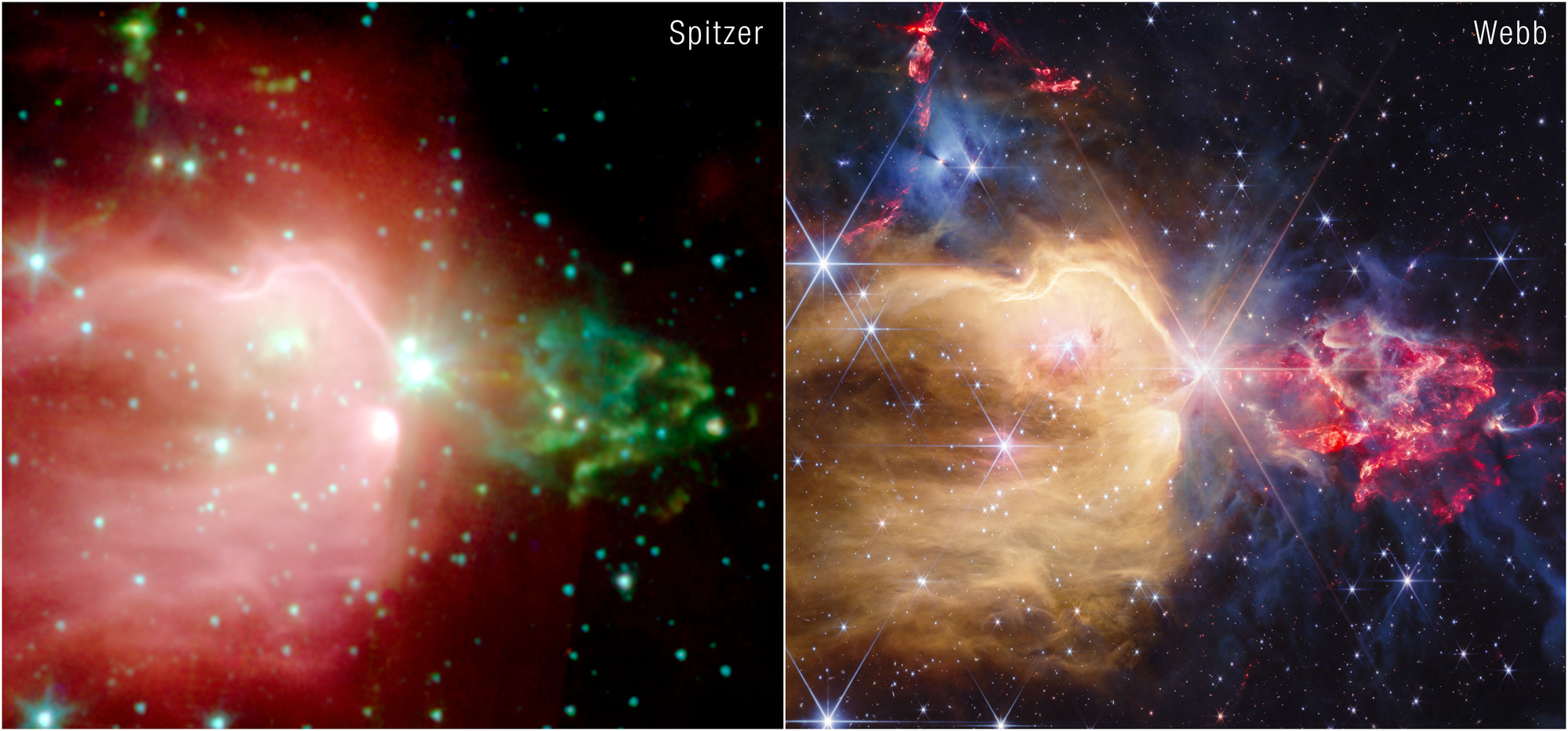
Webb observes the universe mainly in infrared light. Infrared wavelengths can pass through some dust that blocks visible light. This allows the telescope to study regions where stars are still forming.
For NGC 7129, Webb used its Near-Infrared Camera, known as NIRCam. The observations reveal stars and protostars embedded within glowing clouds.
The colours in the released image represent different infrared wavelengths. They are not what a human eye would see if it could travel to the region.
The golden area to the left contains hot atomic hydrogen gas. The cooler region to the right contains molecular hydrogen and younger protostars. Some of this gas glows red because outflows from the growing stars are heating and disturbing it.
The image also reveals faint background galaxies behind the star-forming region.
Together, these details allow astronomers to examine several stages of stellar development in one place.
Young stars are changing their surroundings
One of the most striking features is the contrast between the two sides of the image.
The stars in the golden region are generally more mature than the objects in the red region. The central star, known as LkHα 234, is particularly prominent. It is estimated to have around five to eight times the mass of our Sun.
It has moved beyond the earliest protostar stage. Its energy is already having a major effect on the surrounding cloud.
Earlier outflows from the central star have helped carve a cavity in the gas. This golden region stretches about 3.5 light-years.
The process is not simply one of destruction. As material is pushed away, some gas can also become compressed. Under the right conditions, that compression may help trigger the formation of additional stars.
The younger objects on the right tell another part of the story.
These protostars are still gathering mass. As they grow, they release narrow, powerful streams of material called jets and broader outflows. When these streams collide with nearby gas, they create shock waves.
A shock wave is a sudden disturbance that compresses and heats material. In NGC 7129, these interactions help give the red clouds their clumpy, filament-like appearance.
Several outflows overlap in the telescope’s view. This makes the region look turbulent, even though the activity is taking place across enormous distances.
A star’s birth can influence the next
The image highlights an important feature of star formation: young stars do not develop in isolation.
Their radiation, winds and jets can reshape the same clouds from which they formed. These effects can remove gas from some areas while compressing it in others.
Astronomers call this stellar feedback.
It matters because it helps determine how quickly a cloud forms stars, how many stars it produces and how long the cloud survives.
The balance is complex. Stellar activity can encourage new stars to form in some places, while making it harder for new stars to form elsewhere.
NGC 7129 gives researchers an opportunity to study these effects in a region where several generations of young stellar objects are visible together.
Why this image matters
The value of Webb’s observation goes beyond its striking colours.
By revealing young stars, gas structures and outflows in greater detail, the telescope helps scientists compare objects at different stages of development. That can improve our understanding of when jets become important, how stars influence nearby material and how stellar nurseries change over time.
The observations do not provide a complete account of every process in NGC 7129. Instead, they offer a detailed snapshot that researchers can compare with other observations and scientific models.
That is how a deeper picture of star formation is built: one region, one measurement and one stage of stellar life at a time.
About 3,300 light-years away, NGC 7129 is showing us that the birth of a star is not a quiet event. It can reshape an entire neighbourhood of gas and dust — and perhaps influence what forms there next.
The stars are still taking shape. Their surroundings are changing with them.
And Webb is allowing us to watch more of that story unfold.
📄 Source & Citation
Primary source: NASA Science (2026). NGC 7129: Star Formation with Jets from Webb. Astronomy Picture of the Day, 16 November 2026. https://science.nasa.gov/image-article/apod-2026-november-16-ngc-7129-star-formation-with-jets-from-webb/
Additional sources: NASA Science, NGC 7129 (NIRCam Image) · NASA’s Webb Captures Commotion From Nebula’s Stellar Jets · ESA, Webb captures commotion from nebula’s stellar jets
Comments
No comments yet. Be the first to share your thoughts.
Leave a comment