

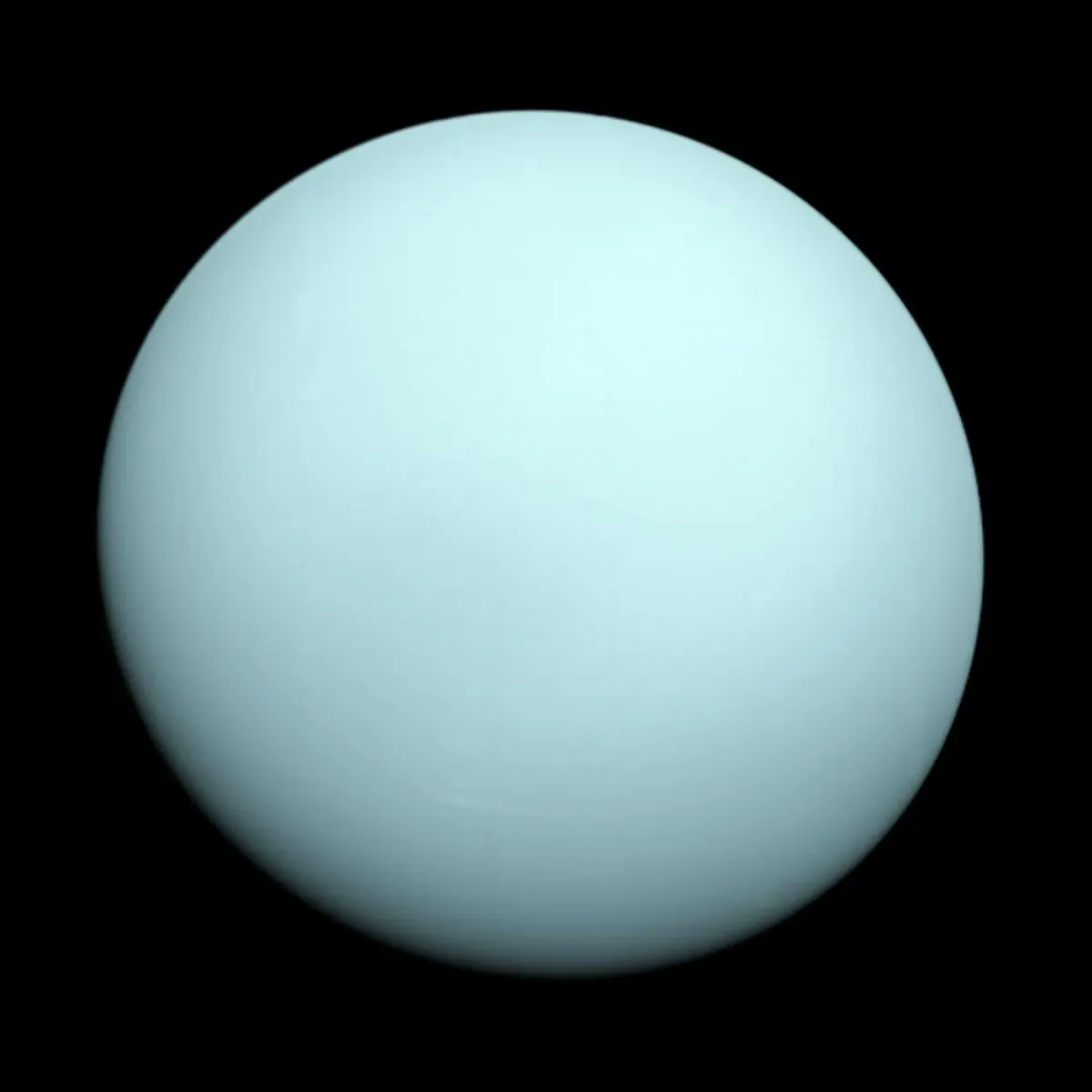
Uranus and Neptune have some of the strangest magnetic fields in the Solar System. Unlike Earth’s relatively simple magnetic field, their fields are tilted, uneven and highly complex. New research suggests these magnetic fields may also change over time.
A study published in Communications Physics in 2026 points to a possible explanation deep inside both planets: changes in how well their interiors conduct electricity. The findings could help scientists understand why these ice giants have unusual magnetic fields and how those fields may evolve.
Why are their magnetic fields unusual?
Most planets with internally generated magnetic fields have a strong dipole, with north and south magnetic poles similar to those of a bar magnet. Earth is a familiar example.
Uranus and Neptune are different. Their magnetic fields contain strong, uneven structures, and their magnetic axes are far from their rotation axes.
NASA’s Voyager 2 spacecraft measured these unusual fields during its encounters with Uranus in 1986 and Neptune in 1989. The study notes that the main dipole component accounts for only about 12% of the total observed surface magnetic energy. Other known planetary magnetic fields are generally much more strongly dominated by their dipole components.

What happens inside the ice giants?
Uranus and Neptune contain large amounts of water and other materials under extreme pressure and temperature. As depth increases, the properties of these materials change. Water can become more electrically conductive as it moves towards ionic states.
This matters because moving electrically conducting fluids can generate magnetic fields through a process called the dynamo effect.
The researchers used computer simulations to investigate how changes in electrical conductivity with depth affect magnetic-field generation. They tested different conductivity profiles and the thickness of the regions where the magnetic fields are generated.
What did the researchers discover?
The simulations showed that models with constant electrical conductivity mainly produced dipole-dominated magnetic fields. These did not closely match the unusual patterns observed at Uranus and Neptune.
When conductivity increased with depth, the simulated fields developed more complex structures. They also produced a feature called the M1 peak, which is prominent in the observed magnetic fields of both planets.
The researchers found that thinner dynamo regions, combined with changing electrical conductivity, often produced magnetic patterns closer to Voyager 2’s measurements.
However, no single model perfectly explained both planets. The results depended partly on which observed magnetic-field model was used for comparison.
Could their magnetic fields have changed since Voyager 2?
Another important finding is that the magnetic fields may change in strength and direction over time.
Voyager 2 provided only one close-up measurement of each planet’s magnetic field. Scientists therefore do not yet have enough direct observations to confirm how these fields have changed since the 1980s.
In the simulations, some magnetic patterns changed substantially over a few decades. One Uranus-like model showed a projected dipole tilt change of about 13 degrees over 40 years, while another produced a change of about 84 degrees over the same period.
These are computer-simulation results, not confirmed measurements of changes on either planet.
The study also found that slower periods of magnetic change are possible, but these periods were temporary in the models and could be followed by faster changes.
Why does this matter?
A changing magnetic field can affect how a planet interacts with the solar wind, the stream of charged particles flowing from the Sun.
Changes could influence magnetic reconnection, the movement of energetic particles and auroras in the planets’ atmospheres. They may also affect how scientists interpret observations of these distant worlds.
Some recent observations have raised questions about possible changes in auroral locations, particularly at Neptune. However, these observations do not prove that its magnetic field has changed.
What happens next?
The research is based on numerical simulations, not new spacecraft measurements. Scientists still have limited information about the internal composition, temperature and electrical conductivity of Uranus and Neptune.
The researchers say future work must also examine other interior properties, including density, thermal conductivity and possible stable layers.
New spacecraft observations will be essential to test these predictions. A future mission to either ice giant could help determine whether its magnetic field has changed since Voyager 2.
For now, the study offers a possible explanation for the unusual magnetic fields of Uranus and Neptune. It suggests that the electrical properties of materials deep inside these planets may play a major role in shaping their magnetic environments.
📄 Source & Citation
Primary source: Yan, C., Soderlund, K. M., Aurnou, J. M., Cao, H., Masters, A. & Melin, H. (2026). Electrical conductivity structure drives anomalous and potentially time-varying magnetic fields at Uranus and Neptune. Communications Physics 9, 336. Published 3 November 2026. https://doi.org/10.1038/s42005-026-02841-y
Comments
No comments yet. Be the first to share your thoughts.
Leave a comment