

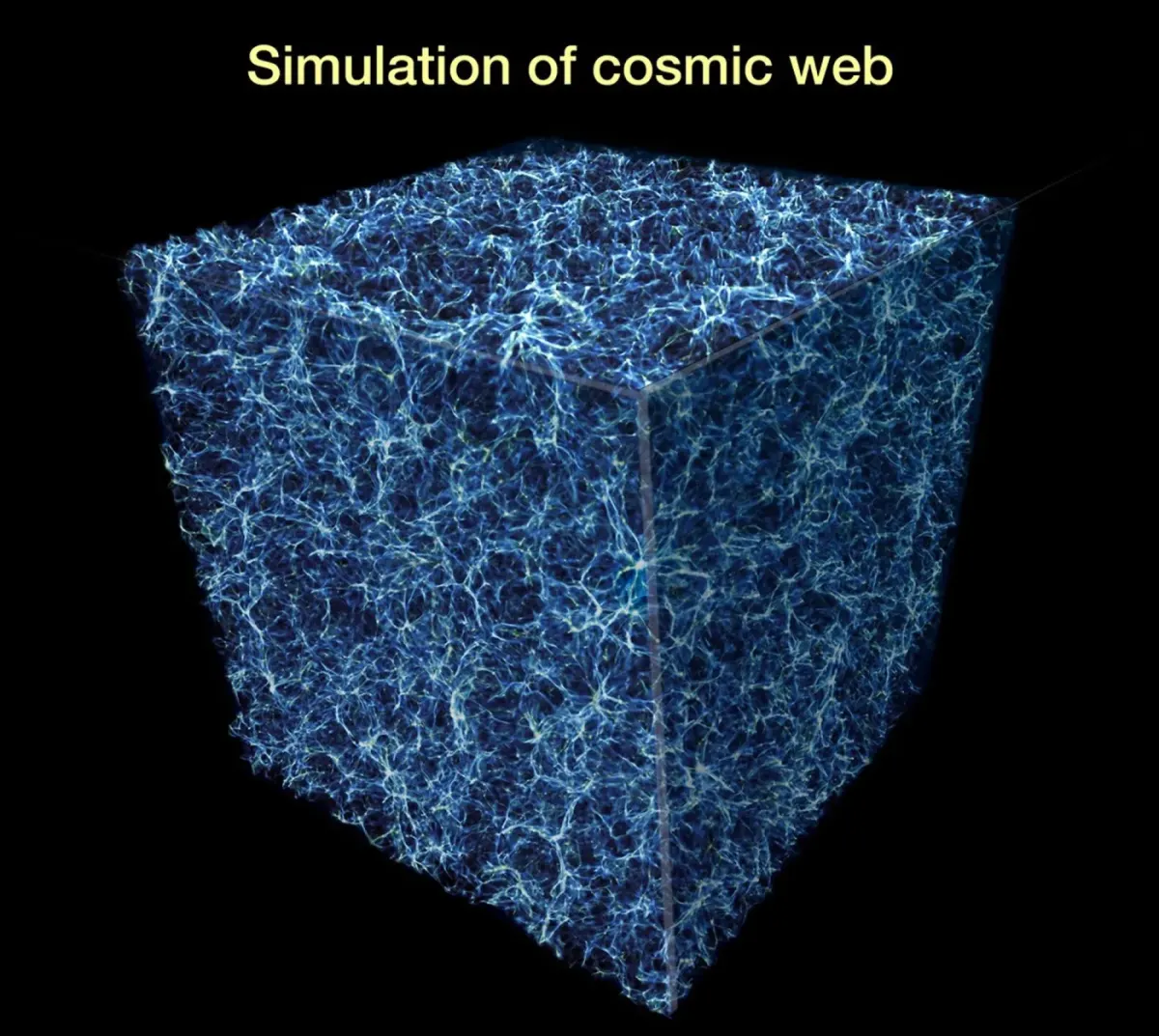
The neutrino mass puzzle has become difficult for cosmologists. Some measurements of the universe seem to leave very little room for the masses of neutrinos. Yet experiments on Earth show that these tiny particles cannot all be massless.
Now, researchers are exploring a possible way through this disagreement. Their idea connects two mysterious parts of the cosmos: dark matter and dark energy.
A new study suggests that these two ingredients may exchange energy as the universe expands. That interaction could change how scientists interpret measurements of neutrino masses.
The research was posted on arXiv on November 10, 2026. It is a preprint, which means it has not yet completed peer review. The findings offer an interesting possibility, not a confirmed discovery.
Why neutrino masses are a cosmic puzzle
Neutrinos are tiny particles that fill the universe. They have extremely small masses and rarely interact with ordinary matter.
Billions pass through your body every second. Most travel straight through without leaving a trace.
Experiments studying neutrinos have shown that their masses cannot all be zero. But measuring their exact total mass remains difficult.
Scientists can study this question in two ways. They can observe neutrinos in experiments on Earth. They can also examine how neutrinos affect the history and structure of the universe.
The second method uses observations of the cosmic microwave background, or CMB. This is ancient light released when the universe was about 375,000 years old.

Scientists also study the distances between galaxies. These measurements help reveal how the universe has expanded over time.
But when researchers combine some of these cosmic measurements, the results can favour an effective neutrino mass below zero. That does not mean neutrinos have negative physical mass. It is a mathematical feature of the way the researchers test the data.
Could dark matter and dark energy be connected?
Dark matter and dark energy are very different, but both shape the universe.
Dark matter helps hold galaxies and larger cosmic structures together through gravity. Dark energy is linked to the universe’s accelerating expansion.
The new study tests a model called coupled quintessence. In this model, dark energy is described by a changing field. That field can interact with dark matter.
Think of it as an exchange between two parts of the universe. As the universe grows, energy can move from dark matter to dark energy.
In the version tested by the researchers, this transfer reduces the amount of dark matter present at later times compared with a model where dark matter evolves independently.
That change matters. Neutrinos also contribute to the universe’s matter content. If the dark matter contribution changes, scientists may infer a different range of neutrino masses from the same cosmic observations.
The interaction also affects how matter gathers into structures. It can change the growth of galaxies and the way gravity bends light from distant objects.
These effects must all be considered together.
What did the researchers find?
The team tested its model against several major sets of observations. They combined cosmic microwave background measurements from Planck, the Atacama Cosmology Telescope and the South Pole Telescope.
They also used distance measurements from the Dark Energy Spectroscopic Instrument , known as DESI. Finally, they included the DES-Dovekie sample of about 1,800 supernovae. These exploding stars help scientists measure cosmic distances.
The negative central value is not a measurement of a negative particle mass. It describes the best-fitting region of the researchers’ mathematical analysis.
More importantly, the model allowed the normal neutrino mass ordering, with a benchmark near 0.06 electronvolts, within roughly two standard deviations.
That is a meaningful change from the standard cosmological model, where the same analysis strongly favoured negative effective mass values.
However, the result does not solve every part of the puzzle. The inverted ordering, with a benchmark near 0.10 electronvolts, remained much less well accommodated.
What happens next?
The researchers also compared coupled quintessence with another model called CPL. Both allowed a wider range of neutrino masses than the standard model.
CPL produced a larger improvement in the overall statistical fit to the combined data. Coupled quintessence was competitive, but it did not outperform CPL in that comparison.
The team also tested other interacting dark energy models. Those models did not produce the same improvement in neutrino mass constraints.
This shows why the details matter. Changing the amount of dark matter alone is not enough. A model must also match the universe’s expansion, the growth of cosmic structures and the way light is bent by gravity.
The study therefore offers a possible explanation, not proof that dark matter and dark energy exchange energy.
Neutrinos are among the universe’s lightest known particles. Dark matter and dark energy remain two of its greatest mysteries. The possibility that these ingredients are connected makes the question even more fascinating.
Future observations may help scientists test whether this interaction is real. For now, the new model gives researchers another way to examine a puzzle that stretches from tiny particles to the largest structures in the universe.
Some of the universe’s biggest answers may depend on how its most mysterious ingredients work together.
Source & Citation
Primary source: Li, T.-N. et al. (2026). A Positive Turn: Coupled Quintessence and Cosmological Neutrino Masses. arXiv:2611.14584. Posted November 10, 2026.
Publication status: Preprint; not yet peer-reviewed.
Comments
No comments yet. Be the first to share your thoughts.
Leave a comment