

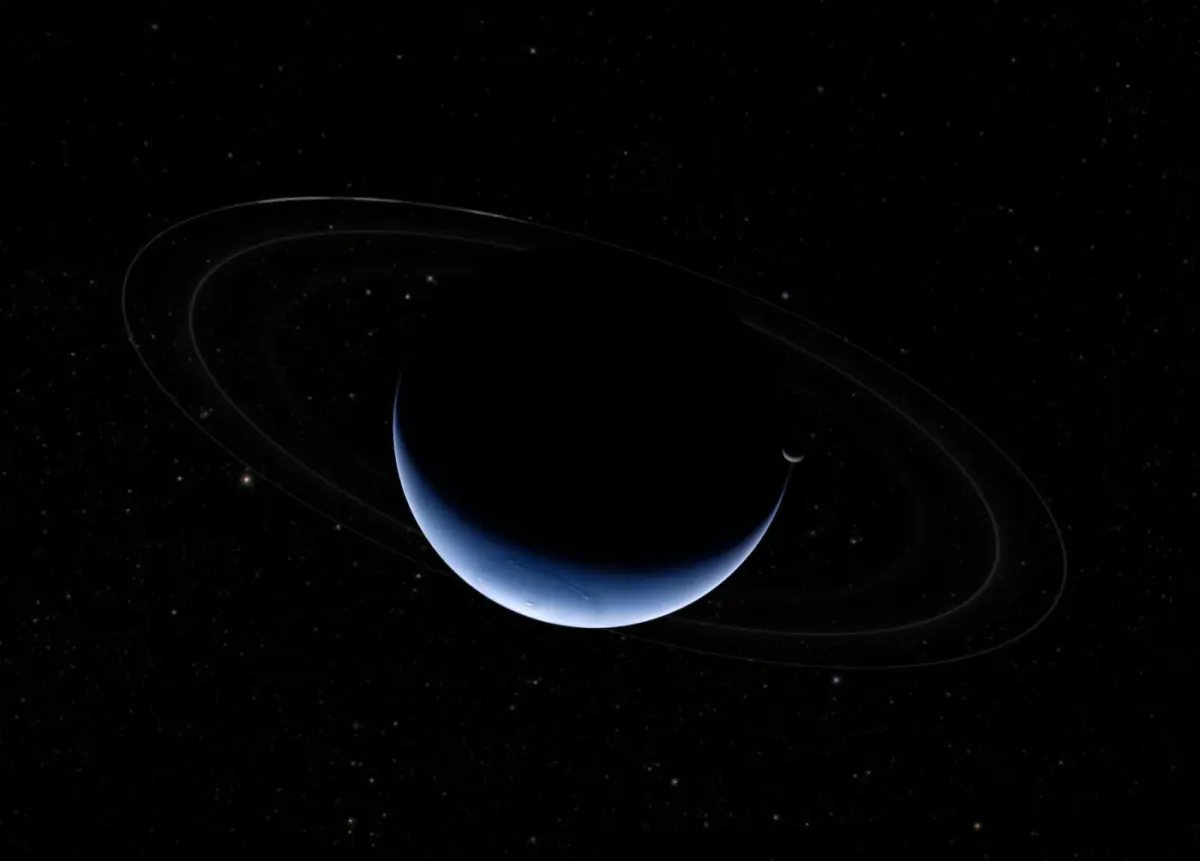
A view from the far side of Neptune
On November 21, 2026, NASA featured a remarkable view of Neptune in its Astronomy Picture of the Day. The image brings together Neptune, its largest moon Triton and the planet’s faint ring system.
Its title is “Voyager’s Neptune”. The picture is based on data from NASA’s Voyager 2 spacecraft. But this is not a new photograph taken by a spacecraft in 2026. It is a composite image assembled and processed by image creator Rolf Olsen using Voyager 2 data.
The viewpoint makes this scene special. It looks back towards the Sun from just beyond Neptune’s orbit. From there, Neptune and Triton appear as thin, sunlit crescents.
Here is something to think about. The light in this view comes from a distant world that Voyager 2 visited more than three decades ago. The spacecraft has since travelled far beyond the planets.
The historic journey that made this view possible
Voyager 2 reached Neptune on August 25, 1989. It became the first spacecraft to fly past the planet, and no other spacecraft has visited Neptune since.
The encounter was the final planetary flyby in Voyager 2’s grand tour. Before reaching Neptune, the spacecraft had visited Jupiter, Saturn and Uranus. Each encounter gave scientists a closer look at the giant planets and their moons.
During its Neptune flyby, Voyager 2 also studied Triton. This is Neptune’s largest moon. The spacecraft passed close to Triton about five hours after its closest approach to Neptune.
The images and measurements revealed a world with more activity than scientists had expected. Voyager 2 observed clouds, storms and powerful winds in Neptune’s atmosphere. It also discovered new moons and rings.
The spacecraft’s observations of Neptune’s rings were especially important. The rings are faint and difficult to see. Voyager 2 captured parts of the ring system, including bright ring arcs in the outer ring.
The November 2026 composite brings these observations together in one wide view. It also includes a background starfield made from sky survey data centred on the constellation Camelopardalis.
Neptune, Triton and the delicate rings
Look closely at the image and three main features stand out. Neptune appears as a thin crescent. Triton is another small crescent nearby. Around the planet, faint rings add another layer to the scene.
The image also shows details near Neptune’s south polar region. Cirrus clouds and a dark band circle this area. A cloudy vortex appears above the pole.
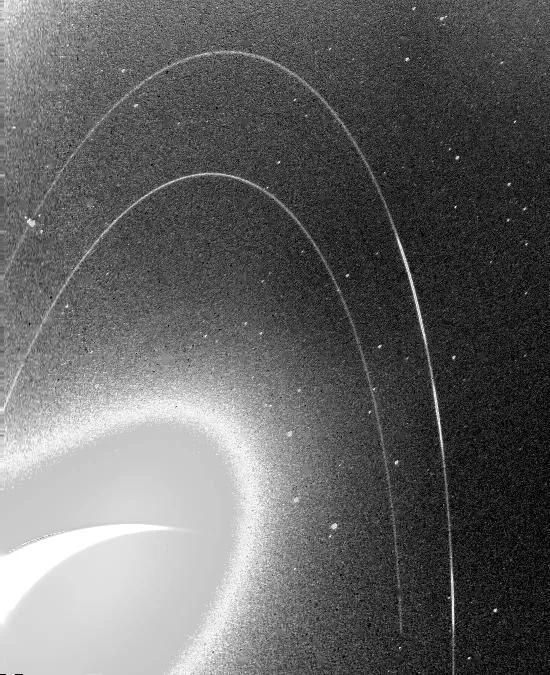
The rings need a little explanation. Voyager 2 first imaged parts of the faint ring system during its flyby. It also recorded three bright ring arcs. However, the faintest ring segments in this composite are modelled rather than directly shown by Voyager images.
That difference matters. The picture combines spacecraft observations with image processing and modelled details. It should not be treated as one untouched photograph of the entire system.
The spacecraft itself has continued travelling long after its Neptune encounter. Voyager 2 crossed the boundary into interstellar space in November 2018. It is still moving outward in 2026, far beyond the orbit of Neptune.
This is what makes the image more than a beautiful view of a distant planet. It connects a historic planetary encounter with a spacecraft that continues its journey into the space between the stars.
Voyager 2 will not return to Neptune. Yet the data it sent home still helps us explore this distant world. More than 37 years after its flyby, its observations can still offer fresh ways to look at the planet, its moon and its rings.
📄 Source & Citation
Source & Citation: NASA — APOD: Voyager’s Neptune, November 21, 2026
Also: NASA — Voyager 2 · NASA — Neptune: Facts · NASA — 30 Years Ago: Voyager 2 Explores Neptune
Comments
No comments yet. Be the first to share your thoughts.
Leave a comment