

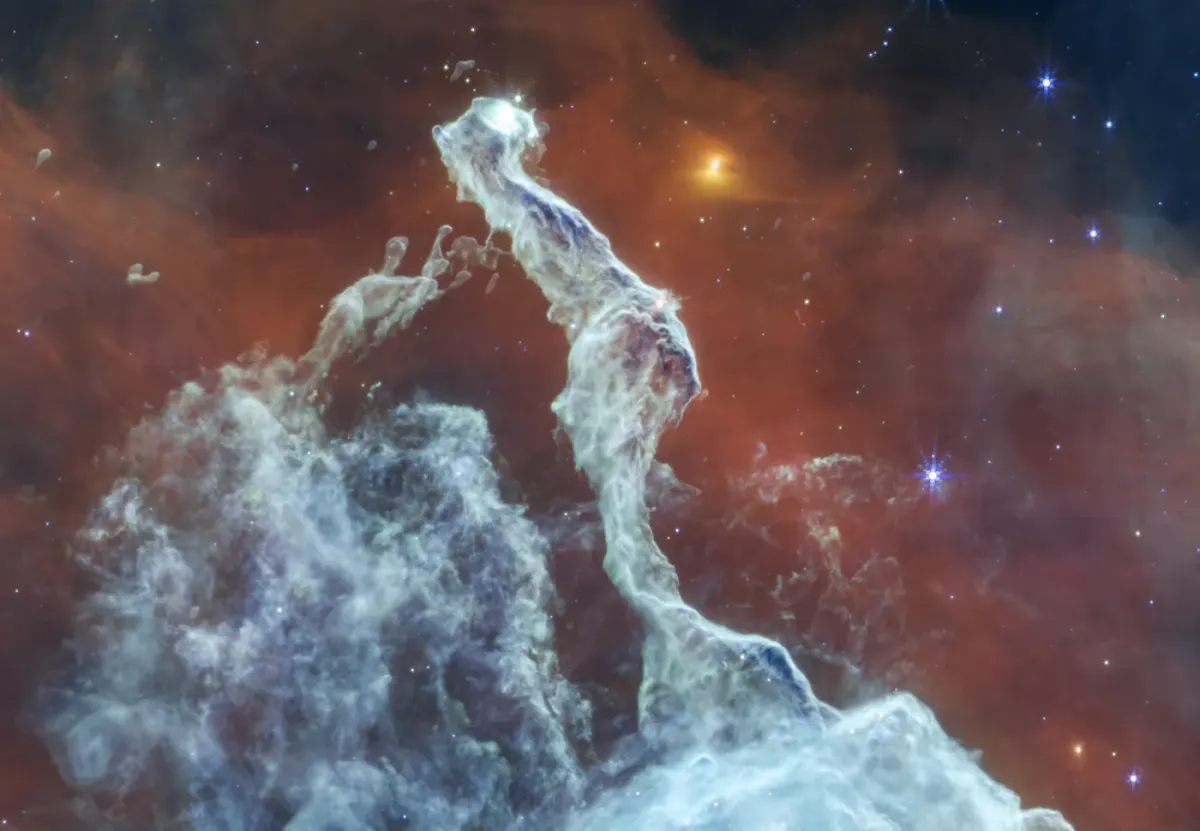
A cat is hiding among the stars. Its shape is made of dust, not fur. And one glowing spot looks like an eye.
On 29 October 2026, ESA shared new views of the Cat’s Head Nebula. NASA’s Hubble and James Webb telescopes observed this region. It lies inside the Carina Nebula, about 7,500 light-years away.
The two telescopes show the same region differently. Hubble sees it in visible light. Webb looks through it using infrared light. Together, their images reveal details hidden in the dusty cloud.
A cat-shaped cloud inside a stellar nursery
The Cat’s Head Nebula is a nickname for this small region. Its dust pillar looks like a sitting cat. The cat’s back faces the viewer. Its head turns towards the right.
But this is more than an unusual shape. The region contains gas and dust. These materials are part of the process of making stars.
The Carina Nebula is a huge cloud of gas and dust. It is home to many massive stars. Their strong light and powerful winds affect nearby material.
Over time, these forces helped shape the cat-like pillar. Ultraviolet light from massive stars heats nearby gas. Winds also push against the surrounding material. The thinner parts slowly wear away.
Denser parts can resist this erosion for longer. This helps the pillar keep its shape. But the structure will not last forever. It will change as stars form and evolve.
What Hubble sees and Webb reveals
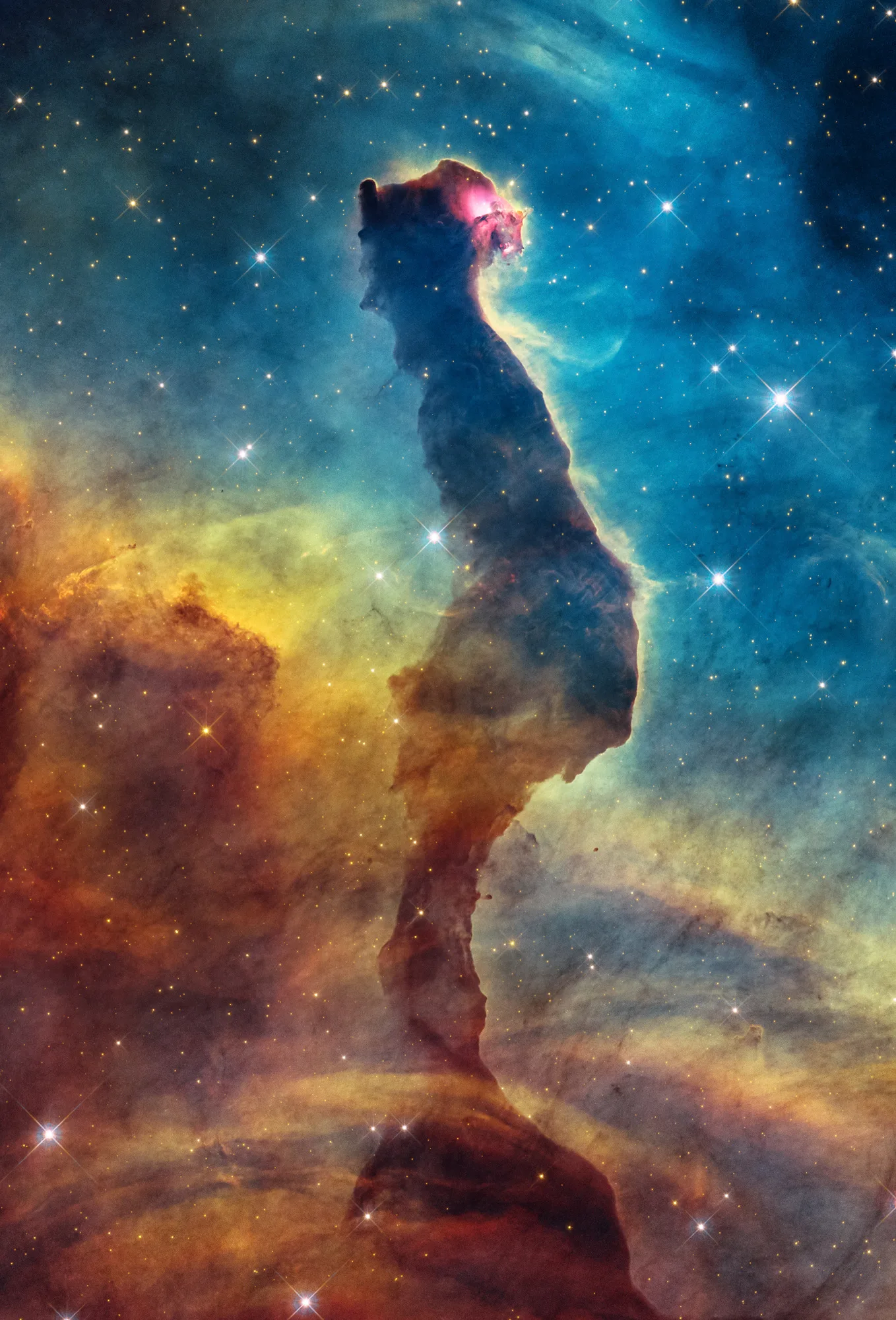
Hubble’s visible-light image shows a dark pillar. Its dusty centre blocks much of the light behind it. A bright rim follows part of its edge. This rim may show gas lit by nearby massive stars.
One detail stands out: the glowing red eye. It may be a young star still partly hidden in dust. The image does not confirm its exact nature.
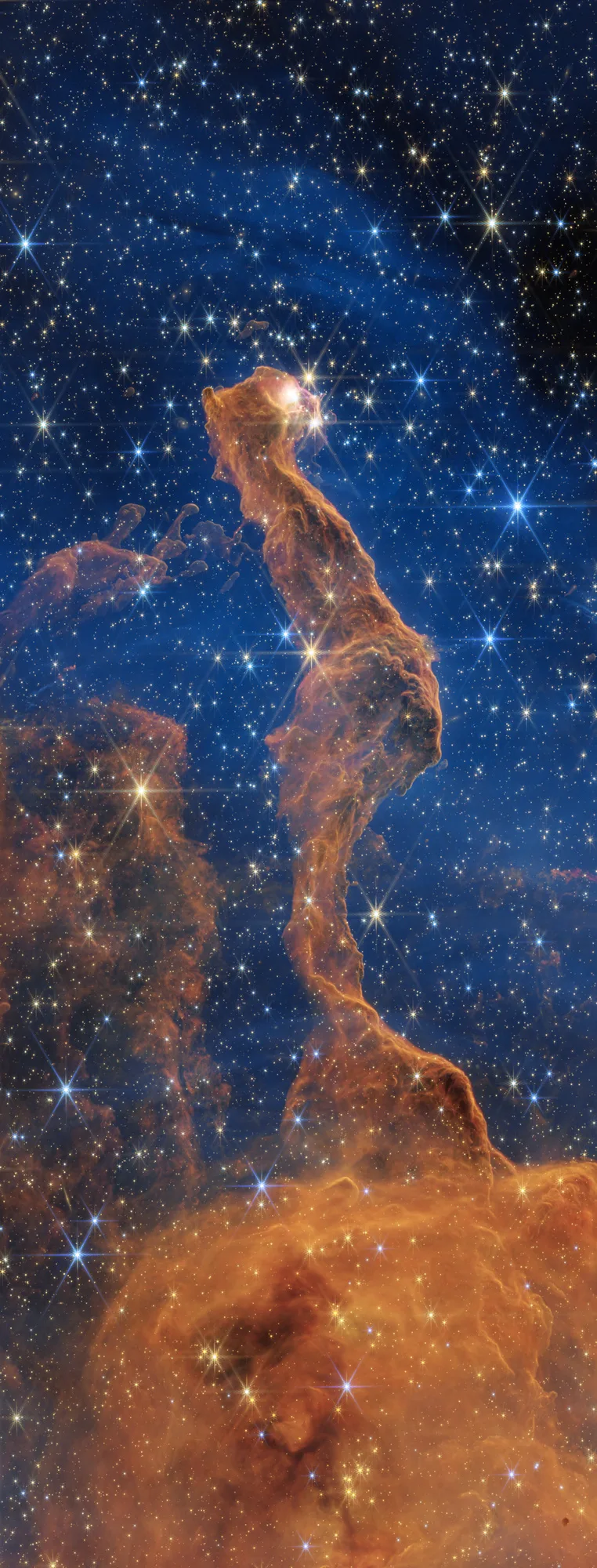
Webb gives us another way to look. Its near-infrared camera can see through some dust. This reveals more stars inside the region. It also shows faint strands of gas and dust. Even distant background galaxies appear in the image.
The cat’s eye remains visible in Webb’s view. Some stars, however, remain hidden by dust. Infrared light reveals more, but not everything.
Webb also observed the region in mid-infrared light. This view shows warm dust and carbon-based molecules. Their light traces delicate shapes inside the cloud. Small rounded structures and thin strands stand out.
These views are not simply different colours. Each one shows different details. Hubble reveals the dark dust pillar. Webb shows parts hidden in visible light. Its two infrared views also reveal different features.
What the images tell us about star formation
The bright edge of the pillar may be important. Ultraviolet light from nearby massive stars reaches the gas. It heats and ionises the material. This can make gas slowly escape into space. Astronomers call this process photoevaporation.
The process can change where stars form. It can also change how gas clouds develop. The denser parts may survive longer than thinner areas.
The images give astronomers a closer look at these changes. They can study how young stars interact with their surroundings. They can also compare the gas and dust. Each wavelength adds another piece of information.
There is something else worth noticing. The cat-shaped pillar is only a temporary structure. Its shape will change over time. The stars forming there will also continue to evolve.
At NavsoraTimes, we often look at space through images. But these views show us more than a shape. They reveal a place where stars are taking shape. A quiet-looking cloud can be a busy stellar nursery.
📄 Source & Citation
Source & Citation: ESA/Webb — Ghostly Cat’s Head Nebula lurks within sight of Hubble and Webb
Also: NASA — Ghostly Cat’s Head Nebula Lurks Within Sight of NASA’s Hubble, Webb (October 29, 2026) · NASA — Multiwavelength Flight into the Cat’s Head Nebula
Comments
No comments yet. Be the first to share your thoughts.
Leave a comment