

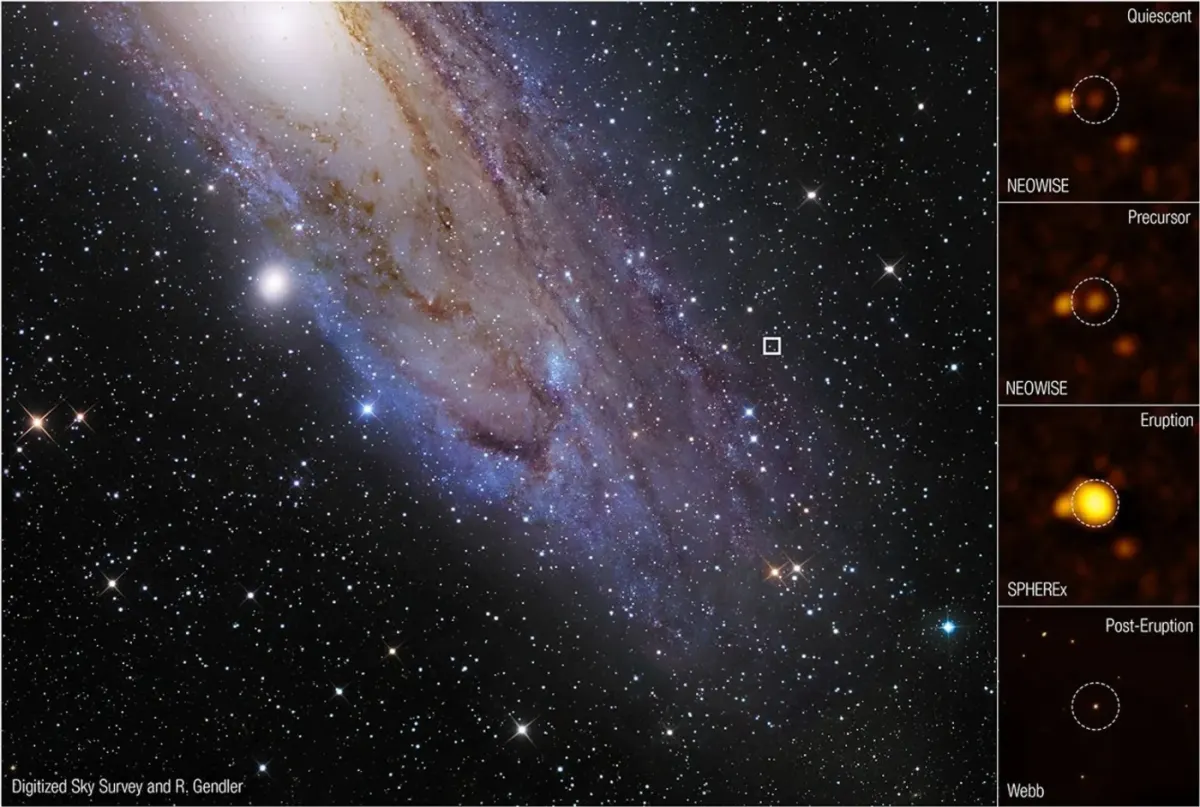
For years, two stars circled one another in the Andromeda galaxy. Then something changed. One began moving deeper into the other, until the pair became a single star.
Astronomers have now pieced together this rare stellar merger using years of observations. The James Webb Space Telescope provided an important part of the evidence. The event happened about 2.5 million light-years away, but its light carried a story that telescopes could follow across time.
The system is known as AT 2025abao, or Bao for short. What makes it special is not simply that two stars became one. Researchers were able to follow the changes before, during and after the merger. That gives scientists a rare chance to study how such an event unfolds.
The first clues appeared years before the merger
Bao did not suddenly appear as a bright flash. Its story began with a much quieter change.
Before 2018, the system's brightness remained fairly steady. In February 2023, researchers noticed something unusual in older observations from NASA's now-retired NEOWISE mission. The object had begun to change.
The team kept watching.
By September 2024, observations from the WINTER telescope showed that Bao was growing brighter and releasing dust. Then, in July 2025, NASA's SPHEREx spacecraft picked up another clue. Bao was fading in visible light while becoming brighter in infrared light.
That difference matters. Dust can block some visible light while giving off infrared light. It was a sign that a large amount of material was gathering around the system.
On October 17, 2025, the Zwicky Transient Facility detected a bright eruption. The light rose rapidly and reached its peak within about a week.
For the researchers, this was the moment the quiet changes became a much bigger event.
What happened inside the giant star?
The team believes Bao began as a pair of very different stars.
The larger one was an ageing giant. It had about seven times the Sun's mass and a radius around 350 times larger. It was also roughly 18,000 times brighter than our Sun.
Its companion was much smaller, with about 70 per cent of the Sun's mass. Researchers gave them the names Big Bao and Little Bao.
As the smaller star moved close to the giant, it entered the giant's outer layers. These layers were made of gas, and both stars became surrounded by this shared material.
Astronomers call this stage common-envelope evolution. The name sounds complicated, but the idea is simple: one star moves inside the outer gas of another.
The gas creates drag, much like resistance slows an object moving through water. The smaller star loses energy and its orbit tightens. With each orbit, it moves deeper into the giant.
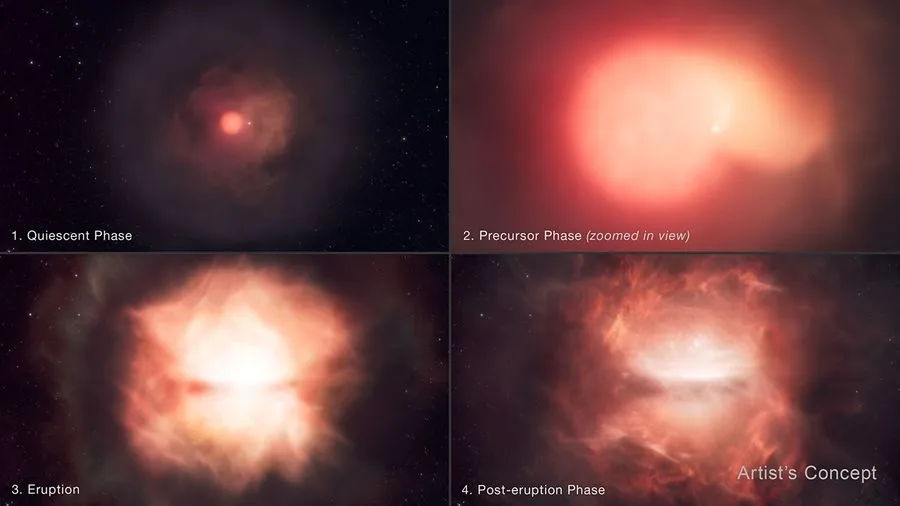
This did not happen in a single moment. The stars had spent thousands of years orbiting one another. After the smaller star began interacting with the giant's outer layers, the final process took about seven orbits — roughly seven years.
The researchers' analysis suggests that Little Bao was pulled into the giant's core. The merger also pushed some of the giant's gas and dust out into space.
Webb helped scientists look back
The eruption alone could not explain everything. Researchers needed to understand what the stars had been doing before it, and what remained afterwards.
That is where Webb became important.
On December 24, 2025, the telescope observed Bao in mid-infrared light. These observations revealed details about the dust released by the giant star. The team compared Webb's data with earlier observations from several other telescopes.
They also updated computer models to find which explanation best matched the evidence.
The result was a reconstruction of the system's changing life. Webb did not record a video of the stars colliding. Instead, its measurements helped scientists test what had happened by studying the light and dust left behind.
The research, led by Viraj Karambelkar, was published in Nature on November 18, 2026. It presents one of the first direct observations of this important stage in a star merger.
There is still more to learn. Researchers want to see how the newly formed Bao settles over time. They also need future observations to confirm its final state.
This matters far beyond one pair of stars. Common-envelope evolution may help create close pairs of neutron stars and black holes. Such systems can later produce powerful explosions or gravitational waves — ripples in space-time.
Bao gives scientists something they rarely get: a chance to study the process while its clues are still fresh. And as new sky surveys begin finding more changing stars, astronomers may soon have other systems to compare with it.
For now, one question remains above all: after swallowing its companion, what kind of star has Bao become?
The next observations may bring us closer to that answer.
📄 Source & Citation
Source & Citation: NASA — NASA Data Clinches First-of-Its-Kind Stellar Merger
Comments
No comments yet. Be the first to share your thoughts.
Leave a comment