

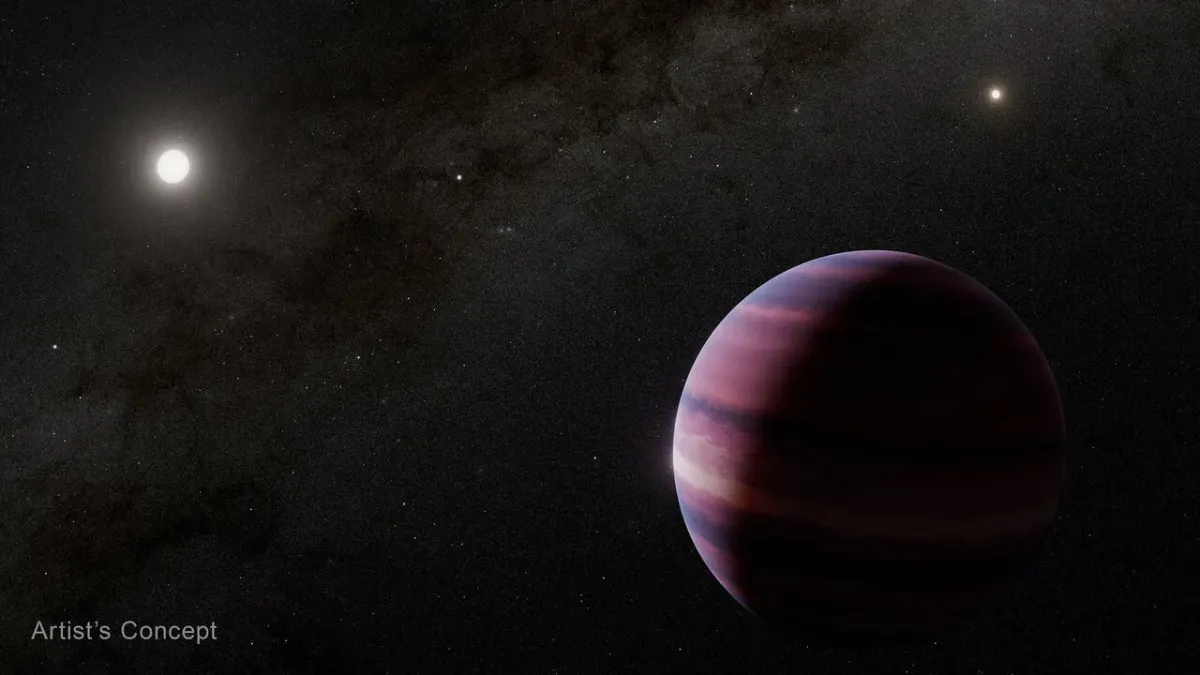
In August 2024, NASA's James Webb Space Telescope (JWST) spotted a faint point of light beside Alpha Centauri A, the closest Sun-like star to Earth. It could be a giant planet. Then it vanished from Webb's next two looks.
The research team worked out when the possible Alpha Centauri planet should be easiest to see again: August 2026. That window has now passed. As of late November 2026, no result from a new observation has been announced.
So where does the search stand? Here is what astronomers found, why the object may have disappeared, and what a new sighting would mean. If confirmed, it would be an extraordinary find: the closest known planet in the habitable zone of a Sun-like star.
A Tiny Point of Light Beside a Bright Star
Alpha Centauri is the closest star system to our Solar System. It lies about four light-years away. The system has three stars: Alpha Centauri A, Alpha Centauri B and Proxima Centauri.
A and B form a pair of Sun-like stars. Proxima Centauri is a smaller red dwarf. Scientists have already found planets around Proxima. Finding one around Alpha Centauri A has proved much harder.
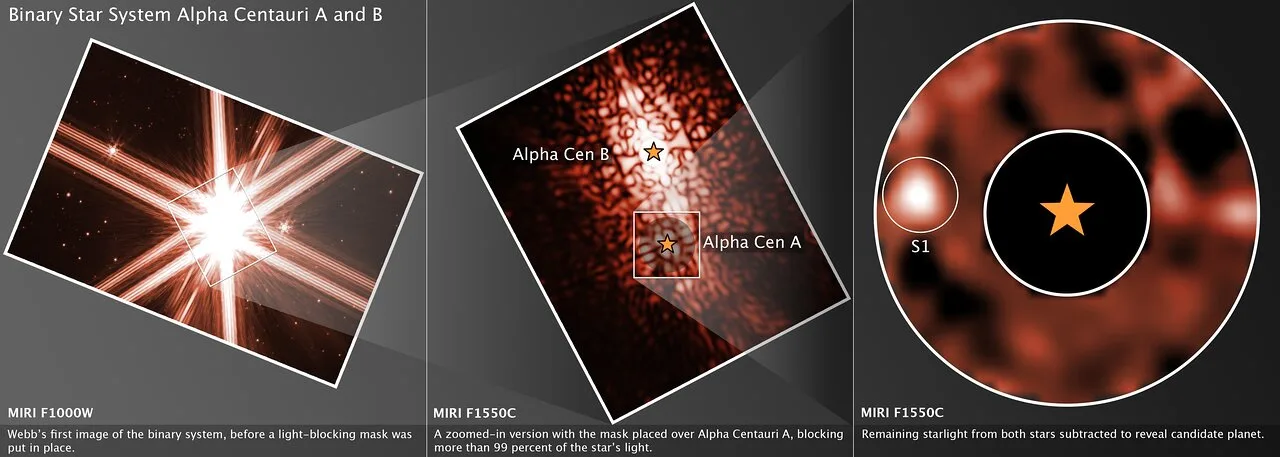
The challenge is the star's bright light. A planet beside it can be lost in that glare. Webb's Mid-Infrared Instrument, called MIRI, helped the team tackle this problem.
MIRI used a special mask called a coronagraph. It blocks much of the star's light, which lets scientists search for faint objects nearby.
“These are incredibly challenging observations to make, even with the world's most powerful space telescope, because these stars are so bright, close, and move across the sky quickly,” said Charles Beichman of NASA's Jet Propulsion Laboratory and Caltech's IPAC astronomy centre, a co-first author of the research.
The first observations took place in August 2024. The team found a small point of light and named it S1. It appeared about 1.5 arcseconds from Alpha Centauri A. At Alpha Centauri's distance, that gap equals about twice the distance between Earth and the Sun.
The source was more than 10,000 times fainter than its star. It could be a giant planet. But one sighting was not enough to prove that.
Why Did the Possible Planet Disappear?
The team looked again in February and April 2025. This time, Webb did not see S1.
“We are faced with the case of a disappearing planet!” said Aniket Sanghi, a PhD student at the California Institute of Technology and the other co-first author.
That raised a difficult question. Was the first signal really a planet?
The researchers tested several explanations. They checked whether S1 could be a background object. They also checked for a passing object closer to Earth. Their tests ruled out both possibilities.
They also examined whether image processing or the detector had created a false signal. The second research paper found that S1 was unlikely to be such an artifact.
There was another clue. In 2019, the European Southern Observatory's Very Large Telescope had seen a possible object in the same system. The team called it C1.
Could the two sightings be the same object?
The researchers used computer models to test millions of possible orbits. They included the earlier sighting and Webb's later non-detections. They also considered the pull of Alpha Centauri B. A possible planet must follow an orbit that can remain stable in this three-star system.
The results offered a way to explain the missing signal. If S1 and C1 are the same object, about 52% of the stable orbits studied could place it where Webb could not see it during both later visits.
In other words, the planet may not have vanished. It may have moved out of view.
What Kind of Planet Could It Be?
The team's models point to a cold gas giant. Its temperature could be about 225 kelvin. Its size may be around one to 1.1 times Jupiter's radius, and its mass could fall between 90 and 150 times Earth's mass — roughly the mass of Saturn.
The possible orbit is unusual too. The models suggest a path lasting about two to three years. It may be stretched rather than perfectly round. Its orbit may also be tilted sharply compared with the path of Alpha Centauri B around the pair's centre of mass.
These are estimates, not direct measurements of a confirmed planet. They depend on the idea that S1 and C1 are the same object.
The term habitable zone also needs care. It means the region where a rocky planet could have liquid water on its surface. It does not mean this candidate could support life. This possible world is a gas giant, and scientists say it would not support life as we know it.
Why August 2026 Mattered
Using the possible orbits, the team mapped where the object should appear next. Their first paper identified August 2026 as an excellent opportunity to see S1 again, when it was predicted to sit well clear of the coronagraph's mask.
A new sighting near the predicted spot would be strong support for a real planet. Another miss would make it harder to link S1 with the 2019 sighting, C1.
As of 24 November 2026, NavsoraTimes could not find any public result from a new Webb observation. It is not yet public whether Webb made that observation or what it found. New results can take months to appear, because the team must analyse the data and usually write up its findings for peer review. Many JWST programmes also have an exclusive access period, when only the observing team can use the data.
The Search Is Not Over
The two papers present different parts of the case. Paper I studies the observations and the candidate's possible size and orbit. Paper II tests the image data and examines why the source may have escaped later detection.
Together, they make S1 a serious planet candidate. But the team says more observations are needed. Webb or future telescopes must find it again before its nature can be confirmed.
If that happens, it would be a record. “Of all the directly imaged planets, this would be the closest to its star seen so far,” Sanghi said.
That is what makes this nearby star so interesting. A faint point of light may be a giant world, hidden beside a bright neighbour. For now, astronomers have a strong clue — and one more reason to keep watching Alpha Centauri A.
📄 Source & Citation
Source & Citation: Beichman, Sanghi et al. (2025), “Worlds Next Door: A Candidate Giant Planet Imaged in the Habitable Zone of α Cen A. I”, The Astrophysical Journal Letters 989, L22 — DOI: 10.3847/2041-8213/adf53f · Sanghi, Beichman et al. (2025), Paper II, ApJL 989, L23 — DOI: 10.3847/2041-8213/adf53e · ESA/Webb — Webb finds new evidence for planet around closest solar twin (7 August 2025)
Comments
No comments yet. Be the first to share your thoughts.
Leave a comment