

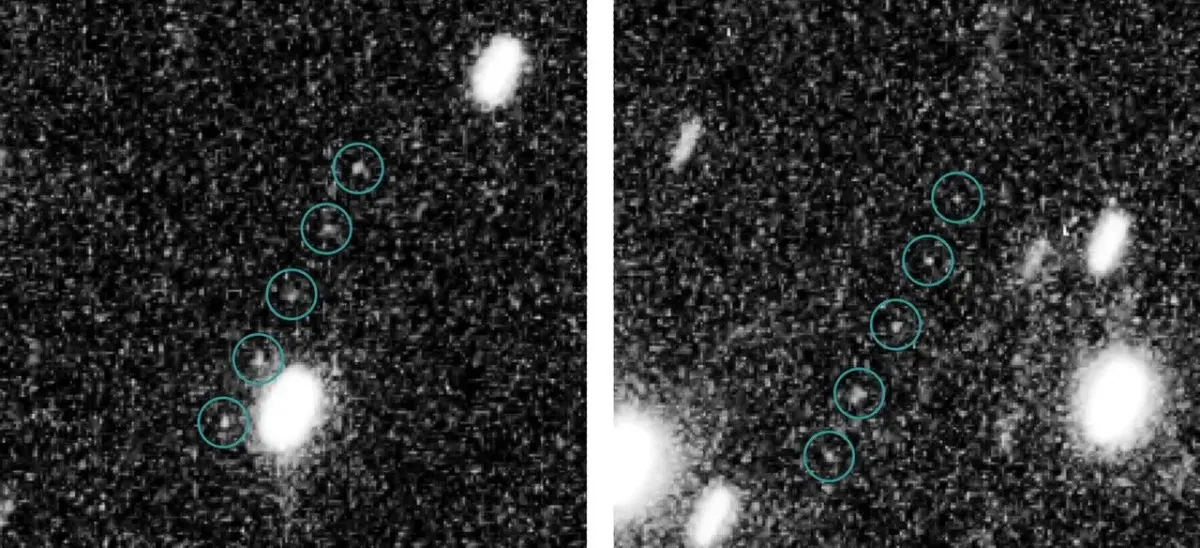
Imagine travelling beyond Neptune. The Sun would look smaller and weaker. Out there, a vast region of icy objects begins. This distant region is the Kuiper Belt. It holds Pluto and a huge number of smaller worlds. These objects preserve clues about our Solar System’s early history.
But what is the Kuiper Belt? Where is it located? And why does this distant region matter?
What Is the Kuiper Belt?
The Kuiper Belt is a large, doughnut-shaped region beyond Neptune. Astronomers estimate that it holds millions of small, icy objects. Hundreds of thousands are more than 100 kilometres wide. Some, including Pluto, are more than 1,000 kilometres wide.
These objects contain rock and water ice. They also contain frozen compounds, including ammonia and methane.
Astronomers sometimes call this region the Solar System’s “third zone.” It is similar to the asteroid belt. Both regions contain leftover material from the Solar System’s formation.
However, the two regions differ in location and shape. The asteroid belt lies between Mars and Jupiter. The Kuiper Belt lies beyond Neptune, and it is much thicker — more like a doughnut than a thin belt. Its objects also hold far more ice.
More than 2,000 trans-Neptunian objects have been catalogued. Yet these discoveries represent only a small fraction of the population.
Where Is the Kuiper Belt Located?
The Kuiper Belt begins near Neptune’s orbit. That is about 30 astronomical units from the Sun.
One astronomical unit, or AU, is the average distance between Earth and the Sun.
The main Kuiper Belt extends to around 50 AU. Beyond it, the scattered disk stretches much farther. Some objects travel nearly 1,000 AU from the Sun.
This makes the region much larger than a simple ring. It contains several groups of objects. Their orbits reveal how Neptune shaped this distant neighbourhood.
Why Didn't These Objects Form a Planet?
The Kuiper Belt contains material left behind during the Solar System’s formation.
Scientists think these icy objects could have formed a planet. But Neptune’s gravity stirred up the region too much. The small bodies could not come together into one large world.
The giant planets also changed their orbits early in Solar System history. One well-supported theory suggests these movements removed most of the original material — perhaps 7 to 10 times the mass of Earth.
The Kuiper Belt has continued changing since then. Objects sometimes collide and break apart. Some fragments may become comets. The collisions also make dust, which the solar wind blows out of the Solar System.
What Is Found Inside the Kuiper Belt?
Not every Kuiper Belt object follows the same path. Astronomers group them by their orbits.
Classical Kuiper Belt objects generally orbit between 40 and 50 AU. Some have nearly circular orbits. Others follow more stretched and tilted paths, shaped by past encounters with Neptune.
Astronomers call these groups “cold” and “hot.” These names describe their orbits, not their temperatures.
Resonant objects follow repeating orbital patterns with Neptune. Pluto is one example. It completes two orbits around the Sun while Neptune completes three.
Scattered disk objects follow more stretched and tilted orbits. Neptune’s gravity helped scatter them into these paths. Eris is the largest known member of this group.
Other objects have detached orbits. They never come closer than about 40 AU to the Sun, so Neptune has little effect on them. Sedna is one example. It never comes closer than about 76 AU, and its orbit takes it out to about 1,200 AU.
Is Pluto Part of the Kuiper Belt?
Yes. Pluto was the first Kuiper Belt object ever discovered.
Astronomers found it in 1930. At that time, astronomers did not yet know about the large population of icy worlds beyond Neptune.
Pluto is a dwarf planet. It follows a resonant orbit with Neptune. Eris is another major object in this distant region. It is similar in size to Pluto but has slightly more mass.
Pluto is not alone. Other dwarf planets in the Kuiper Belt include Haumea and Makemake.
Kuiper Belt vs Oort Cloud: What Is the Difference?
Both regions contain icy objects. Both are also considered sources of comets. But they are not the same.
The Kuiper Belt is a broad, doughnut-shaped region beyond Neptune. Its objects generally orbit near the plane of the planets.
The Oort Cloud is much farther away. Scientists think it forms a vast, roughly spherical shell around the Solar System.
The two regions also supply different types of comets. The Kuiper Belt is linked to short-period Jupiter-family comets, which orbit the Sun in 20 years or less. The Oort Cloud supplies most long-period comets.
Arrokoth: A World Frozen in Time
NASA’s New Horizons spacecraft explored Pluto in 2015. It later travelled farther into the Kuiper Belt.
On January 1, 2019, it flew past Arrokoth. This small object has two connected lobes. Its shape resembles a partly flattened red snowman.
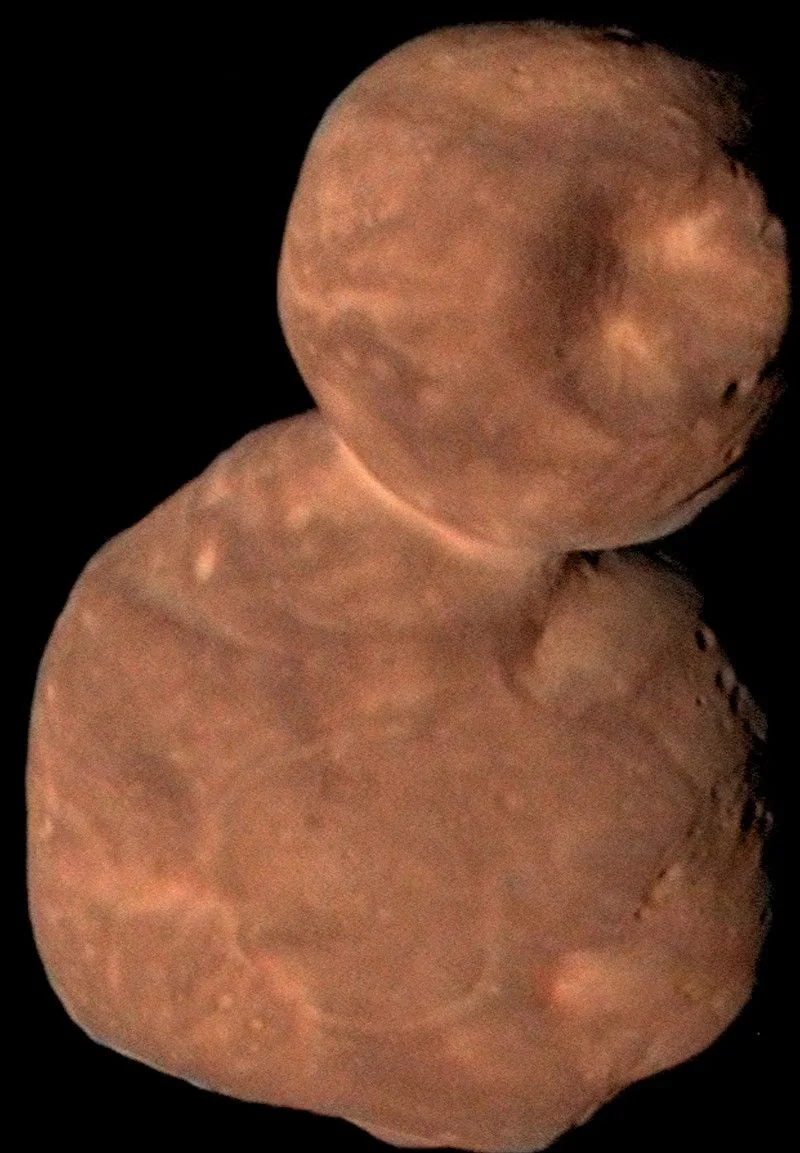
Arrokoth is especially interesting because NASA calls it the most distant and most primitive object ever explored by a spacecraft. It may preserve material from the early Solar System.
The spacecraft’s visit gave scientists a close look at one of these ancient icy worlds.
Why Does the Kuiper Belt Matter?
The Kuiper Belt is more than a distant collection of icy objects. It preserves material from the Solar System’s formation.
Its objects also reveal how Neptune shaped the outer Solar System. Their different orbits hold clues to that history.
Scientists have explored only a small part of this region. Only one spacecraft, New Horizons, has visited it. Many objects remain undiscovered. Each new observation can help explain how our planetary neighbourhood developed.
Beyond Neptune, the Solar System still holds many unanswered questions.
📄 Source & Citation
Source & Citation: NASA Science — Kuiper Belt: Facts · NASA Science — Arrokoth: Facts · NASA Science — Oort Cloud: Facts
Comments
No comments yet. Be the first to share your thoughts.
Leave a comment