

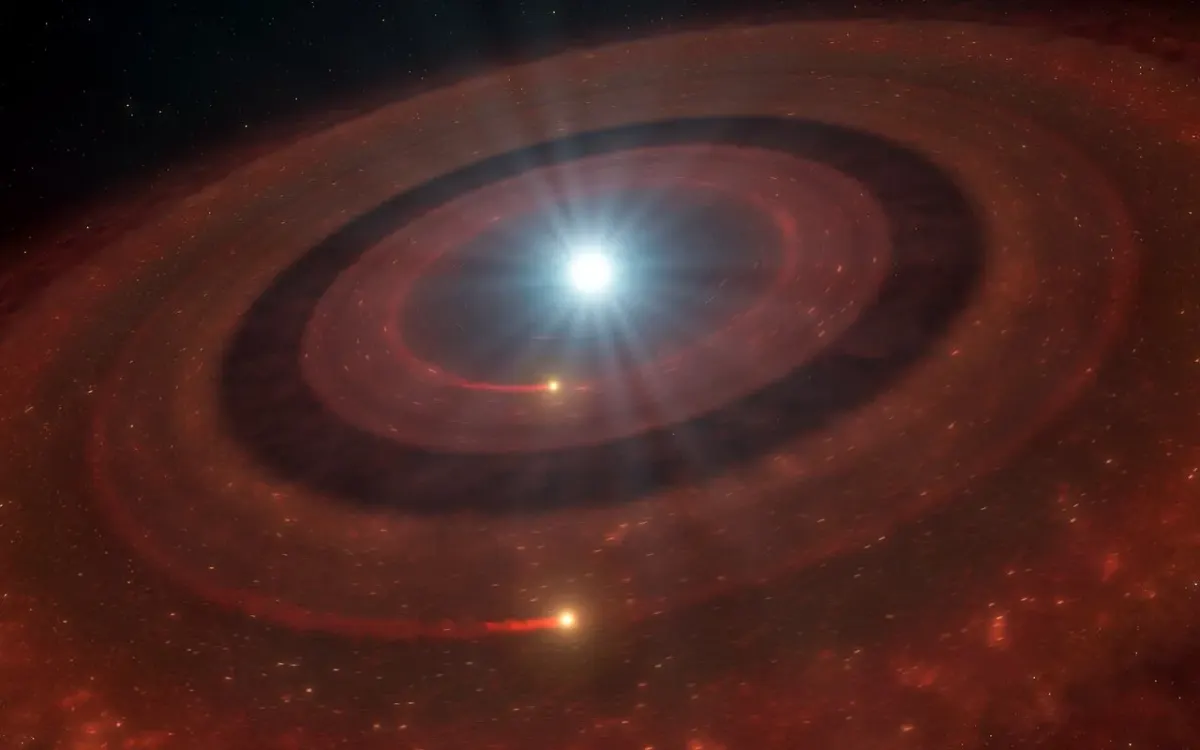
A star can die, but the planetary material around it may continue to tell its story. Around a white dwarf called J1328−1450, astronomers have discovered something unusual: a white dwarf debris disc made not of one ring of planetary rubble, but of two separate gaseous rings with a clear gap between them.
The discovery, made using the European Southern Observatory’s Very Large Telescope (ESO’s VLT), offers a rare look at what can happen to a planetary system after its central star reaches the end of its life. The white dwarf lies about 1,600 light-years from Earth. The two rings may be maintained by two planet-like bodies that survived the star’s transformation. One could be as large as Pluto or even the Moon.
The findings were published in Nature Astronomy on 26 October 2026.
A Dead Star With Two Rings Around It
J1328−1450 is a white dwarf: the dense, hot core left behind after a star similar to our Sun runs out of fuel and sheds its outer layers.
The final stages of a Sun-like star’s life can be violent for the planets around it. As the star expands, it can engulf and destroy nearby planets. Rocky bodies that survive may later break apart, leaving behind material that forms a debris disc around the white dwarf.
Astronomers have found gaseous debris discs around 21 other white dwarfs, and every one of them is a single, flat, rotating disc. J1328−1450 stands out because its gaseous material is not arranged in a single disc. Instead, it forms two concentric rings, with a distinct gap separating them.
The two rings also appear remarkably stable: their signal stayed almost unchanged over more than two years of observations, and they remain separated rather than spreading into one another. That unusual structure is what makes this system particularly interesting.
How Did Astronomers Find Two Separate Rings?
To investigate the system, the research team used X-shooter, an instrument on ESO’s Very Large Telescope in Chile’s Atacama Desert.
The key evidence came from the light emitted by gas around the white dwarf. When gas moves, its light shifts towards shorter or longer wavelengths depending on whether it is moving towards or away from us. Astronomers can use these shifts to study how the gas is moving.
A single rotating gaseous disc normally produces two peaks in its emission-line profile. One comes from the side moving towards us, while the other comes from the side moving away.
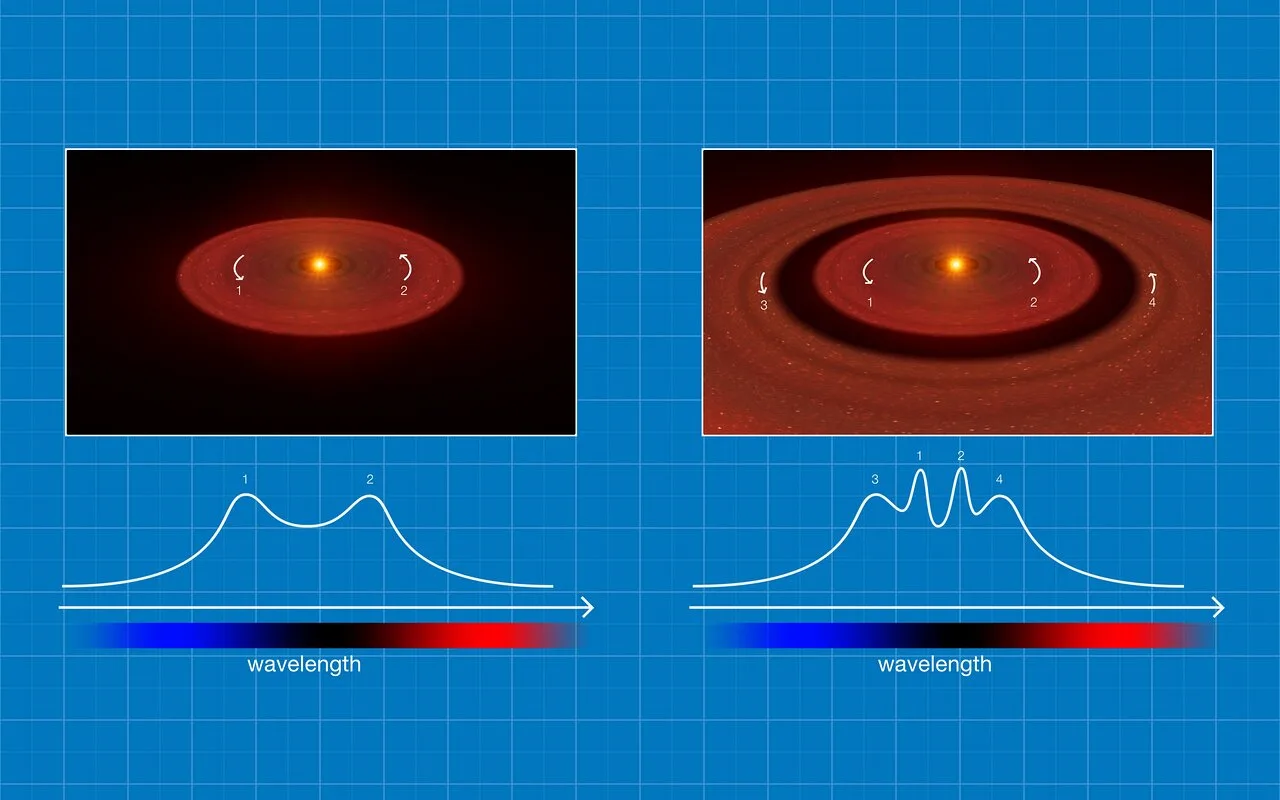
But J1328−1450 showed something different. Its emission lines had four peaks instead of two.
The researchers explain that this pattern can be understood as the combined signal from two separate rotating gaseous rings. Each ring produces its own pair of peaks because the gas in the two rings moves at different speeds.
The observations revealed an inner ring extending from 0.14 to 0.34 times the Sun’s radius, and an outer ring extending from 0.54 to 1.93 times the Sun’s radius. In other words, the whole inner ring is smaller than the Sun itself, and even the outer ring reaches only about twice the Sun’s radius. The gap between these regions provides further evidence that the gas is arranged in two distinct rings.
Two Rings May Point to Two Surviving Planetary Bodies
What could keep these rings in place?
The research team proposes that two surviving planet-like bodies, known as planetesimals, may be responsible. Each could occupy a separate orbit and help maintain the gaseous material around it.
The estimated sizes vary widely. The body associated with the inner ring may be comparable to a typical asteroid, measuring a few kilometres across. The object associated with the outer ring could be much larger — potentially reaching the size of Pluto or even the Moon.
“We have known for some time that planets may survive beyond the transformation of their central star, but this is the first example of a complex system with a double debris disc and potentially two surviving planetesimals,” says Nicola Gentile Fusillo, an astronomer at the University of Trieste, Italy, who led the study.
However, these bodies have not been directly observed. Their presence and estimated sizes are interpretations based on the structure of the rings and the researchers’ analysis.
The material in the disc provides another important clue. The observations detected calcium, oxygen, magnesium and iron — elements consistent with rocky planetary material found in our own Solar System.
The two rings also appear to have different compositions. Magnesium gas shows up only in the inner ring, while the outer ring appears largely depleted of it. This difference could mean that the material came from two bodies with different compositions. Another possibility is that the rings contain material from different parts of one body, such as its crust and core.
Why Have the Rings Not Merged?
The separation between the rings raises another question: what prevents the gas from spreading across the gap?
The researchers discuss a possible explanation involving sublimation and condensation. Gas may be released when dust particles collide or when solid material turns directly into gas. As this gas spreads outward, it cools. At sufficiently low temperatures, some of it can condense again into solid material.
This process could help confine the gas near the regions where it was produced, limiting its outward spread and helping the two rings remain separate.
It is a proposed explanation rather than a directly confirmed mechanism. The unusual structure also presents a challenge for existing models of how gaseous debris discs form and evolve.
Could This Be a Glimpse of Our Solar System’s Future?
Our Sun will eventually exhaust its fuel, expand and shed its outer layers before becoming a white dwarf. That transformation may destroy Earth. The system around J1328−1450 offers astronomers a glimpse of the kind of debris structures that could remain after a Sun-like star reaches the end of its life.
It is not an exact prediction of what will happen to our Solar System. But it shows that planetary systems can leave behind more complex structures than a single disc of debris.
For now, J1328−1450 gives researchers a rare opportunity to study how planetary material behaves around a dead star — and how some planetary bodies may survive even after their star has changed beyond recognition.
📄 Source & Citation
Source & Citation: ESO — eso2613 press release · Research paper: Gentile Fusillo et al., “A double debris disc around a white dwarf sculpted by two planetary bodies”, Nature Astronomy (2026), DOI: 10.1038/s41550-026-03004-3 (arXiv version)
Comments
No comments yet. Be the first to share your thoughts.
Leave a comment