

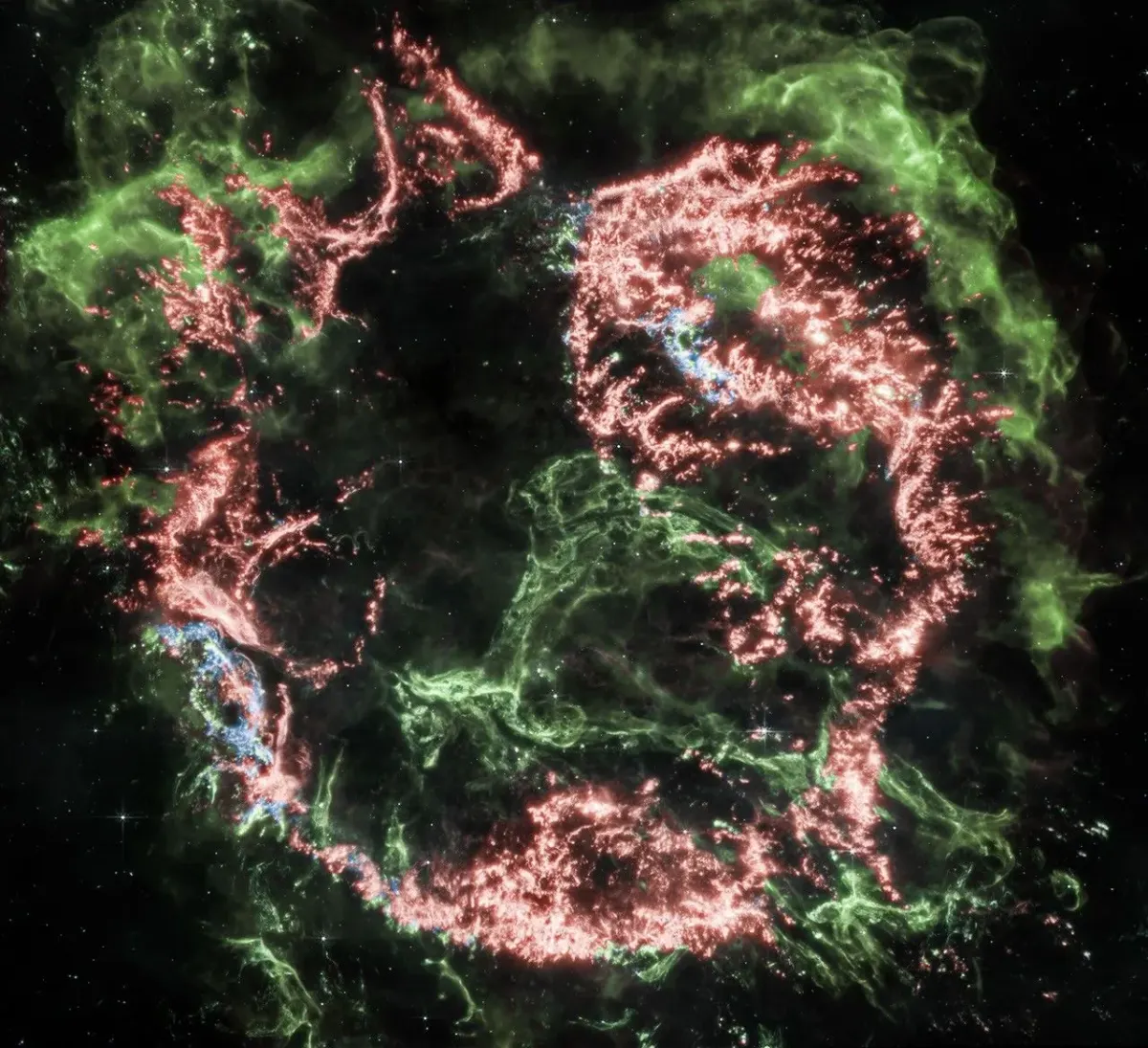
A star can leave behind more than glowing debris. Its dust can preserve clues about its final moments. Now, NASA’s James Webb Space Telescope has found such clues in Cassiopeia A. This famous supernova remnant holds material from a massive star that exploded. Webb’s new observations suggest its inner layers may have mixed shortly before the blast.
The findings were announced on November 23, 2026. They were published in The Astrophysical Journal Letters. They offer a new way to study a star’s life. Even centuries after its explosion, its remains can reveal what happened inside.
Dust That Remembers a Star
Cassiopeia A, also called Cas A, is a supernova remnant. It is the cloud of gas and dust left behind after a massive star explodes. Cas A lies about 11,000 light-years away in the constellation Cassiopeia. Its explosion took place 340 years ago from Earth’s perspective, making it the youngest known remnant of an exploding massive star in our galaxy. The material spreads into space. Over time, it can help form new stars and planets.
Before the explosion, the star had a layered structure. It began its life inside a large cloud. Gravity pulled gas and dust together. The centre grew hotter and denser. Eventually, hydrogen began changing into helium. It became a full star, like the Sun.
As its core used up hydrogen, the story changed. The core shrank and grew hotter. Helium then began forming heavier elements. This process continued through later stages. Iron marked the end of this chain of core fusion. Meanwhile, lighter elements kept fusing in shells around the core. The star built layers containing different elements.
These layers were not just parts of a star. They held a record of its changing life. When the star exploded, its material spread outward. Some of that material cooled and formed dust grains. Those grains gathered into clumps, each about the size of our Solar System.
Webb studied the light from these clumps. Its sharp mid-infrared observations revealed their chemical makeup. That gave researchers a way to trace the star’s earlier structure.
Three Regions Tell Different Stories
The research team used earlier observations from NASA’s retired Spitzer Space Telescope. Spitzer could not show the same fine details. But it helped identify three regions worth studying.
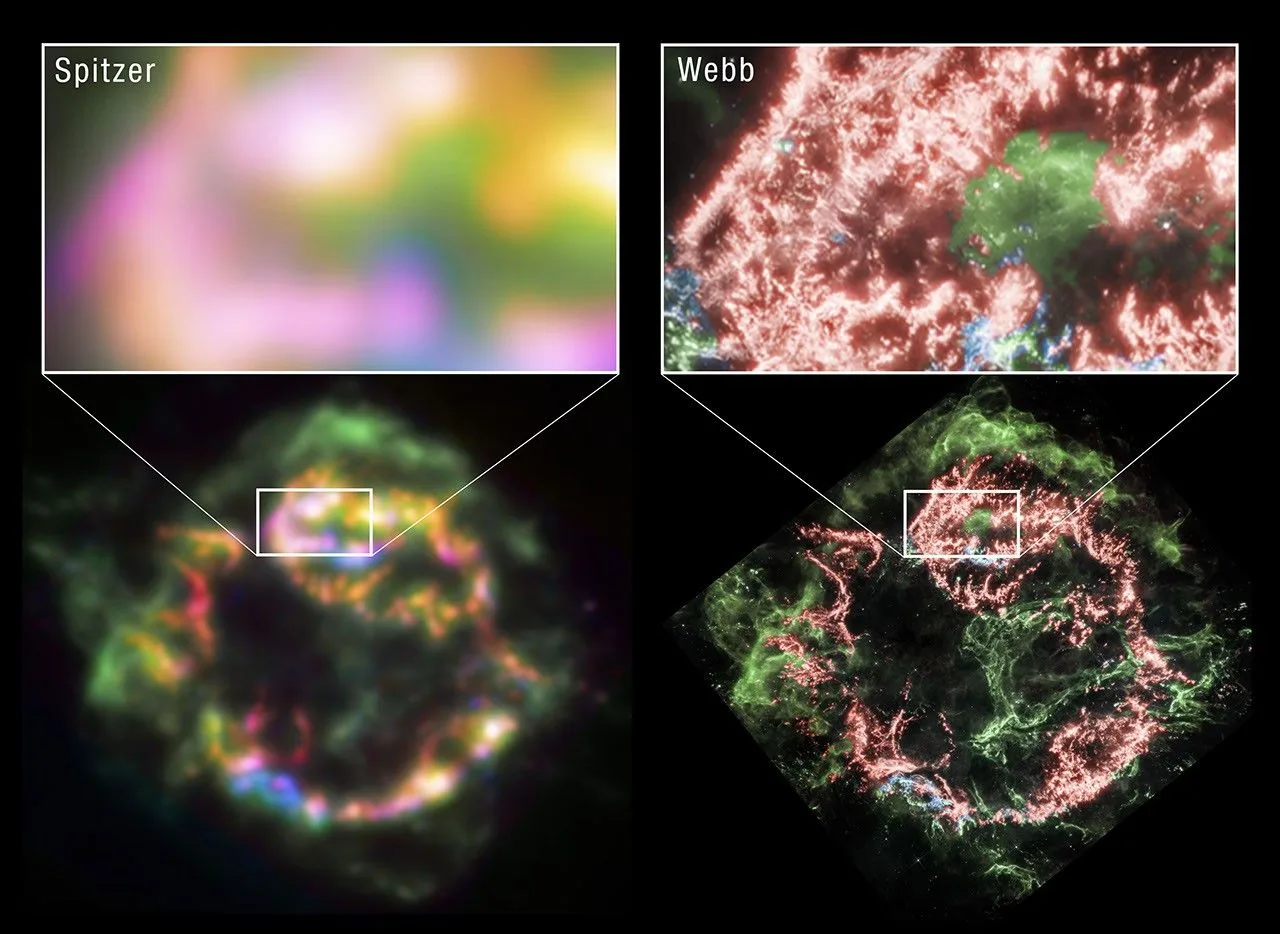
Webb then examined those targets in much greater detail. Two were inside a region called the reverse-shocked area. Here, a shock wave moves inward. It meets material thrown outward by the explosion.
The dust in these two regions was different. One region contained mostly silica dust. The other was dominated by carbon dust. Silica is a material made from silicon and oxygen.
The third target was the Green Monster. Webb had discovered this structure earlier. Its dust was rich in complex magnesium silicates. But it had a different origin. This material came from the star’s outer layers. The star had shed it before the explosion.
Together, these regions showed different parts of the star’s history. They also helped researchers connect the dust to the star’s internal layers.
A Possible Change Just Before the Explosion
The most important clue involved a process called a shell merger. It happens when layers inside a star mix together. The research team found evidence that this may have happened in Cas A’s original star.
“Material within these shells churns and circulates, which can cause the shells to merge shortly before the supernova explosion,” said Tea Temim, the study’s lead author and a research scientist at Columbia University. For example, oxygen-burning and carbon-burning layers can mix.
Such a change would alter the star’s structure. It would also change the elements found in the material thrown out. The dust left behind can therefore carry signs of that event.
Webb mapped these clues across the whole remnant. The observations suggest the merger was underway very shortly before the explosion. Researchers think it may have happened just hours before the star’s core collapsed.
“It’s telling us about what was happening, we think, in the hours leading up to core collapse,” said Dan Milisavljevic of Purdue University, a co-author of the study.
This timing is an interpretation of the evidence. Webb did not watch the star explode. Instead, astronomers used its remaining dust as a record. They also combined Webb’s findings with X-ray observations from NASA’s Chandra X-ray Observatory and the JAXA-led XRISM mission.
The result gives scientists a new way to study dead stars. It may help them work backwards from a remnant. They can use its dust to understand the star that once existed.
Why This Discovery Matters
Supernovae spread elements through galaxies. Those elements become part of future stars and planets. Dust also plays an important role in this process.
Webb’s observations show how a star’s final changes affect the material it releases. They also show that the dust left behind can link an explosion to the star that came before it.
At NavsoraTimes, we find one detail especially striking. A star can vanish, yet its dust keeps clues. Those tiny grains carry a story across time. Webb is helping us learn how to read it.
📄 Source & Citation
Source & Citation: NASA — NASA’s Webb Shows How Supernova Dust Chronicles Star Evolution (23 November 2026) · Temim et al. (2026), “JWST Resolves Dust Emission from Individual Ejecta Clumps in Cassiopeia A: Dominant Grain Compositions Point to a Shell Merger in the Progenitor”, The Astrophysical Journal Letters 1012, L26 — DOI: 10.3847/2041-8213/aea901
Comments
No comments yet. Be the first to share your thoughts.
Leave a comment