 Sanjay Verma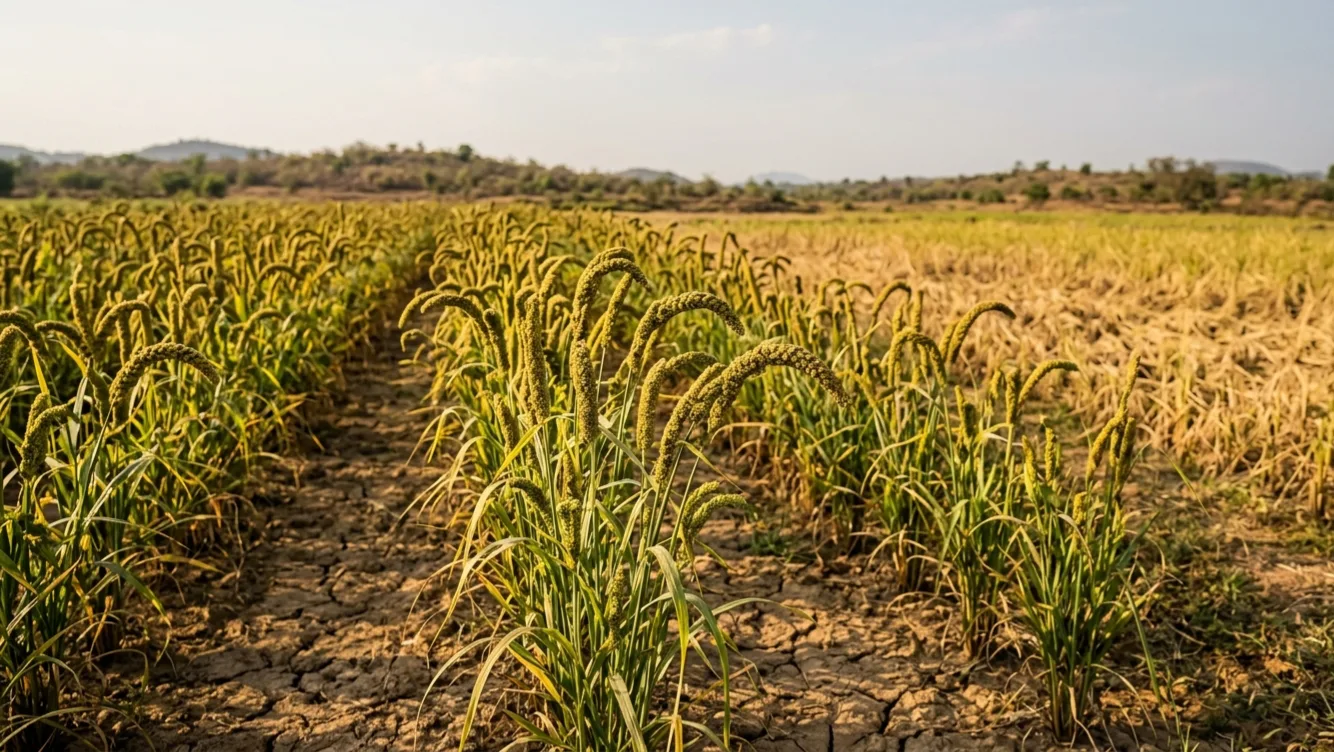
In This Article
- The Crop That Keeps Producing When Everything Else Fails
- Why Rice Struggles When Rains Are Unreliable
- How Did Scientists Actually Measure Drought Resilience?
- What This Means for Farmers and Food Security
- The Limits of the Study and What Comes Next
Picture a village in eastern India. The monsoon arrives late. The rice paddies, flooded and nursed for months, lose more than half their harvest in a single bad season. A few kilometres away, on a dry hillslope, a farmer's finger millet crop loses almost nothing. A major study published in Scientific Reports just proved, with 25 years of real data, that this gap is not luck. Drought resilience in millets is structural, measurable, and large enough to reshape how India feeds itself on uncertain rain.
The Crop That Keeps Producing When Everything Else Fails
About 80 percent of the world's farmland depends entirely on rainfall, with no pipes or irrigation channels to fall back on. In India, that figure covers roughly 60 percent of all agricultural land, and in the state of Odisha it is nearly everything. When the monsoon runs short, yields crash, incomes collapse, and families go hungry.
For decades, rice dominated these farms. Governments pushed it. Markets rewarded it. But rice is a thirsty crop, and the monsoon is becoming less predictable every decade. Researchers at the ICAR-Indian Institute of Water Management in Bhubaneswar decided to test whether the older, tougher crops had been right all along.
They studied seven crops across seven drought-prone districts of Odisha over 25 years (1998 to 2023): two types of rice, maize, and four millets (finger millet, small millet, sorghum, and pearl millet). The answer surprised even the researchers behind the study.
Why Rice Struggles When Rains Are Unreliable
Rice is extremely sensitive to how much rain falls. Think of it like a car that runs perfectly on a full tank but breaks down the moment fuel dips below a certain level. When seasonal rainfall in Odisha fell below normal, wet-season rice yields dropped by 40 to 60 percent across the study districts, and in some places even more.
In Sundargarh district, a single bad monsoon year wiped out nearly 65 percent of the wet-season rice harvest. In Ganjam, rice showed an elasticity value of 27 — meaning a small drop in rain caused a disproportionately enormous drop in yield. Maize fared slightly better, with yield losses between 28 and 46 percent, but still suffered badly by any measure.
The problem is not just one bad year. It is the unpredictability over time. Farmers who rely on rice face wildly swinging harvests year after year, making it nearly impossible to plan, save, or invest. That instability is just as damaging as the drought itself.
How Did Scientists Actually Measure Drought Resilience?
This is where the study does something genuinely new. Most earlier research asked a simple question: does this crop die in a drought? The team led by A. K. Nayak and B. S. Satpathy asked a harder one: how resilient is this crop across all the ways drought can hurt a farm?
They built a tool called the Composite Crop Resilience Index, or CCRI. Think of it as a report card with three grades. The first grade measures how much drought the area is exposed to in the first place. The second measures how sensitively a crop's yield reacts to changes in rainfall. The third measures how stable the crop's yield is year after year, regardless of weather swings. All three scores are combined into a single number between 0 and 1, where 1 means perfectly resilient.
"Millet-based systems exhibited substantially greater climatic resilience than rice-based systems under drought-prone rainfed conditions, highlighting their potential for climate adaptation and resilient crop diversification."
— Nayak, Satpathy et al., ICAR-Indian Institute of Water Management · Scientific Reports, 2026Finger millet and small millet scored between 0.90 and 0.98 on the CCRI. Wet-season rice scored between 0.25 and 0.40. That is not a small gap. It is the difference between a crop that holds firm and a crop that crumbles. The team then tested the index under five different scoring methods to make sure the result was not a fluke. The millet ranking held every single time.
What This Means for Farmers and Food Security
The findings carry a direct message for agricultural policy. India declared 2023 the International Year of Millets, and the government has been encouraging farmers to grow more of them. This study puts hard numbers behind that push for the first time, at least for the drought-prone districts of eastern India.
Millets already grow in the hardest conditions: shallow soils, hillslopes, low inputs, no irrigation. They have deeper roots than rice, shorter growing seasons, and need far less water per kilogram of food produced. The study shows these biological advantages translate directly into stable harvests across 25 years of real monsoon variability, including the drought years of 1998, 2002, 2009, and 2015.
The study also found that crop choice matters far more than geography. Districts that are close together and face similar rainfall still show very different outcomes depending on what farmers grow. That means shifting to millets could meaningfully reduce climate risk even without any change in the weather itself.
The Limits of the Study and What Comes Next
The researchers are clear about what this study does not cover. The CCRI measures climate and yield data, but it does not account for soil health, farmer income, market prices for millets, or whether households can actually afford to switch crops. Rice commands better prices in many markets, and social habits around rice are deeply rooted. A crop that scores 0.98 on a resilience index still needs someone willing to grow and eat it.
The rainfall-yield relationship in the model also assumes a straight line, where more rain always means more yield. Real droughts can behave differently, with yield losses accelerating sharply once rainfall drops past a critical threshold. Future versions of the index could capture those non-linear effects using field-level data or remote sensing.
The framework itself, however, is openly available. The team published the Python code on Zenodo, and the method works on any long-term rainfall and yield dataset. That makes it potentially useful for drought-risk planning in rainfed regions of South Asia and Sub-Saharan Africa, where the same water uncertainty plays out across entirely different crops and landscapes.
- Millets hold firm in drought — Finger millet and small millet lost less than 20 percent of their yield in the worst drought years, while rice lost up to 65 percent in the same conditions.
- Crop choice beats geography — Statistical tests showed no significant difference in resilience between districts, but a massive difference between crops. What you grow matters more than where you grow it.
- The tool is transferable — The CCRI requires only rainfall records and crop yield data, making it usable in any data-scarce region that wants to plan for a drier future.
"The framework may support climate-resilient crop diversification planning, drought adaptation strategies, and resilience-oriented agricultural policy development in vulnerable rainfed agroecosystems." — Nayak, Satpathy et al., Scientific Reports, 2026.
Millets fed people on difficult land for thousands of years before rice took over. The data now says they were doing something right. For farmers who must grow food under a changing sky, with no irrigation and no safety net, that is not just an agricultural finding. It is a practical path to staying fed.
📄 Source & Citation
Primary Source: Nayak AK, Satpathy BS, Pradhan S, et al. (2026). A data-light composite climate resilience index reveals superior drought resilience of millets in rainfed agroecosystems. Scientific Reports. https://doi.org/10.1038/s41598-026-55943-6
Authors & Affiliations: A. K. Nayak, B. S. Satpathy, S. Pradhan, N. M. Jeepsa, S. Barik, Mithlesh Kumar, D. K. Panda, M. Jothimani, A. Sarangi, S. K. Mishra (ICAR-Indian Institute of Water Management, Bhubaneswar; OUAT, Bhubaneswar; Addis Ababa University, Ethiopia)
Data & Code: Python scripts for CCRI computation available at Zenodo (Record 20098036). District-level crop yield data: Government of Odisha Directorate of Agriculture. Rainfall data: India Meteorological Department.
Key Themes: Drought Resilience · Millets · Rainfed Agriculture · Climate Adaptation · Food Security
Supporting References:
[1] IPCC (2022). Climate change 2022: Impacts, adaptation and vulnerability. Cambridge University Press.
[2] Satyavathi CT et al. (2021). Pearl millet: A climate-resilient nutricereal for mitigating drought and water scarcity. Frontiers in Plant Science, 12:659938.
[3] Wilson MKL & VanBuren R (2022). Leveraging millets for developing climate resilient agriculture. Current Opinion in Biotechnology, 75:102683.
No comments yet. Be the first to share your thoughts.
Leave a Comment