 Priyanka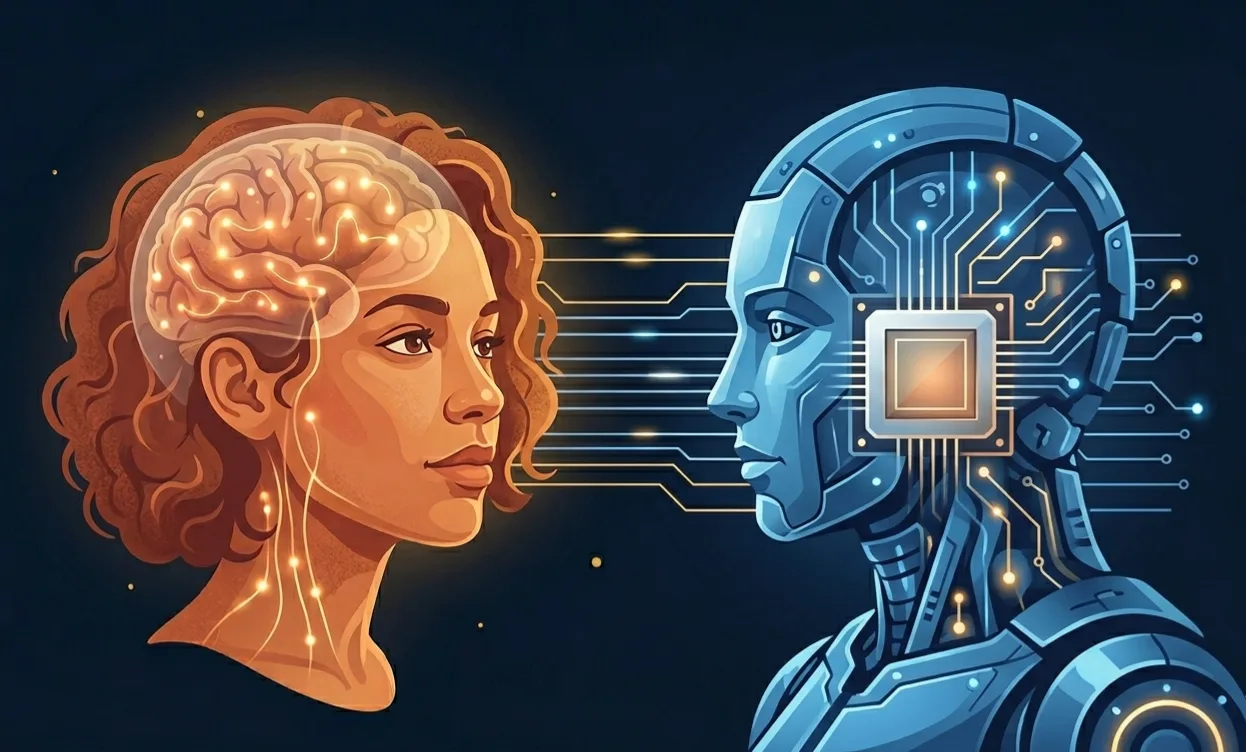
In This Article
- The Quiet Problem With Calling AI "Smart"
- Why Copying the Human Brain Keeps Failing
- Why Is a Toddler Harder to Copy Than a Chess Master?
- What Smarter Machines Mean for Your Daily Work
- The Questions That Still Need Answering
Your phone can do sums faster than any maths teacher on Earth. Yet it cannot tie a shoelace, and a three-year-old can. That odd gap sits right at the heart of the human vs artificial intelligence debate, and a team of Dutch scientists says we have been thinking about it the wrong way. Their work argues that machines are not racing to become little copies of us. They are something else entirely, and that matters for your job, your safety, and your trust.
The Quiet Problem With Calling AI "Smart"
For years, people have measured machines against one yardstick: the human mind. We ask when AI will "think like us" or "reach human level." Researchers at the Dutch institute TNO say this question is built on a quiet mistake. We treat human intelligence as the one true kind of intelligence, and everything else as a copy that is not quite real.
But humans are just one example of a thinking system, shaped by millions of years of survival. A machine is shaped by physics and engineering instead. So judging it by our standard is like grading a fish on how well it climbs a tree.
Once you drop the idea that human thinking is the gold standard, a bigger question opens up. If machines are not copying us, then what exactly are they becoming?
Why Copying the Human Brain Keeps Failing
Imagine trying to rebuild a brick house using only glass. You can copy the shape, but the material changes everything. That is the gap between human and machine intelligence. Our brains are wet biology. Machines are dry silicon, and the two run on completely different rules.
The differences are huge. Signals in a machine move close to the speed of light. Signals in your nerves crawl along at about 120 metres per second. Machines can copy a new skill to a million other machines instantly. You cannot copy your bike-riding skill into a friend's head.
There is one place where biology still wins big. Your brain runs on less power than a light bulb, while a computer doing similar work could light up a whole village. So the human brain is not weak. It is just built for a different job, and that job becomes clear in one famous puzzle.
Why Is a Toddler Harder to Copy Than a Chess Master?
Here is the surprise that still trips up engineers. It is fairly easy to make a computer beat a champion at chess or ace a hard maths test. It is shockingly hard to give that same computer the skills of a one-year-old: seeing, grabbing, balancing, walking across a messy room. Scientists call this Moravec's paradox, and it flips our common sense upside down.
Why does it happen? Because the tasks we find "easy" are not actually simple. When you tie a shoelace, millions of signals rush through your eyes, muscles, and balance organs at once. Your brain spent over a billion years getting good at this. Abstract thinking, like algebra, is a brand new trick, maybe less than 100,000 years old. We are still beginners at it.
"We are all prodigious Olympians in perceptual and motor areas, so good that we make the difficult look easy."
— Hans Moravec, roboticist · Mind Children, 1988So a hard task for you is not always a complex task for a machine, and an easy task for you is not always simple for a machine. Once you see that, the idea of one mind being "smarter" starts to fall apart, and a more useful question takes its place.
What Smarter Machines Mean for Your Daily Work
The TNO team argues we should stop chasing human-like AI and start building machines that fill our weak spots instead. Humans are slow at big calculations and we carry over 200 thinking traps, known as cognitive bias, where the mind quietly bends facts in unhelpful ways. Machines do not get tired, stressed, or emotional, and they do not have a hidden agenda.
So the smart plan is teamwork, not a contest. Let machines handle the heavy data, the maths, and the steady checking. Let people handle surprise, judgement, creativity, and odd situations no rulebook covers. A team that mixes both, instead of two players with the same blind spots, is safer and stronger.
This also changes how you should treat AI at work. You do not need to understand every step inside the machine to trust it, just as you trust a plane without knowing its engine. Trust should come from testing and proven results, not from a smooth story the system tells you.
The Questions That Still Need Answering
This view has limits, and the researchers are honest about them. They do not claim human-level AGI is impossible. Most AI experts think it will arrive one day. The open debate is when, and what shape it will take. Narrow AI also has a real weakness: it struggles badly when events get rare, messy, or unexpected, which is exactly when human judgement still matters most.
The biggest gap right now is people, not machines. We need workers and leaders who truly understand how AI "thinks," so they know when to trust it and when to step in. The next race is not machine against human. It is whether we can learn fast enough to work beside a mind unlike our own.
- Not one scale — Human and machine intelligence are different kinds of smart, not higher and lower on the same ladder.
- Easy is not simple — Walking and seeing are computationally harder for machines than chess or algebra.
- Teamwork beats rivalry — The best results come when AI covers human weak spots, not when it copies human strengths.
"No matter how intelligent autonomous AI agents become, at least for the foreseeable future, they will remain unconscious machines with a fundamentally different operating system than people and other animals." — Korteling et al., Frontiers in Artificial Intelligence, 2021.
The real lesson is not about who wins. It is about working well with a partner who will never see the world the way you do, and being wise enough to value that difference instead of fearing it. [INTERNAL LINK: how machine learning actually works]
📄 Source & Citation
Primary Source: Korteling JE, van de Boer-Visschedijk GC, Blankendaal RAM, Boonekamp RC, Eikelboom AR (2021). Human- versus artificial intelligence. Frontiers in Artificial Intelligence, 4:622364. https://doi.org/10.3389/frai.2021.622364
Authors & Affiliations: J. E. Korteling and colleagues, TNO Human Factors, Soesterberg, Netherlands.
Data & Code: Conceptual analysis paper; no datasets. Open access under the Creative Commons Attribution License (CC BY).
Key Themes: Human vs artificial intelligence · Artificial general intelligence · Moravec's paradox · Narrow AI · Human-AI collaboration
Supporting References:
[1] Moravec H (1988). Mind children. Harvard University Press.
[2] Tversky A, Kahneman D (1974). Judgment under uncertainty: heuristics and biases. Science, 185(4157):1124–1131.
[3] Tegmark M (2017). Life 3.0: being human in the age of artificial intelligence. Knopf.
No comments yet. Be the first to share your thoughts.
Leave a Comment