 Krishan Gopal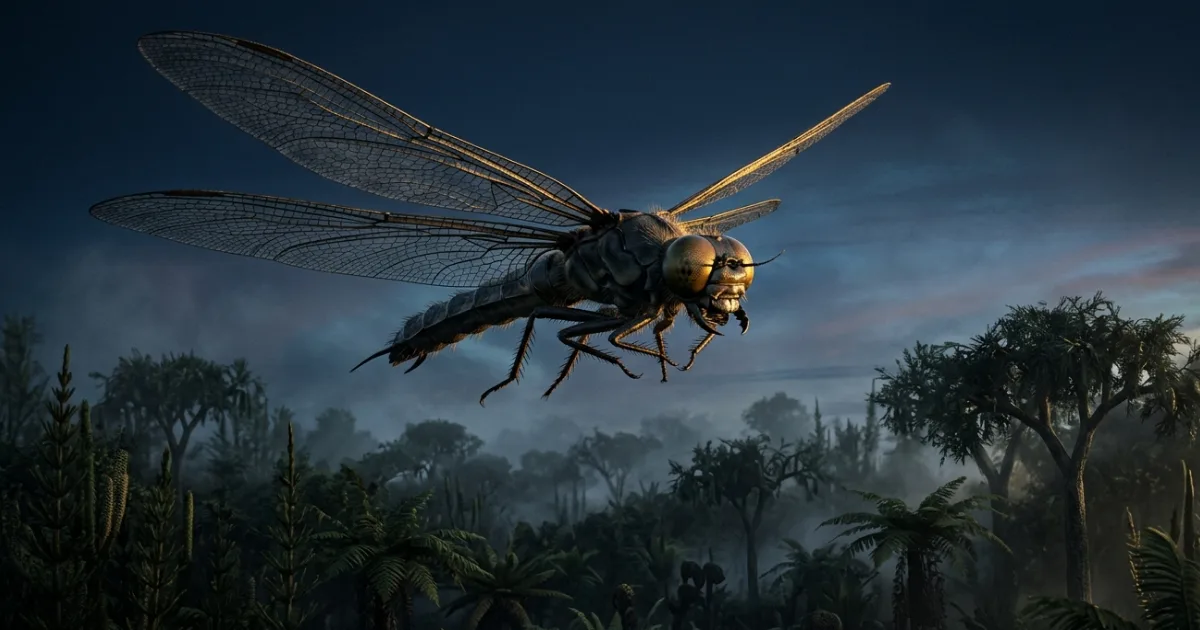
In This Article
- The Age of Giant Insects
- The Popular Theory That Made Sense
- How Do Insects Actually Breathe?
- Why the Old Theory Is Falling Apart
- What This Means for Science (and You)
Imagine a dragonfly with a wingspan as wide as a grown man's arm. Three hundred million years ago, such creatures were not fantasy — they ruled the skies. These ancient insects, some as large as modern seagulls, have long puzzled scientists. The popular explanation has been that back then, Earth's air contained much more oxygen. But a groundbreaking new study has just called that whole idea into question. And now, researchers are back to square one.
The Age of Giant Insects
During the Carboniferous period, the planet looked alien. Supercontinent Pangaea dominated the globe. Giant ferns and towering mosses formed vast swamp forests. And the air? It was thick — oxygen levels were around 30% to 35%, a full half again as much as what we breathe today. It's no wonder that life took on monstrous proportions. Cockroaches the size of mice skittered through the undergrowth. Millipedes called Arthropleura grew as long as a small car, stretching up to 2.5 metres. But the true marvels were above. Mayfly-like insects boasted wingspans of 45 centimetres. The real giants — dragonfly-like predators known as griffinflies — stretched up to a stunning 70 centimetres, or roughly the size of a sparrowhawk. These were the largest insects that have ever existed.
The Popular Theory That Made Sense
For decades, scientists had a tidy answer. The high oxygen levels of the Carboniferous (often called the "Oxygen Pulse") must have allowed insects to grow so big. It seemed logical: insects breathe through a network of tubes called tracheae, not lungs. Scientists reasoned that oxygen simply diffuses, or spreads, into the insect's tissue through these tubes. The bigger the bug, the farther the air has to travel, and the more oxygen you'd need in the air to push it through. So, when oxygen levels later dropped in the Permian period, the giant insects could no longer breathe and died out. This elegant story has been taught for years, and to many, it felt like a closed case.
How Do Insects Actually Breathe?
To understand why the old theory might be wrong, we need to look inside an insect. Unlike us, they don't have lungs. Instead, air enters through tiny holes in their body called spiracles. From there, it moves into a branching tree of tubes — the tracheae. These tubes get thinner and thinner until they end in microscopic, fluid-filled sacs called tracheoles. It's at these tracheoles where oxygen passes into the muscles. The problem is, this final step relies entirely on passive diffusion, a relatively slow process. But here's the catch: new research suggests that, far from being a bottleneck, this system is highly adaptable and likely wasn't limiting insect size at all.
Why the Old Theory Is Falling Apart
The new study, led by Professor Edward (Ned) Snelling of the University of Pretoria, took a fresh look at insect flight muscles. Using high‑power electron microscopes, the team examined the flight muscles of 44 different insect species — from tiny flies to massive Goliath beetles. They wanted to measure the physical space taken up by the tracheoles. Here's what they found: in almost every species, the tracheoles occupied only about 1% of the flight muscle's volume. This tiny percentage remained the same whether the insect was tiny or huge. That's the exciting part. It means insects have enormous room to grow more breathing tubes if they need to. They are not restricted by space.
"It's a simple, elegant explanation. But it's wrong."
— Prof. Edward Snelling, University of Pretoria, on the old oxygen theoryTo underline the point, the researchers compared insects with vertebrates like birds and mammals. In birds and mammals, the blood vessels that deliver oxygen to the heart muscle take up about 10% of the space. Insects can squeeze their entire breathing system into just one‑tenth of that. "There must be great evolutionary potential to invest more in breathing tubes," said Professor Roger Seymour of Adelaide University. If oxygen supply was really the main limitation, evolution would have made more breathing tubes a long time ago. Since it didn't, oxygen might not be the boss we thought it was.
What This Means for Science (and You)
So, if high oxygen levels weren't the reason for giant insects, what was? The honest answer is that scientists don't yet know. The new study has rocked a foundational theory, and that's a good thing. It means science is self‑correcting. Some researchers argue that oxygen might still limit insects in other ways, but the flight muscle tracheoles — the core of the old argument — are off the hook. Other possibilities are now being explored: Was it fierce competition with ancient birds and reptiles that drove them to extinction? Did a limit in the physical strength of their exoskeletons prevent them from growing larger? Or was it a combination of factors? For now, the mystery of the Carboniferous giants is wide open again. And that's exactly where the next big discovery lies — waiting for us to ask bigger and better questions.
- Old theories are not gospel. Even the most popular scientific ideas can be overturned with new, rigorous evidence.
- Tiny details can unlock huge mysteries. By looking at microscopic tubes inside a muscle, scientists challenged our understanding of an entire prehistoric world.
- Science is a process, not a destination. The "fall" of the oxygen theory means we now know enough to ask smarter questions next time.
📄 Source & Citation
Primary Source: Snelling, E. P., Lensink, A. V., Clusella-Trullas, S., Weldon, C., Lehmann, P., Terblanche, J. S., et al. (2026). Oxygen supply through the tracheolar–muscle system does not constrain insect gigantism. Nature. https://doi.org/10.1038/s41586-026-10291-3
Authors & Affiliations: Edward P. Snelling (University of Pretoria), Roger S. Seymour (Adelaide University), and an international team from Arizona State University, Stellenbosch University, and Trinity College Dublin.
Data & Code: Data available via the Nature journal's online portal or by contacting the corresponding author.
Key Themes: Palaeontology · Insect Physiology · Evolutionary Biology · Carboniferous Period · Atmospheric Science
Supporting References:
[1] Harrison, J. F., et al. (2010). Atmospheric oxygen level and the evolution of insect body size. Proceedings of the Royal Society B, 277(1690), 1937-1946.
[2] Dudley, R. (1998). Atmospheric oxygen, giant Paleozoic insects and the evolution of aerial locomotor performance. Journal of Experimental Biology, 201(8), 1043-1050.
[3] Clapham, M. E., & Karr, J. A. (2012). Environmental and biotic controls on the evolutionary history of insect body size. Proceedings of the National Academy of Sciences, 109(27), 10927-10930.
No comments yet. Be the first to share your thoughts.
Leave a Comment