 Krishan Gopal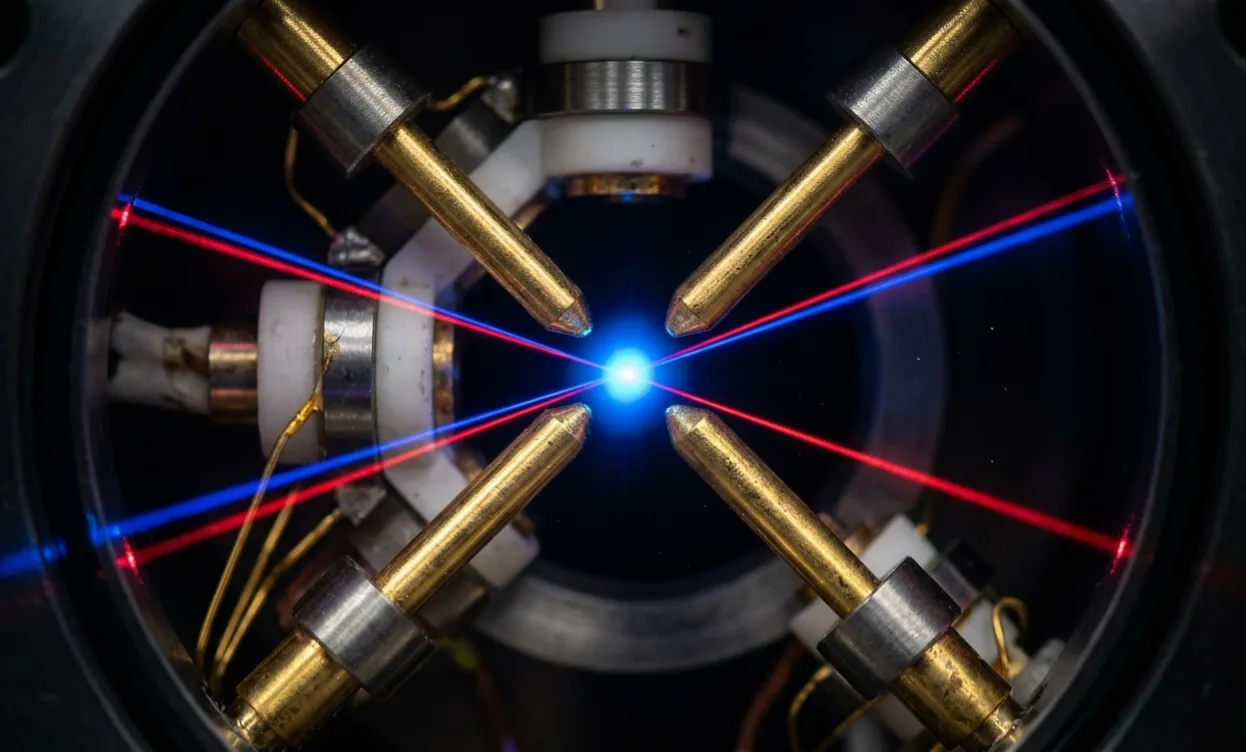
In This Article
- Time Already Slows Down — That Much We Knew
- The Clocks That Can Measure a Single Heartbeat of the Universe
- How Does a Clock Experience Multiple Times at Once?
- The Four Strange Effects Scientists Found
- The Experiment That Could Catch Time Being Quantum
- Why This Changes Everything About How Physicists Think of Time
Time is the most familiar thing in existence. Everyone feels it passing. Everyone knows it cannot be paused or reversed. And for over a century, science has known something even stranger about it: time does not pass at the same speed everywhere. A clock on a fast-moving rocket ticks more slowly than a clock sitting still. A clock on the ground floor of a building ticks a tiny bit more slowly than one on the roof. This is called time dilation, and it is one of Einstein's most tested and confirmed predictions. But now a team of physicists at Stevens Institute of Technology, the University of Waterloo, NIST, Colorado State University, and Stockholm University has found something that even Einstein never imagined. They have shown that time dilation itself can become quantum — meaning a single tiny clock can experience multiple versions of time simultaneously, existing in a superposition of different time flows, all at once.
Time Already Slows Down — That Much We Knew
The idea that time can slow down is strange enough on its own. Albert Einstein predicted it in 1905 as part of his special theory of relativity, and again in 1915 in his general theory. The key insight was this: time is not a fixed, universal backdrop ticking away the same for everyone. It is woven into the fabric of space itself, and it bends and stretches depending on how fast something is moving and how strong the gravitational pull around it is. The first direct proof of this came from a simple but brilliant experiment in 1971. Two physicists named Hafele and Keating put atomic clocks onto aeroplanes and flew them around the world in both directions. When they compared those clocks to identical ones that stayed on the ground, the flying clocks had recorded different amounts of time — by exactly the tiny amount Einstein's equations predicted. Time had genuinely passed at different rates for the two sets of clocks. Since then, every GPS satellite in orbit has to constantly correct for the fact that time runs slightly faster in space than on the ground — if it did not, navigation errors would pile up at a rate of more than ten kilometres per day.
The Clocks That Can Measure a Single Heartbeat of the Universe
The atomic clocks used in this research are unlike any timepiece most people have ever imagined. They are called optical ion clocks, and they are the most precise measuring instruments ever built by humans. A standard atomic clock, like those used in GPS systems, is accurate to about one second in 300 million years. An optical ion clock is roughly 100 times more precise than that. The current world record holder — an aluminium-ion clock at NIST that is central to this paper — has a systematic uncertainty of about 5.5 parts in ten to the nineteenth power. To understand how precise that is: if this clock had been running since the Big Bang, 13.8 billion years ago, it would still be accurate to within a fraction of a second today. These clocks work by trapping a single electrically charged atom (an ion) in an invisible cage made of electric and magnetic fields, cooling it with lasers until it barely moves, and then measuring the natural vibration frequency of its internal energy levels with laser light. That vibration — the tick of the atomic clock — is so stable and so well understood that it can detect changes in time so tiny they would be invisible to every other instrument on Earth.
How Does a Clock Experience Multiple Times at Once?
Here is where the story becomes genuinely mind-bending. In quantum physics, particles can exist in a superposition — meaning they are in two or more states at the same time, until someone measures them and forces them to pick one. The most famous example is Schrödinger's cat, which is famously both alive and dead inside its sealed box. Now consider a trapped ion in an atomic clock. The ion is bouncing back and forth inside its trap, vibrating like a tiny pendulum. In quantum physics, the ion does not have a single definite speed or position at any moment — it has a quantum spread of possible speeds and positions, all existing at once. Because time dilation depends on speed and position, and the ion has a quantum spread of both, the time it experiences — what physicists call its proper time — also has a quantum spread. The clock inside the ion is not ticking at one single rate. It is ticking at a superposition of different rates, all simultaneously. This is what the paper calls a "quantum superposition of proper time" — and it is something that has never been directly observed before. All previous measurements of time dilation, no matter how precise, could be explained as if the clock were simply following one single, classically defined path through space with one classically defined proper time. This new study shows that the full quantum description is richer and stranger than that — and it predicts several measurable effects that the classical picture simply cannot explain.
"Experiments with trapped ion clocks are within reach of probing relativistic evolution of clocks for which a quantum description of proper time becomes necessary."
— Sorci, Foo, Leibfried, Sanner & Pikovski · Physical Review Letters, 2026The Four Strange Effects Scientists Found
The team derived four distinct effects that emerge from the quantum nature of proper time. Two of them are tiny shifts in the clock's ticking rate. One of them is a measurable reduction in the sharpness of the clock's signal. And one of them — the most exotic — is a completely new quantum effect with no classical equivalent at all. Here is what each one means in plain words:
The Standard Doppler Shift (SODS)
A hot, thermally moving ion bounces around faster on average, experiencing more time dilation. Its clock ticks a tiny bit slower. This has been measured many times and is well understood. The new paper reproduces it cleanly from first principles.
The Vacuum Shift (vSODS)
Even when the ion is cooled to absolute zero — as cold as anything can get — it still moves a tiny bit because of quantum vacuum fluctuations. This tiny residual motion causes a small but real clock shift of about 5 parts in ten to the nineteenth power. Possibly observable with the best current clocks.
The Squeezing Shift (sqSODS)
When the ion's motion is "squeezed" — compressed into a very specific quantum shape — the clock loses sharpness. The signal drops from perfect clarity to about 93% — a 7% reduction in visibility that can be measured with current technology. This is the smoking gun of quantum time.
The Quantum Doppler Shift (qSODS)
A completely new effect with no classical equivalent — the clock acquires a tiny phase shift caused purely by quantum relativistic dynamics. Currently too small to detect, but future clocks using lighter ions like boron may bring it into reach.
The Experiment That Could Catch Time Being Quantum
The most exciting part of this paper is that the key effect — the squeezing-induced visibility drop — is not a theoretical dream for the distant future. The team calculated exactly what would need to happen for it to be measured with real, existing equipment. The recipe is as follows. Take a single aluminium-27 ion clock — the kind already operating at NIST. Prepare the ion's motion in a squeezed quantum state with a squeezing parameter of about r = 2.26, which has already been achieved in laboratory experiments. Allow the clock to evolve freely for about one second without any interference. Then measure the sharpness of the clock's signal. According to the calculations, the signal should have dropped from perfect to about 93% of its maximum — a clearly measurable 7% reduction. This drop is not caused by noise or imperfection in the equipment. It is caused by the quantum entanglement between the ion's motion and its internal clock, generated purely by the proper time evolution. In plain words: the clock becomes slightly blurry because it has been ticking at multiple rates at once, and the blur is the evidence. The team also showed that the vacuum shift of about 5 parts in ten to the nineteenth power should already be within reach of the best current optical clocks, which have demonstrated systematic uncertainties of the same order of magnitude. Looking further ahead, a boron-10 ion clock, which uses a much lighter ion and therefore has stronger quantum effects, could push the visibility drop all the way down to 76% — a strikingly large signal that would be impossible to miss.
Why This Changes Everything About How Physicists Think of Time
The deepest problem in all of physics right now is this: quantum mechanics and general relativity — the two greatest theories ever written — are not compatible with each other. Quantum mechanics describes how tiny particles behave. General relativity describes how space, time, and gravity behave. Both theories are extraordinarily successful in their own domain. But when scientists try to combine them — to describe what happens inside a black hole, or at the moment of the Big Bang, or to a quantum particle in a strong gravitational field — the mathematics breaks down and gives nonsensical answers. One of the central issues is how time itself is treated. In quantum mechanics, time is a fixed, external parameter — like a clock on the wall of the universe that ticks away steadily regardless of what is happening inside. In general relativity, time is a dynamic, physical thing that bends and changes. These two very different pictures of time cannot both be completely right. The paper by Sorci, Foo, Leibfried, Sanner, and Pikovski is one of the first steps toward testing which picture is closer to the truth — or whether a deeper theory is needed that contains both. By showing that a quantum clock can experience a superposition of proper times, they are pushing atomic clocks beyond their original purpose as timekeepers and into a new role as probes of the fundamental nature of time itself. Every second in a trapped ion clock is now potentially a small experiment about what time really is.
- Time dilation is quantum: A single trapped ion can experience a superposition of different proper times simultaneously — something Einstein's relativity alone cannot explain.
- Four new effects predicted: The team derived four distinct measurable consequences of quantum proper time, ranging from known clock shifts to completely new quantum phenomena.
- Observable with existing clocks: The most dramatic effect — a 7% drop in clock visibility using squeezed aluminium-ion states — is within reach of today's best laboratories.
- A step toward quantum gravity: These experiments are among the first real-world tests of the boundary between quantum mechanics and general relativity, one of the deepest unsolved problems in physics.
"Our results show that the seemingly simple proper time evolution of clocks offers new phenomena and unique quantum features that can be probed with trapped ion clocks." — Sorci, Foo, Leibfried, Sanner & Pikovski, Physical Review Letters 136, 163602 (2026).
📄 Source & Citation
Primary Source: Sorci, G., Foo, J., Leibfried, D., Sanner, C. & Pikovski, I. (2026). Quantum Signatures of Proper Time in Optical Ion Clocks. Physical Review Letters, 136, 163602. doi.org/10.1103/qhj9-pc2b
Authors & Affiliations: Gabriel Sorci and Igor Pikovski (Stevens Institute of Technology, Hoboken, NJ); Joshua Foo (Stevens Institute & University of Waterloo, Canada); Dietrich Leibfried (NIST, Boulder, CO); Christian Sanner (Colorado State University, Fort Collins, CO). Contact: pikovski@stevens.edu
Journal: Physical Review Letters, Vol. 136, Issue 16, 20 April 2026. Selected as Editors' Suggestion. Funded by the National Science Foundation, NASA, Alfred P. Sloan Foundation, Gordon and Betty Moore Foundation, John Templeton Foundation, and Simons Foundation.
Key Themes: Quantum Time · Proper Time · Optical Ion Clocks · Time Dilation · Quantum Squeezing · Quantum Gravity · Relativity · Atomic Clocks
Supporting References:
[1] Hafele, J. C. & Keating, R. E. (1972). Around-the-world atomic clocks: predicted relativistic time gains. Science, 177:166.
[2] Marshall, M. C. et al. (2025). High-stability single-ion clock with 5.5×10⁻¹⁹ systematic uncertainty. Physical Review Letters, 135:033201.
[3] Zych, M., Costa, F., Pikovski, I. & Brukner, Č. (2011). Quantum interferometric visibility as a witness of general relativistic proper time. Nature Communications, 2:1.
No comments yet. Be the first to share your thoughts.
Leave a Comment