 Dr. Raj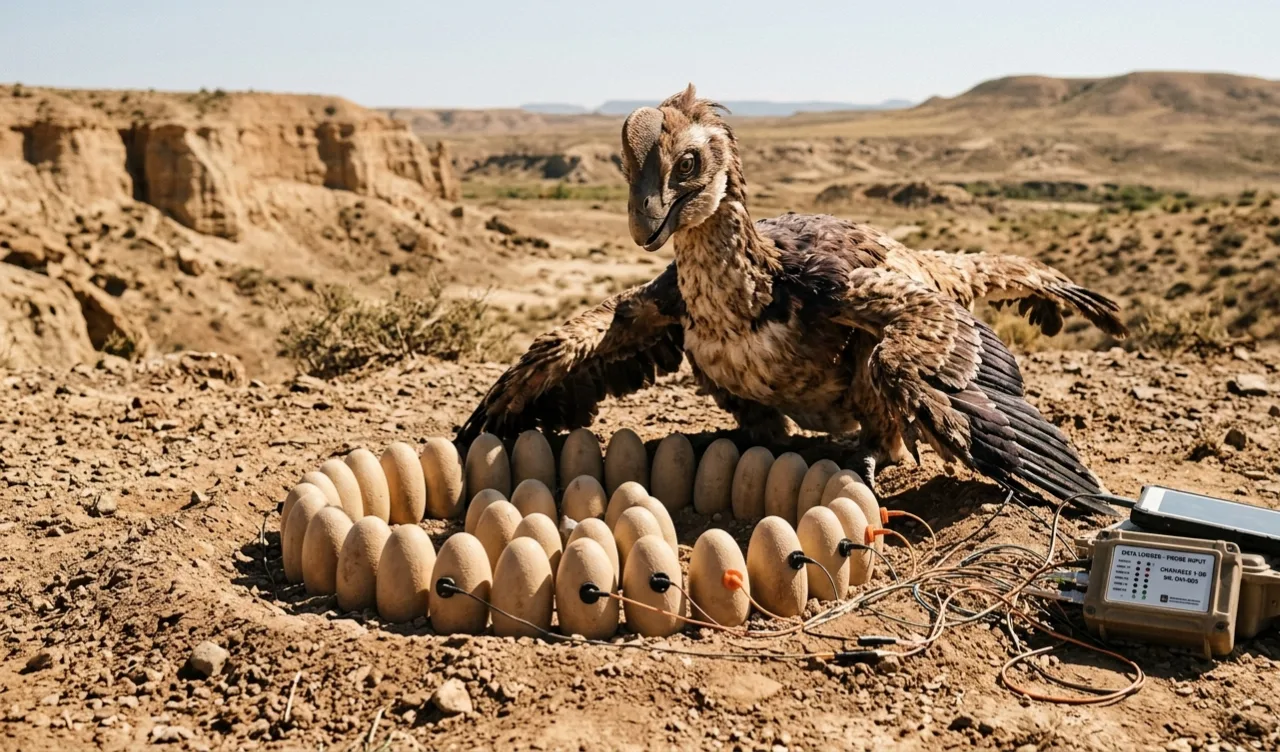
In This Article
- The Nest That Looked Just Like a Bird's
- Why Fossil Posture Alone Couldn't Settle the Question
- How Much of a Dinosaur Egg Did the Parent Actually Warm?
- What Dinosaur Egg Incubation Reveals About Raising Young
- The Questions That Still Need Answering
Picture a mother bird settling onto her nest, her warm belly pressed against every single egg. For decades, that image shaped how scientists imagined dinosaur parenting too. A new heat transfer study built a life-size replica of the dinosaur Heyuannia huangi, wired it with a real heating pad, and rested it on egg clutches shaped exactly like fossil ones, outdoors, for days at a time, and the results, published in Frontiers in Ecology and Evolution, show that dinosaur egg incubation looked nothing like it does in a modern bird's nest.
The Nest That Looked Just Like a Bird's
Seven fossilized oviraptorid dinosaurs have been found sitting directly on top of their own egg clutches, arms spread wide, legs tucked under them, in almost the exact pose a brooding bird strikes today. Paleontologists took this as strong evidence that these dinosaurs warmed their eggs with their own bodies, a behavior scientists call thermoregulatory contact incubation. But a fossil frozen mid-pose cannot tell you how much heat actually passed from parent to egg, or whether every egg in the nest even got touched.
Some of the best examples of this pose come from Mongolia, where specimens like the oviraptorid Citipati osmolskae were found crouched over their nests, work documented over the years by the American Museum of Natural History, which helped excavate several of these finds in the Gobi Desert. Those skeletons made a striking visual case for parental care. What they could not show was whether that care actually kept the eggs warm enough, evenly enough, for healthy embryos to grow inside.
Why Fossil Posture Alone Couldn't Settle the Question
Oviraptorid nests were not simple piles of eggs. The eggs stood on end in tight pairs, stacked into an inner ring and an outer ring around an empty center, with a layer of soil between the two tiers. That stacked structure raised an awkward possibility: the outer ring of eggs might physically block the parent's belly from ever reaching the inner ring, no matter how the adult sat.
Earlier attempts to test this used indoor setups with emu eggs, which are rounder and more tightly packed than the slender, elongated oviraptorid eggs found in the fossil record. Indoor testing also skipped something crucial, the sun. Real nests sat exposed to daylight and cool nights, and any honest model of dinosaur egg incubation needed to include that swinging outdoor heat, not just a steady room temperature.
How Much of a Dinosaur Egg Did the Parent Actually Warm?
To find out, researchers built the dinosaur itself: a torso-shaped skeleton of polystyrene foam and wood, padded with cotton and bubble wrap, wrapped in cloth, and finally fitted with a household heating blanket to stand in for body warmth. Resin eggs filled with water, since water heats and cools similarly to real egg white, carried tiny thermometers inside to record every temperature shift, minute by minute, for up to a full day and night.
The numbers that came back were stark. In every version of the experiment, the incubator's belly never touched a single inner-ring egg, and even the outer-ring eggs it did reach were only lightly kissed by contact, at most about 3 percent of an egg's total surface. That is far below the 8 to 10 percent brood-patch contact recorded in chicken eggs, a figure the team compared against in the 2021 Science Bulletin study of an oviraptorid found atop its embryo-bearing clutch.
"Oviraptorids co-regulated incubation with environmental heat, with the adult stabilizing clutch temperatures, reducing thermal extremes."
— Su, Liao, Wu, Chou, Chen, Lee & Yang · Frontiers in Ecology and Evolution, 2026What Dinosaur Egg Incubation Reveals About Raising Young
Left completely alone under the sun, egg temperatures swung wildly, sometimes topping 54 degrees Celsius by afternoon and crashing more than 20 degrees by night. That is well past the point where bird embryos start dying from heat. With the model parent in place, the same eggs stayed within a survivable range even after sunset, suggesting the adult's real job may have been less about supplying warmth and more about acting as a living umbrella and blanket combined.
That uneven warmth also offers a tidy explanation for a puzzle buried in the fossil record itself: some oviraptorid nests preserve embryos at clearly different stages of growth within the very same clutch. Eggs sitting closest to the parent's warm core reached higher, steadier temperatures than eggs out at the rim, and warmer eggs develop faster. Staggered hatching, in other words, may not be an accident of bad luck but a direct fingerprint of where an egg happened to sit under the parent's body.
The Questions That Still Need Answering
The team, working with simulations run through COMSOL Multiphysics software, only modeled a 12-egg clutch, smaller than some real fossil nests that held 20 eggs or more, so bigger nests might behave differently. The model also could not move the way a living, restless dinosaur parent likely did throughout the day. Whether other feathered dinosaur relatives, like the sickle-clawed dromaeosaurids, practiced better dinosaur egg incubation remains completely unknown, and only new fossil discoveries will settle that.
There is one more twist worth sitting with. The temperature ranges recorded for two closely related oviraptorid species barely overlapped, which argues against these dinosaurs using temperature to decide the sex of their young, the way crocodiles do today. If true, dinosaur sex may have been locked in by genetics from the moment an egg was laid, much like it is in birds now, a detail that quietly reshapes how this whole family tree is understood.
- Not true bird-style brooding — The dinosaur's own body heat covered barely a quarter to two-thirds of what its eggs needed, well short of a bird's typical performance.
- The sun was a co-parent — Ambient heat did real work alongside the adult, making oviraptorids more like a hybrid between crocodiles and birds.
- Uneven warmth, uneven hatching — Eggs near the parent's warm core likely developed faster than eggs at the nest's edge, possibly explaining why some hatchlings emerged before their siblings.
"This comparatively less efficient incubation behavior, relative to modern birds, combines adult incubation and ambient heat sources, which could be a more ancestral state of incubation and the precursor of thermoregulatory contact incubation." — Su et al., Frontiers in Ecology and Evolution, 2026.
📄 Source & Citation
Primary Source: Su C-Y, Liao J-Y, Wu H-J, Chou K-Y, Chen C, Lee M-T, Yang T-R (2026). Heat transfer in a realistic clutch reveals a lower efficiency in incubation of oviraptorid dinosaurs than of modern birds. Frontiers in Ecology and Evolution, 14:1351288. https://doi.org/10.3389/fevo.2026.1351288
Authors & Affiliations: Washington High School, Taichung; National Tsing Hua University; National Museum of Natural Sciences, Taiwan; National Cheng Kung University; National Chung Hsing University.
Data & Code: Supplementary figures, videos and full simulation parameters are available with the published article on the Frontiers website.
Key Themes: Dinosaur egg incubation · Oviraptorid nesting · Thermoregulatory contact incubation · Asynchronous hatching · Heat transfer simulation
Supporting References:
[1] Bi S, Amiot R, de Fabrègues C-P, et al. (2021). An oviraptorid preserved atop an embryo-bearing egg clutch sheds light on the reproductive biology of non-avialan theropod dinosaurs. Science Bulletin, 66(10):947-954.
[2] Hogan JD, Varricchio DJ (2021). Do paleontologists dream of electric dinosaurs? Investigating the presumed inefficiency of dinosaurs contact incubating partially buried eggs. Paleobiology, 47(1):101-114.
[3] Yang T-R, Engler T, Lallensack JN, et al. (2019). Hatching asynchrony in oviraptorid dinosaurs sheds light on their unique nesting biology. Integrative Organismal Biology, 1(1):obz030.
No comments yet. Be the first to share your thoughts.
Leave a Comment